


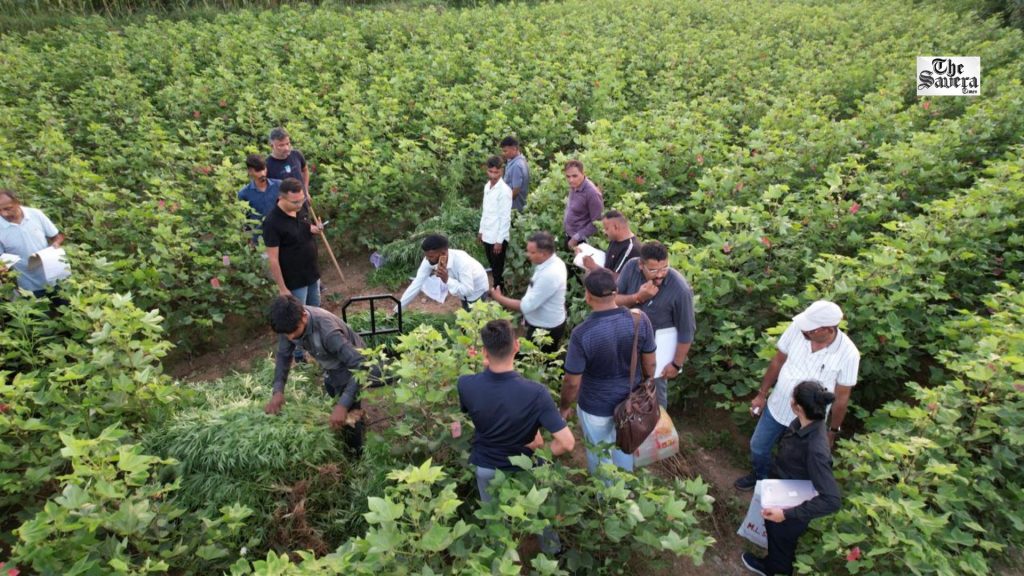
Himmatnagar: The Local Crime Branch (LCB) of Sabarkantha Police has seized 967 cannabis plants weighing 345.6 kg and valued at ₹1.72 crore from a farm in Kotda Gadhi village near the Gujarat-Rajasthan border.
Police said the cannabis was allegedly being cultivated alongside cotton crops. The action was carried out as part of the “Say No to Drugs” and “Drug-Free Sabarkantha” campaigns aimed at curbing the illegal cultivation, transportation, purchase and sale of narcotic substances.
Cannabis Cultivation Found Among Cotton Crops
The LCB team received information during patrolling in the Kheroj police station area that cannabis was allegedly being cultivated in agricultural fields in the Magra Falia area of Kotda Gadhi village.
Acting on the information, police conducted a raid and found cannabis plants growing alongside cotton crops.
The fields were identified as being owned and possessed by Raychandbhai Ramabhai Gamar, Jaga Ramabhai Gamar and Rava Punabhai Gamar, all residents of Kotda Gadhi village in Poshi taluka.
Police seized 967 cannabis plants weighing 345.600 kg, with their estimated value put at ₹1,72,80,000. Three soil samples and three control samples were also collected during the operation.
One Arrested, Two Yet to Be Held
A case has been registered at Kheroj Police Station under Sections 8(c), 20(a)(1), 20(b)(2-C) and 29 of the NDPS Act, 1985.
Raychandbhai Ramabhai Gamar, 25, has been arrested, while Jaga Rama Gamar and Rava Punabhai Gamar remain absconding, according to police.
Further investigation and legal proceedings are underway.
Police Focus on Remote Areas
Sabarkantha Police said detecting illegal cannabis cultivation along the Rajasthan border and in remote areas is challenging because of the hilly terrain, isolated locations, farms away from main roads and limited human movement.
The LCB said it is using human intelligence, technical inputs and field verification to detect illegal cultivation in such areas.