


Shrotik Bose
The global waste crisis is no longer a slow-building challenge; it is advancing faster than recent forecasts anticipated. The latest What a Waste 3.0 report by the World Bank shows that waste generation has already surpassed earlier projections, signalling a sharper and more immediate escalation than previously perceived.
The earlier 2018 report, based on 2016 data, projected 3.40 billion tonnes of waste by 2050. Updated estimates, using 2022 as the baseline, now place this figure at 3.86 billion tonnes. While the percentage growth to 2050 appears lower, the absolute volume is significantly higher, intensifying pressure on already stretched systems.
In 2022 alone, the world generated 2.56 billion tonnes of municipal solid waste, which is a milestone earlier models had anticipated only toward the end of the decade. If current trends continue, this will still translate into roughly a 50 per cent increase by 2050. Waste systems already under stress are being forced to respond to a crisis accelerating ahead of schedule, leaving little room for gradual adaptation.
Where the crisis is shifting
What a Waste 3.0 marks a shift not just in numbers but in how the waste challenge is framed. While What a Waste 2.0 focused primarily on volumes, the new report adopts a systems and circularity lens, incorporating scenario-based modelling for emissions, plastic lifecycle and leakage analysis, and GDP-level economic framing instead of just municipal budgets. It also expands from a static global snapshot to a dynamic, scenario-driven dataset, reflecting a more complex and interconnected understanding of the waste crisis. The geography of waste is also shifting in a way that places the greatest pressure on regions least equipped to respond.
While high-income countries continue to generate more waste per capita, the fastest growth is concentrated in the Global South, where infrastructure, financing and governance systems remain uneven. Sub-Saharan Africa is projected to see waste volumes grow by 124 per cent, while South Asia is expected to nearly double its waste generation (99 per cent) by 2050. Rapid urbanisation, rising incomes and changing consumption patterns are driving this growth, but without a parallel expansion of waste management systems. The result is a widening gap between waste generation and system capacity. India sits at the centre of this transition. Over the past decade, cities have expanded collection coverage and processing infrastructure under the Swachh Bharat Mission (SBM), the world’s largest sanitation initiative. Yet the pace of urbanisation, particularly in peri-urban areas and smaller towns. continues to outstrip infrastructure gains.
At the same time, waste composition is changing. The growing share of low-value, multilayered plastic packaging, which is difficult to recycle and often escapes formal systems, adds complexity to already strained urban waste management, turning what was once a scale challenge into a combined problem of scale, composition and capacity.
Real faultline: Collection, not generation
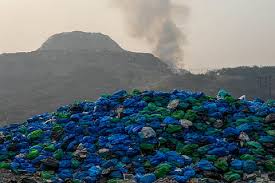
The most critical divide in global waste management is not how much waste is generated, but how much is actually collected. High-income countries have achieved near-universal collection, ensuring waste enters controlled systems. In low-income countries, only 28 per cent of waste is collected, with coverage dropping sharply outside urban centres. Globally, around 30 per cent of waste is either uncollected or openly dumped. This is where the crisis becomes visible and dangerous. Uncollected waste is burned, dumped in open areas, or washed into rivers and drains. In India, claims of 100 per cent door-to-door collection often mask ground realities, reflected in clogged drainage systems, seasonal flooding and expanding illicit dumping sites.
Policy focus has often been on downstream solutions such as processing plants, waste-to-energy facilities and recycling targets. But without universal collection, no system can function effectively.
(Courtesy: DTE