


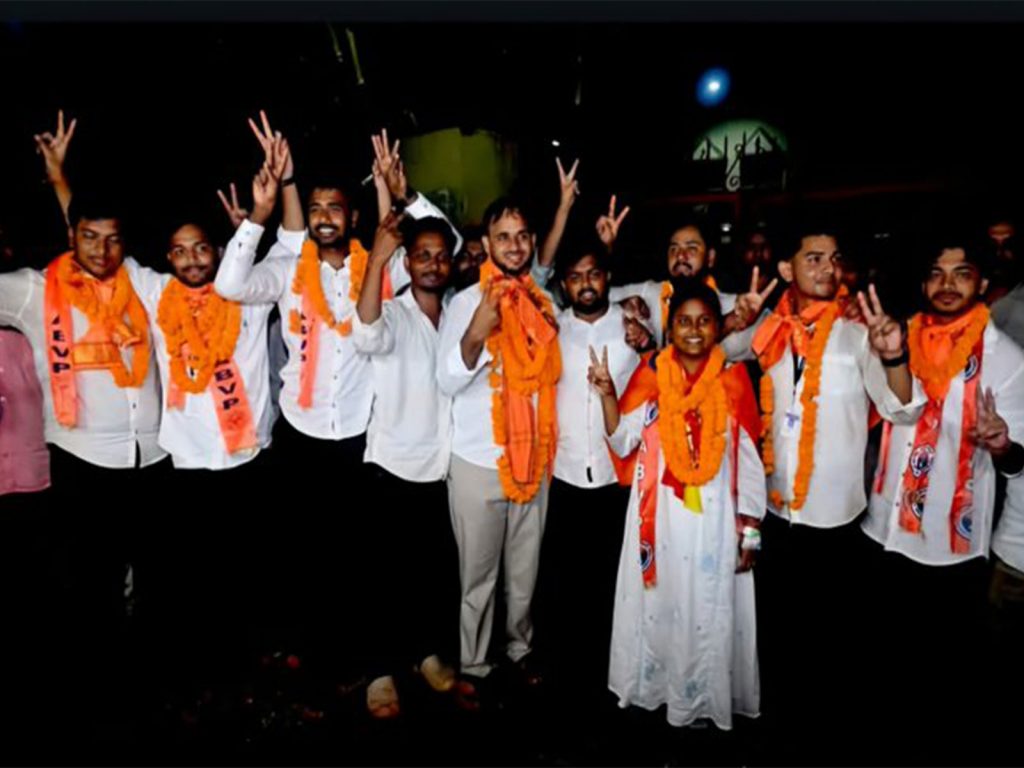
Victories in universities and colleges underline the organisation’s campus presence, with similar gains reported in Delhi, Punjab and Uttarakhand
Student politics in Odisha has returned to the spotlight after nearly eight years, and the results have brought the Akhil Bharatiya Vidyarthi Parishad (ABVP) into focus. The organisation has registered a strong performance in the state’s student union elections, winning across universities and colleges and reinforcing its presence on campuses.
According to the declared results, ABVP won in eight of Odisha’s 13 universities, while the Biju Chhatra Janata Dal (BCJD), associated with the Biju Janata Dal, secured victories in the remaining five. The organisation also performed strongly at the college level. Of the results declared across 342 colleges, ABVP won 208, compared with 117 for BCJD and 17 for the Congress-affiliated National Students’ Union of India (NSUI).
The scale of the victory makes Odisha an important part of the current discussion on student politics. Elections after such a long gap offered student organisations an opportunity to reconnect with voters and demonstrate their organisational strength. ABVP’s performance across institutions suggests that it was able to mobilise support beyond a handful of prominent campuses.
For student organisations, elections are about more than campaign slogans and social media visibility. Regular contact with students, an active network of campus workers and the ability to raise local issues often shape the outcome. The Odisha results have once again drawn attention to the importance of sustained grassroots work in university politics.
The outcome also comes at a time when the political preferences of young people are frequently debated. Students today have varied concerns, ranging from educational facilities and examination systems to employment opportunities and campus administration. How organisations engage with these issues can influence their standing among students.
ABVP’s performance has not been limited to Odisha. In the Delhi University Students’ Union elections, the organisation won three of the four major posts, including president, secretary and joint secretary. At Panjab University, it secured the president’s post for the second consecutive time. In Uttarakhand, ABVP candidates also won several positions across colleges in areas including Dehradun, Mussoorie, Almora and Bageshwar.
These results point to the organisation’s continued presence across different university environments. However, Odisha stands out because of the scale of the results and the return of student union elections after an extended interval.
Independent candidates have also influenced contests in several institutions. If some of the successful independents formally join ABVP or extend their support, the organisation could expand its presence further. Such developments, however, will depend on whether post-election associations translate into lasting political cooperation.
The real test for ABVP will be to maintain this momentum beyond election season. Winning student union posts provides visibility, but sustaining support requires regular engagement with students and a response to their everyday concerns.
For now, the Odisha results offer a significant snapshot of the state’s campus politics. They also underline a continuing reality: even as student communication increasingly moves online, a strong organisational presence on the ground remains an important factor in electoral success.