


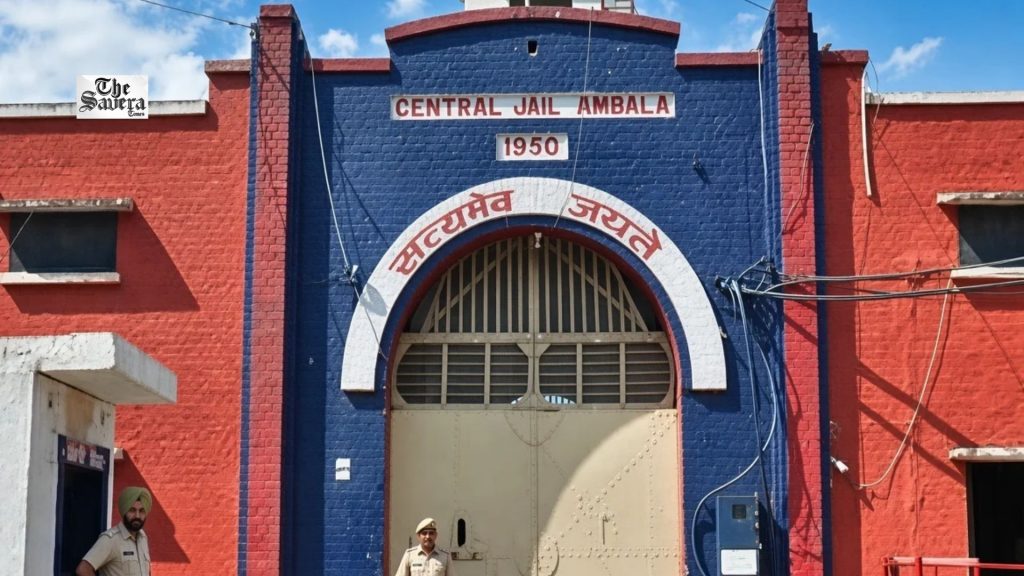
Ambala: A demand has been raised to declare the 154-year-old Ambala Central Jail in Haryana a national monument and develop it as a museum dedicated to India’s freedom struggle. The Ambala District Bar Association has submitted a memorandum to the President, the Prime Minister and other concerned authorities, seeking to transform the historic jail into a ‘Freedom Struggle Museum and Research Centre’ on the lines of the Cellular Jail in the Andaman and Nicobar Islands.
The demand comes after the construction of a memorial dedicated to the 1857 Uprising in Ambala at a cost of Rs 600 crore. The Bar Association has maintained that the memorial and the Central Jail have separate historical significance and that one cannot replace the legacy of the other.
The jail is particularly significant because Nathuram Godse and Narayan Apte, who were convicted in the assassination of Mahatma Gandhi, were executed there. Several freedom fighters, including Bhagat Singh’s sister Bibi Amar Kaur, were also imprisoned in the jail during the British period.
Advocate Rohit Jain, president of the Ambala District Bar Association, said the jail is connected with several important events and personalities associated with India’s freedom struggle.
Ambala Central Jail Has a History Dating Back to 1872
According to the memorandum, Ambala Central Jail was established as a sub-jail in 1872 during British rule. It was upgraded to a district jail in 1930 and eventually became a Central Jail by the time India gained independence.
The jail witnessed several executions during the colonial period and after independence. Among those executed there was Nathuram Godse, along with Narayan Apte, on November 15, 1949, following their conviction in the assassination of Mahatma Gandhi.
Basant Kumar Biswas and 12 Revolutionaries Were Executed
The memorandum highlights the execution of revolutionary Basant Kumar Biswas, who was sentenced to death for his role in the 1912 bombing attempt targeting then Viceroy Lord Hardinge.
It also mentions that 12 people were executed at the jail on September 3, 1915, for their involvement in a military mutiny against British rule.
These events, the association argues, make the jail an important site in the history of India’s freedom movement.
Sucheta Kriplani, Rajkumari Amrit Kaur and Bhagat Singh’s Sister Were Imprisoned
The memorandum also lists several prominent freedom fighters who were imprisoned at Ambala Central Jail.
They include:
-
Sucheta Kriplani: Freedom fighter who later became the first Chief Minister of Uttar Pradesh.
-
Rajkumari Amrit Kaur: India’s first Health Minister after independence.
-
Bibi Amar Kaur: Sister of revolutionary Bhagat Singh.
The association believes that the contribution and history of these personalities should be preserved and presented to future generations through a dedicated museum and research centre.
29 Executions Since Independence; Last Hanging in 1989
According to the memorandum, 29 people have been executed at Ambala Jail since India’s independence.
Among them were Sucha Singh and Baldev Singh, who were convicted for the assassination of Partap Singh Kairon, the third Chief Minister of Punjab. Both were executed in 1972.
The last execution at the jail took place on June 21, 1989, when Gulab Singh, a resident of Karnal, was hanged. No executions have taken place at the jail in the last 37 years, although the gallows remain there.
Bar Association Seeks Preservation of Historic Jail Complex
The memorandum has also raised concerns about the future of the old jail complex if the prison is shifted to another location for administrative or security reasons.
It states that the relocation of jail operations should not lead to the neglect or destruction of its historic buildings. The association has demanded that the old barracks, prison cells, execution chamber and other structures be preserved in their original form.
Advocate Rohit Jain has also sought a ban on the demolition or alteration of any historic structure within the complex until a comprehensive conservation plan is prepared.
The association has proposed setting up a committee comprising historians, researchers and archaeological experts to examine the site and prepare a preservation plan.
Museum and Light-and-Sound Show Proposed on Cellular Jail Model
Taking inspiration from the Cellular Jail in the Andaman and Nicobar Islands, the memorandum proposes converting Ambala Central Jail into a museum showcasing the history of India’s freedom struggle.
The proposed museum could display photographs of freedom fighters, historical documents, archival records and artefacts connected with their lives and contributions.
The association has also suggested introducing a light-and-sound show to narrate the history of the jail and the freedom fighters associated with it.
The proposal aims to preserve the historic complex and develop it as a centre for public education, research and remembrance of India’s freedom movement.