


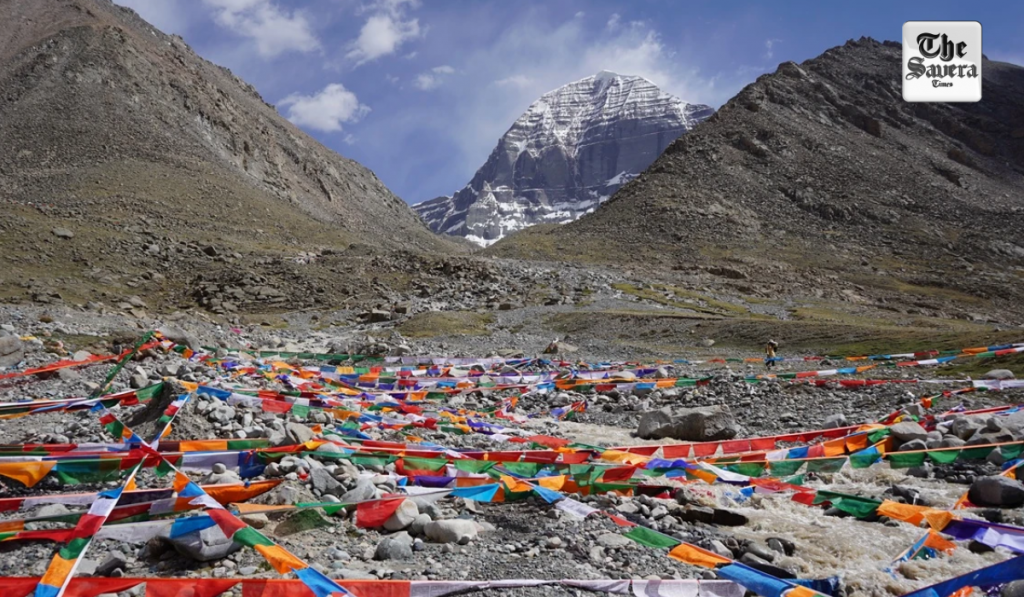
Sitting right before the sacred presence of Ashtapad, with the cold Himalayan winds touching my face and an indescribable silence surrounding the soul, I found myself chanting the sacred Namokar Mantra and reciting the divine verses of Bhaktamara Stotra. In that moment, it no longer felt like a pilgrimage.
It felt like time itself had stopped. The mountain did not speak, yet it said everything the soul had been searching for across lifetimes. For followers of Jainism, Ashtapad is not merely a geographical location hidden amidst the mystical terrains of Tibet.
It is a moksha-bhumi — a land eternally sanctified because it is believed to be the place where Rishabhanatha, also known as Adinath Bhagwan, attained liberation from the endless cycle of birth and rebirth. Jain scriptures describe it not just as a mountain, but as a divine realm vibrating with purity, austerity, and transcendence.
The word “Ashtapad” itself carries deep symbolism. Derived from Sanskrit, Ashta means eight and Pad means steps or levels. Some traditions describe it as a mountain of eight natural terraces, while others interpret it as the eight spiritual steps leading the soul toward liberation. Many Jain thinkers also see it as a metaphor for the inward ascent from ego to enlightenment.
According to Jain cosmology, Bhagwan Rishabhdev was not only the first Tirthankara but also the pioneer of human civilization. Scriptures narrate that he taught humanity agriculture, cooking, mathematics, writing, governance, and arts.
After fulfilling his worldly duties and guiding mankind toward dharma, he renounced everything in pursuit of ultimate truth. Through intense tapasya and kevala jnana — absolute knowledge — he ultimately attained moksha at Ashtapad. The revered Adi Purana by Acharya Jinasena beautifully glorifies this sacred event.
It describes the region as spiritually radiant, inaccessible to ordinary beings, and worshipped by celestial devas. Jain traditions narrate that when Adinath attained nirvana, heavenly beings descended in celebration and the mountain became eternally sacred.
One of the most moving beliefs associated with Ashtapad is the story of Bharata Chakravartin, the son of Rishabhdev. Scriptures say he built an extraordinary celestial shrine there adorned with jewels, crystal stairways, and divine artistry.
Some legends believe the temple disappeared with time, while others say it remains hidden from ordinary eyes, visible only to spiritually evolved souls. This mystical aura has made Ashtapad one of the most spiritually charged and mysterious places in Jain consciousness. Ancient Jain texts such as the Kalpa Sutra, Trishashti Shalaka Purusha Charitra, cosmological literature, and Digambara and Svetambara traditions continue to preserve the sacred memory of Ashtapad.
The mountain is often described as radiant, inaccessible, divine, and eternally worshipped by celestial beings. Jain philosophy believes that while a Tirthankara transcends worldly existence after moksha, the land associated with liberation remains spiritually awakened forever. A deeply powerful Jain prayer echoed within me while sitting before Ashtapad: Namo Arihantaanam Namo Siddhanam.
“I bow to the enlightened beings. I bow to the liberated souls.” At Ashtapad, the words Namo Siddhanam carry unimaginable depth, because this is the very land where Adinath Bhagwan became a Siddha — free from karma, attachment, suffering, and rebirth forever. Another profound reflection from Jain philosophy captures the essence of Ashtapad: Karmakshayo Mokshah.
“Destruction of karma is liberation.” Perhaps this is why the landscape around Kailash and Ashtapad feels so different from anywhere else on Earth. The barren mountains, the haunting silence, the absence of worldly distractions — everything there reflects the Jain ideals of aparigraha, austerity, detachment, and inner stillness.
One does not merely visit Ashtapad; one confronts oneself there. Many Jain traditions identify Ashtapad with the region around Mount Kailash, creating a profound spiritual bridge between Jainism, Shaivism, Bon, and Tibetan Buddhism. For Hindus, Kailash is the eternal abode of Shiva and Parvati.
For Buddhists, it symbolizes supreme enlightenment. For Jains, it is the sacred mokshabhumi of Adinath Bhagwan. One mountain, yet countless paths converging toward the same eternal silence.
Even today, despite debates around its exact location and the absence of archaeological confirmation, the spiritual power of Ashtapad remains untouched. It continues to live not merely in scriptures, but in the hearts of seekers who feel called toward something beyond words, beyond identity, beyond possession. As I sat there chanting the Navkar Mantra with tears in my eyes, one truth became deeply clear within me — Ashtapad is not only a mountain in Tibet. It is also the mountain every soul must climb within itself before it finally becomes free.