


Sheena Sandhu
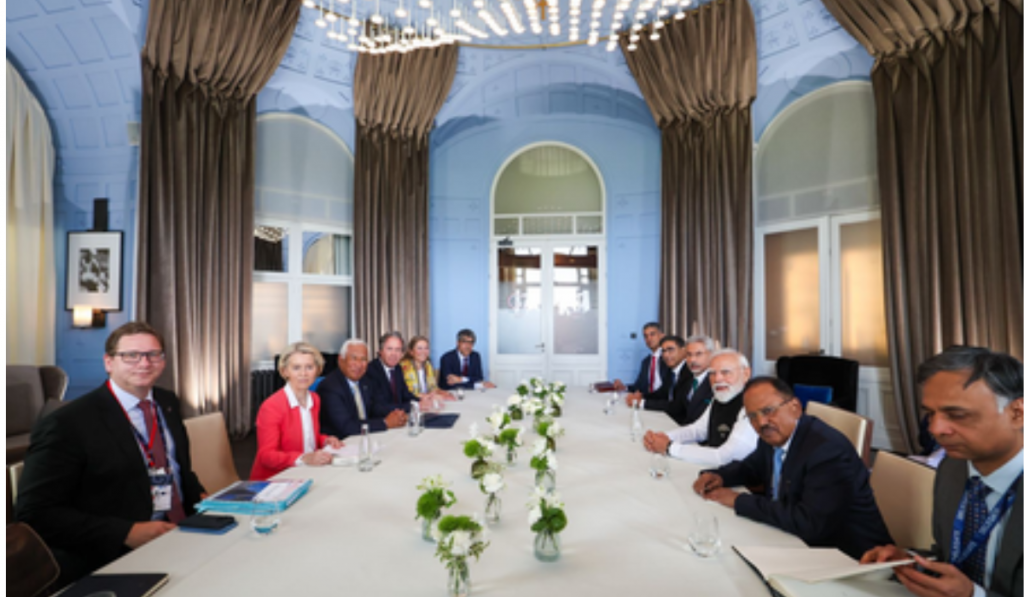
Diplomacy is often judged by what can be photographed. Handshakes. Bilateral meetings. Leaders standing shoulder to shoulder for the customary summit picture. But the true measure of diplomacy lies elsewhere. It lies in who gets invited into the room when the world’s biggest questions are being discussed. Prime Minister Narendra Modi’s participation in the G7 outreach sessions and the discussions on artificial intelligence this week may not have produced a dramatic headline or a landmark agreement.
Yet the visit revealed something more significant: India has become too important for the world’s leading powers to ignore. India is not a member of the G7. It has no permanent seat at that table. Yet year after year, India finds itself invited whenever conversations turn to the future of technology, economic growth, energy security, supply chains or global governance. That is not diplomatic courtesy. It is strategic necessity. The reality confronting major powers is simple. No serious discussion about the global economy can take place without India. No meaningful debate on technology can ignore a country that is home to one-sixth of humanity. No attempt to reshape supply chains can succeed without factoring in one of the world’s fastest-growing large economies. The invitation itself reflects a larger geopolitical shift. For decades, India occupied an awkward position in the international system. It was respected but rarely central. It was consulted but seldom decisive.
The rules of trade, finance and technology were largely framed elsewhere, and countries like India were expected to adapt. That era is gradually drawing to a close. The most interesting aspect of Modi’s participation in the AI discussions was not a specific policy proposal. It was India’s assertion that it has a stake in shaping the rules governing a transformative technology. Artificial intelligence is rapidly becoming the defining technology of our age. Much as the internet transformed economies and societies over the past three decades, AI is expected to reshape everything from healthcare and education to manufacturing and defence. The countries that help establish the norms around AI today will influence how technology evolves tomorrow.
Until recently, those conversations were dominated by the United States, Europe and a handful of technology giants. Increasingly, however, there is recognition that global standards cannot be framed by a small club of advanced economies alone. India’s intervention reflects this changing reality. The country’s emphasis on inclusive and human-centric AI is not merely rhetoric. It emerges from India’s own experience of using technology at scale. Whether through digital payments, identity systems or public service delivery, India has demonstrated that technology can reach hundreds of millions of people if designed with inclusion in mind. That experience gives India something increasingly valuable in global forums: credibility. Many countries in Asia, Africa and Latin America face challenges similar to India’s. They are searching for ways to expand access to services, improve governance and accelerate development without creating new forms of exclusion. India’s digital journey offers lessons that resonate far beyond its borders. That is one reason why the country’s voice carries greater weight today than it did a decade ago. The visit also highlighted India’s continuing effort to position itself as the principal voice of the Global South. The phrase is often repeated, sometimes to the point of cliché. Yet it captures a genuine sentiment across much of the developing world. Many countries believe that international institutions continue to reflect the realities of the twentieth century rather than the twenty-first. The distribution of economic power has changed. Demographics have changed. Technology has changed. Yet decision-making structures have struggled to keep pace. India’s argument is that countries representing the majority of the world’s population deserve a greater role in shaping global outcomes. Whether the issue is climate finance, energy transition, food security or emerging technologies, the concerns of developing nations can no longer be treated as an afterthought.
Few countries are better placed than India to make that case. Unlike China, India is viewed by many nations as a relatively benign power. Unlike smaller developing countries, it possesses the economic and political heft required to influence outcomes. That combination gives India a unique diplomatic space that successive governments have sought to expand. The visit also underlined the growing importance of the IndiaFrance partnership. Among Western powers, France has consistently treated India as a long-term strategic partner. The relationship extends beyond defence contracts and diplomatic statements. It encompasses cooperation in space, nuclear energy, maritime security and advanced technologies. At a time when international alignments are becoming more fluid, such partnerships matter. They provide stability in an increasingly uncertain world. Yet the most important takeaway from the visit lies beyond any single meeting or announcement. India’s challenge today is fundamentally different from what it was two decades ago. The question is no longer whether India will be invited to influential forums. That debate has largely been settled. The challenge now is whether India can convert presence into influence and influence into outcomes.
That requires economic strength, technological capability, institutional credibility and sustained diplomatic engagement. It requires India not merely to participate in global conversations but to shape them. The good news is that the foundations are increasingly visible. When leaders gather to discuss artificial intelligence, climate transition, economic resilience or global governance, India is now part of the conversation by default. Not because it demands inclusion, but because its exclusion would render the conversation incomplete. That may be the clearest sign yet of India’s changing place in the world. Great powers are not defined solely by military strength or economic size. They are defined by whether global decisions can be made without taking their interests and perspectives into account. The message from this week’s meetings is unmistakable. The world may still debate with India. It may disagree with India. It may compete with India. But it no longer meets without India