


Pakistan’s continued reliance on proxy militias, enforced disappearances, bureaucratic marginalisation, and the exploitation of natural resources without corresponding benefits for local communities has, according to analysts, intensified the insurgency in Balochistan rather than containing it.
Many observers argue that incidents involving missing students, the displacement of families for large infrastructure projects, and the lack of basic services in resource-rich areas have strengthened the perception among sections of the Baloch population that they remain politically and economically excluded.
The report contends that Pakistan has increasingly adopted a security-centric approach in Balochistan, focusing primarily on counter-insurgency operations instead of governance, political dialogue and inclusive development. It argues that this strategy has become counterproductive, contributing to greater instability across the province.
In recent weeks, Balochistan has witnessed a surge in militant violence, including attacks on a Pakistani military convoy in Mastung, a deadly assault in Ziarat in which police personnel were killed and abducted, attacks around Quetta, and several other coordinated incidents, highlighting the deteriorating security situation.
According to the report, large parts of Awaran, Kohlu, Kech (Turbat) and the Zarghoon Ghar mountain region remain highly insecure, with security forces reportedly facing significant operational challenges in these areas.
The report also cites remarks by senior Pakistani politician and JUI-F chief Maulana Fazlur Rehman, who publicly stated that large parts of Balochistan were effectively beyond the government’s administrative control and questioned the state’s ability to enforce its authority in the region.
Security concerns have also affected major economic projects linked to the China-Pakistan Economic Corridor (CPEC). According to the report, the China-backed Hangeng Group has permanently closed its industrial operations in the Gwadar Free Zone due to persistent security threats. It also states that the management of the Saindak Copper-Gold Project has warned that repeated insurgent blockades and highway disruptions have placed mining operations at risk of suspension.
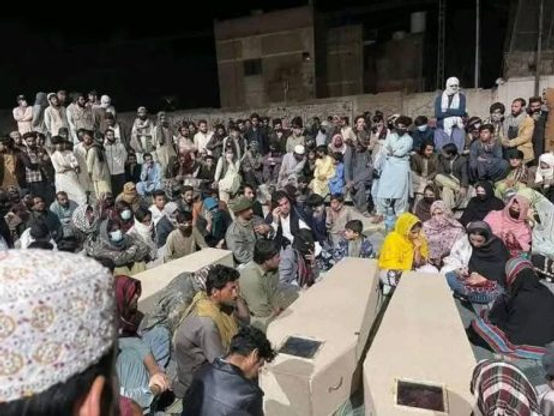
In one of the deadliest recent incidents, nine police personnel, including two Station House Officers (SHOs), were killed after insurgents attacked the police checkpoint guarding the Kuch Mangi Phase-III construction site of the Mangi Dam Project. During the same attack, 18 police personnel were reportedly abducted, and their bodies were later recovered in the Zarghoon Ghar mountains.
The Pakistani military has maintained that the attack was jointly carried out by the Baloch Liberation Army (BLA) and the Tehreek-e-Taliban Pakistan (TTP). However, the report notes that some local activists, sections of the affected communities and families of the victims have questioned this account and made alternative allegations regarding those responsible for the killings.
The report concludes that the continuing cycle of violence, political alienation and economic grievances has made Balochistan one of Pakistan’s most challenging security and governance issues. It argues that addressing the crisis will require not only security measures but also sustained political engagement, equitable development and greater inclusion of local communities in decision-making processes.