


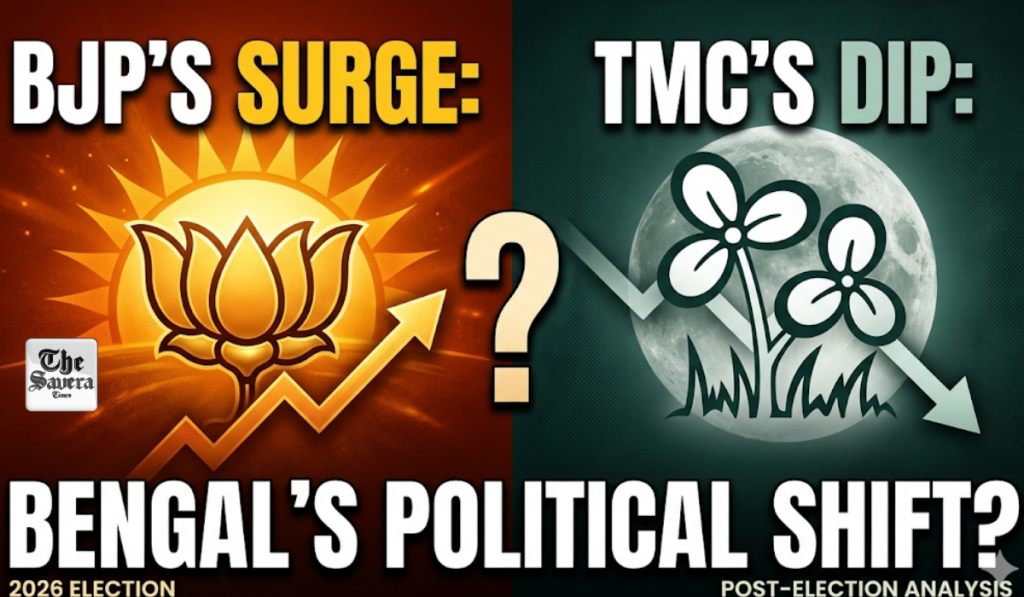
West Bengal has delivered a political jolt—ending a 15-year rule and opening the door to a completely new power shift.
It wasn’t just an election—it felt like a political reset. In a stunning upheaval that few predicted at this scale, the Bharatiya Janata Party (BJP) swept West Bengal with 207 seats, toppling a 15-year regime and ending Mamata Banerjee’s long-standing dominance. For a state that has historically resisted right-of-centre politics, this verdict raises a bigger question: is this a one-time surge driven by anger, or the beginning of a deeper political transformation?
A Verdict That Changed the Map
The numbers tell a dramatic story. The BJP’s leap from 77 seats in 2021 to 207 now is not just growth—it’s a takeover. The ruling party’s vote share climbed close to 46%, while the Trinamool Congress (TMC) dropped significantly in both seats and public confidence. Even Mamata Banerjee, a towering figure in Bengal politics, lost her stronghold seat—symbolising not just defeat, but a shift in voter mood.
A voter turnout of over 92% adds another layer to the story. This wasn’t apathy or quiet acceptance—it was active participation. Bengal’s electorate came out in large numbers, suggesting urgency, frustration, and perhaps a desire for change that had been building over time.
The Fall of a Long Regime
After three consecutive terms, the TMC faced the classic burden of incumbency—but this time, it seemed heavier than before. Corruption allegations played a central role in shaping public perception. High-profile scams involving recruitment, ration distribution, and local syndicates became recurring talking points, eroding trust.
Equally significant were concerns around governance and law and order. Incidents highlighting women’s safety and allegations of political violence added to the narrative that the system was no longer working for many. For younger voters, the issue of jobs loomed large. A lack of visible industrial growth and limited employment opportunities created dissatisfaction, especially among first-time voters.
Over time, these factors didn’t just remain issues—they became a collective sentiment. And elections, more often than not, reflect sentiment more than statistics.
How BJP Built Its Moment
This victory didn’t appear overnight. The BJP spent years expanding its organisational network across Bengal, moving beyond urban pockets into rural and semi-urban regions. Areas like North Bengal and Jangalmahal, once considered peripheral, became crucial battlegrounds—and eventually, strongholds.
The party’s campaign struck a clear chord: development, governance, and alignment with the central government. The idea of a “double engine” government—where state and centre work in sync—was positioned as a practical advantage rather than just a slogan.
Equally important was leadership at the local level. Leaders who understood regional dynamics helped the party connect with voters beyond national narratives. The campaign blended national messaging with local concerns, making it more relatable and effective.
The Promise of Change
With such a sweeping mandate comes equally high expectations. The incoming government has outlined an ambitious agenda—financial support for families and youth, implementation of pay commission benefits, focus on women’s safety, and a push for industrial growth.
There is also an emphasis on improving delivery of welfare schemes, reducing leakages, and strengthening infrastructure. If executed effectively, these steps could reshape governance in the state.
But promises are one thing—delivery is another. The scale of commitments, especially financial ones, will test the government’s planning and execution capacity.
What This Means for Bengal
For many residents, this election is about hope. Hope for better job opportunities, improved law and order, and a more transparent system. There’s also optimism that stronger coordination with the central government could bring investments and revive industries that Bengal once led.
At the same time, challenges are immediate and real. Managing social cohesion in a politically charged environment will be critical. Reports of post-election tensions highlight the need for stability and reassurance.
The opposition, though weakened, is far from irrelevant. A strong opposition can shape governance by holding power accountable—and in Bengal, political competition has always been intense.
A Moment or a Movement?
This is the question that lingers. Was this result driven primarily by dissatisfaction with the past, or genuine confidence in a new direction?
If it’s the former, the mandate could be fragile—dependent on quick results and visible improvements. If it’s the latter, Bengal may be witnessing the beginning of a long-term political realignment.
History suggests that voters reward performance, not just promises. The coming months will be crucial. Governance, delivery, and the ability to maintain trust will determine whether this breakthrough becomes a lasting shift or fades as a moment shaped by circumstance.
For now, one thing is clear: Bengal has spoken—and it has chosen change.