


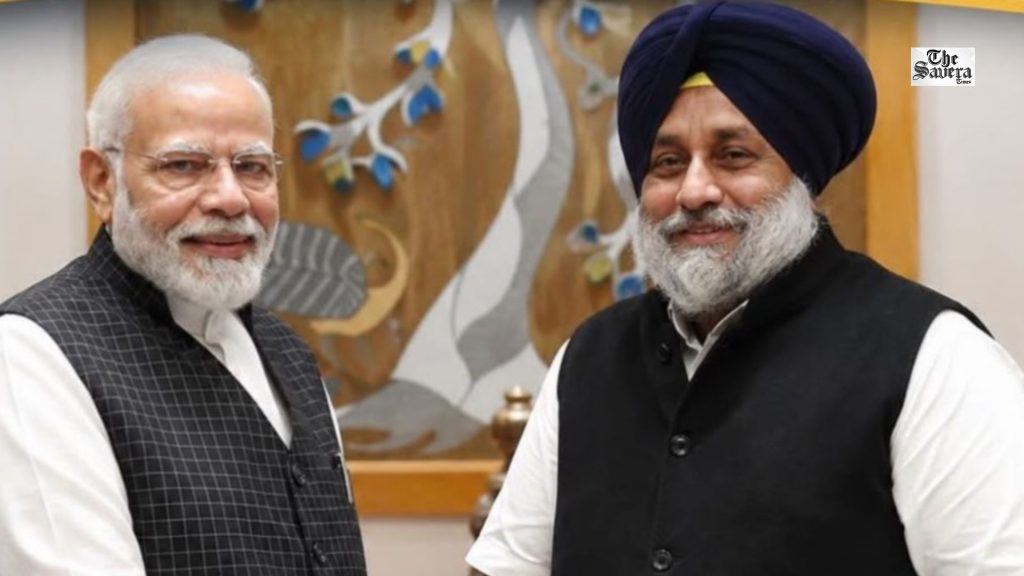
Punjab: The alliance process between the Bharatiya Janata Party (BJP) and the Shiromani Akali Dal (SAD) in Punjab has reportedly been finalised, although the top leadership of both parties has not yet made the alliance public. SAD candidates are awaiting the formal announcement.
SAD leaders eyeing urban seats have remained silent, anticipating that such constituencies could go to the BJP under the alliance arrangement. Meanwhile, the Shiromani Akali Dal has conducted an internal survey indicating that the party should contest the 2027 Punjab Assembly election in alliance with the BJP.
A senior Akali Dal leader said the party has conducted three surveys regarding the alliance and all of them concluded that an alliance with the BJP is crucial for the 2027 elections. According to the leader, the formal announcement could be made soon.
Key findings of the SAD internal survey
- Alliance with BJP considered essential
The Shiromani Akali Dal (Badal) conducted a multi-phase survey regarding a possible alliance with the BJP. The survey indicated that an alliance with the BJP is necessary and that without it, the Akali Dal would not be in a position to form the government.
- SAD projected to win 30-35 seats alone
The internal survey indicated that if the Akali Dal contests the election alone, it is projected to win between 30 and 35 seats.
According to the survey, such a tally would not be enough to form the government. However, contesting the election alongside the BJP is projected to take the alliance to 58-60 seats, which would enable it to form the government.
BJP’s rural influence also growing
The SAD survey also indicated that the BJP’s popularity is increasing not only in urban areas but also in rural constituencies.
According to the survey, contesting the election as an alliance could therefore benefit the parties in rural seats as well.
Three reasons behind delay in alliance announcement
1. Accommodation of SAD’s ‘revival’ faction
The alliance between the SAD and BJP has reportedly been finalised, while the process of accommodating the Punarsurjit faction is still underway.
According to the information, the BJP is bringing Punarsurjit into the alliance and has agreed to allocate 10 of its own allotted seats to the group.
However, the formal announcement of the alliance is being delayed because the process of accommodating Punarsurjit has not yet been finalised.
2. Delay in seat allocation
The BJP has shared a list of the 60 seats allocated to it with the Shiromani Akali Dal.
The Akali Dal wants to contest some of these 60 constituencies, as several are seats where senior SAD leaders have traditionally contested elections.
3. Parties keeping workers active across all 117 seats
There are still four months remaining until the election. Both the BJP and the Akali Dal are asserting their intention to contest all 117 Assembly seats.
The strategy is aimed at keeping leaders and workers active across all constituencies and maintaining their engagement with the public.
Both parties have already started election-related activities in line with the alliance framework. Sukhbir Badal is holding continuous rallies in rural constituencies, while BJP workers remain active in urban areas.
What is the BJP-SAD seat-sharing formula?
- 60-57 seat-sharing formula
An agreement based on a 60-57 seat-sharing formula has reportedly been reached between the BJP and the Akali Dal.
Under the arrangement, the BJP will contest 60 seats, while the Akali Dal will contest 57 seats. The top leadership of both parties has reportedly agreed to the formula.
- BJP to accommodate Punarsurjit
The BJP is also preparing to form an alliance with Punarsurjit, which is expected to contest 8 to 10 seats.
It has been clarified to the Akali Dal that the seats allocated to Punarsurjit will be taken from the BJP’s own quota.
- No designated CM face
The BJP and SAD have reportedly decided to contest the election without declaring a designated Chief Ministerial face.
The BJP will campaign projecting Prime Minister Narendra Modi, while the Akali Dal will campaign projecting Sukhbir Badal.
After the election, the party with the higher number of elected MLAs will have its leader appointed as the Chief Minister, according to the arrangement described.