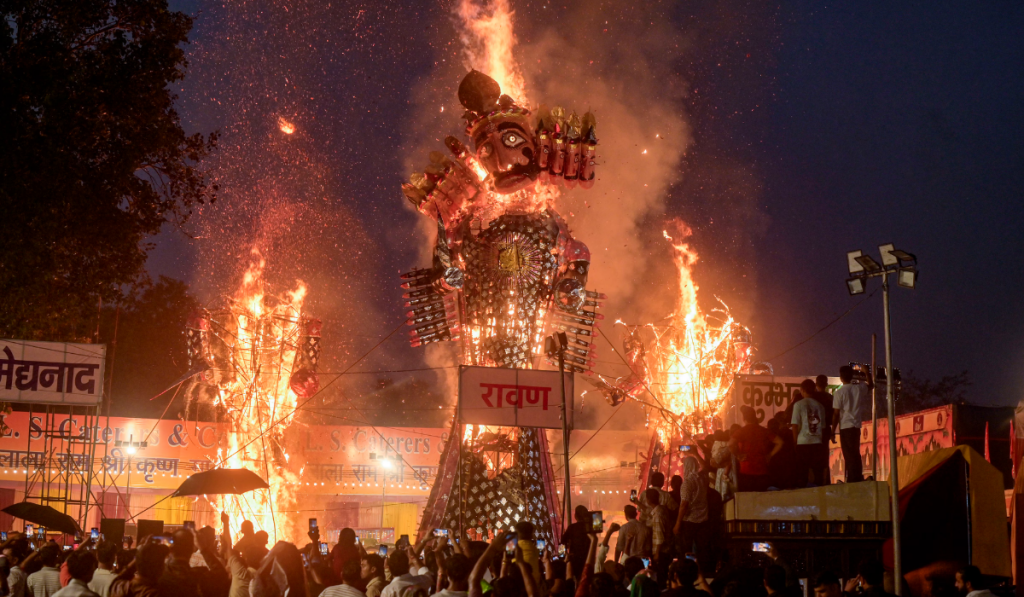
As is the tradition in our country full of faith and festivals, Dussehra was celebrated with great pomp on Tuesday. The effigies of Ravana, Kumbhakarna and Meghnad were burnt. As the times have changed, the consciousness of the people has changed, similarly the size, structure of these effigies and the message conveyed by the festival have also changed. Nowadays, efforts are made to live life at a two-step ahead level, similarly the effigies made for Ravana Dahan were also made taller and taller. The tallest effigy was made in Panchkula, Haryana, whose size was 221 feet. Another phenomenon that was common during Diwali was the bursting of firecrackers in neighborhoods and squares. Similarly, this time, small effigies were also burned in the streets and corners. Another aspect of public awareness was the burning of symbolic effigies to protest issues like corruption, inflation, and terrorism. In Delhi, a 30-foot cockroach effigy was burned on one side, and on the other, an effigy of the Chief Election Commissioner was burned, meaning the influence of politics also entered the festival grounds. New experiments were conducted in the making of effigies at many places. In some places, Ravana’s effigies were blinking and waving their hands. Artisans created designs inspired by six-pack abs, motorbikes, dragons, and cars. In cities, Dussehra committees competed to create taller effigies. A 221-foot effigy was created in Panchkula, 181 feet in Dehradun, 111 feet in Indore, 105 feet each in Kota and Bhopal, 101 feet each in Raipur and Ujjain, and 80 feet in Mandsaur. Painters gave free rein to their imagination in creating Ravana’s face. By depicting Ravana’s face as a symbol of corruption, inflation, and terrorism, a message was sent against these. In West Bengal, an effigy was burned to protest against communalism. For centuries, Ramlila has been staged in India during Dussehra. According to mythological history, Tulsidas’s disciple Medha Bhakt started Ramlila in Varanasi in the 17th century, but the first historical evidence of it dates back to 1834 when British artist James Prinsep created a painting of it, which still exists in the British Library in London. In Kullu, Himachal Pradesh, the Dussehra festival begins on Dussehra Day and continues for seven days. Hundreds of chariots and palanquins of village deities arrive for the festival. On the seventh day, effigies of Ravana, Kumbhakaran, and Meghnad are not burned, but a symbolic burning of Lanka is celebrated in a large thatched structure. After seven days, the festival marks the end of Lord Raghunath’s departure, marking the end of Vijayadashami. In the south, Ravana is considered a scholar and a great pandit, and therefore, in Mysore, Karnataka, a grand procession is held on Vijayadashami, featuring the idol of Goddess Chamundeshwari seated on an elephant decorated with a golden howdah. Thus, the grand festival of Vijayadashami concludes with a colorful celebration of the spirit and culture of India. This demonstrates that India is a fusion of diverse worship, sentiments, and cultures. But one thing we must remember is that the fundamental spirit of Vijayadashami is that no matter how much you feel the dominance of evil, ultimately, goodness and virtue will prevail. The faith, devotion, and belief with which this Vijayadashami festival is celebrated conveys the message that after the darkness of evil, the light of goodness surely comes.
Burning of Ravana Amid Changing Times