


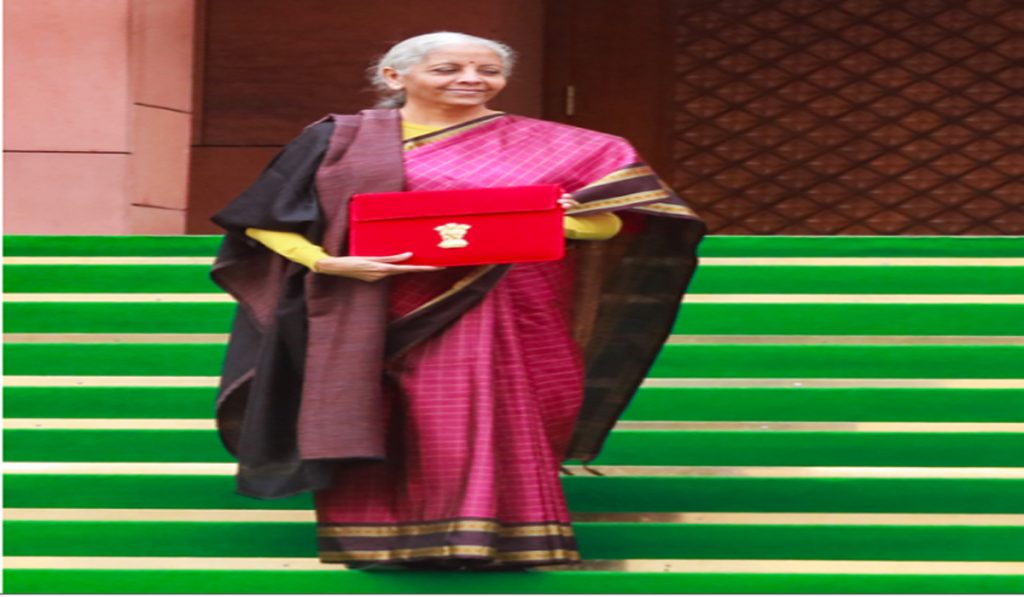
New Delhi: Finance Minister Nirmala Sitharaman on Sunday presented the Union Budget 2026-27, delivering an 85-minute speech in Parliament. While the Budget did not announce any major relief for the common man, it outlined significant policy measures aimed at infrastructure expansion, healthcare, manufacturing, education, and long-term economic growth.


The Budget was approved earlier in the day by the Union Cabinet. Sitharaman presented the Budget on the auspicious occasion of Magh Purnima and Guru Ravidas Jayanti and also tabled the report of the 16th Finance Commission.
No Change in Income Tax Slabs, Filing Gets Easier
The Finance Minister announced that there would be no changes in income tax slabs.
However, taxpayers were given relief in compliance, with the deadline for filing revised returns extended by three months, from December 31 to March 31.
The New Income Tax Act will come into effect from April 1, 2026, with redesigned, simplified forms.
Motor accident compensation amounts will now be fully exempt from income tax.
Overseas tour packages will attract 2% tax instead of 5, while education and medical remittances abroad will also be taxed at 2%.
There will be no penalty for declaring overseas immovable property worth less than Rs 20 lakh.

Seven High-Speed Rail Corridors Announced
Sitharaman announced the development of seven high-speed rail corridors, including Mumbai–Pune, Pune–Hyderabad, Hyderabad–Bengaluru, Hyderabad–Chennai, Chennai–Bengaluru, Delhi–Varanasi, and Varanasi–Siliguri.
A dedicated freight corridor connecting eastern and western ports was also announced.

Major Push for Infrastructure and Cities
An allocation of Rs 12.2 lakh crore was announced for the development of Tier-2 and Tier-3 cities with populations above five lakh. An Infrastructure Risk Guarantee Fund will be created to support private developers, and internal waterways will be developed through hubs like Varanasi and Patna.
Capital expenditure for FY27 has been pegged at Rs 12.2 lakh crore, while the total Budget estimate stands at Rs 36.5 lakh crore.
Healthcare, Ayurveda and Medical Tourism Boost
The Budget announced the establishment of three AIIMS of Ayurveda, national testing laboratories for Ayurvedic medicines, and a WHO Traditional Medicine Centre in Jamnagar. Five regional medical tourism hubs will be set up across India.
Import duty has been removed on 17 cancer drugs and medicines for seven rare diseases, including haemophilia, sickle cell disease, and muscular dystrophy.

Education, Youth and Women-Focused Measures
Content creator labs will be set up in 15,000 secondary schools and 500 colleges. Girls’ hostels will be constructed in around 800 districts, with one hostel per district.
A scheme to create one lakh specialist healthcare professionals and train 1.5 lakh caregivers over the next five years was also announced.
Support for MSMEs, Manufacturing and Textiles
A Self-Reliant India Fund and a transaction settlement programme will be introduced to support MSME liquidity. Mega textile parks, a National Fibre Scheme, handloom incentives, and industrial cluster upgrades were also announced.
The government allocated Rs 40,000 crore for electronic equipment manufacturing and strengthened the Semiconductor Mission. Dedicated mineral parks for rare earth materials will be set up in Odisha, Tamil Nadu and Andhra Pradesh.
Agriculture and Allied Sectors
A Coconut Promotion Scheme was proposed to boost productivity and replace degraded trees. Special programmes for cashew and cocoa production aim to make India self-reliant and globally competitive by 2030.
Three ‘Kartavyas’ and Fiscal Targets
Sitharaman outlined three guiding duties of the Budget:
-
Accelerating and sustaining economic growth
-
Empowering people as partners in development
-
Ensuring inclusive access to resources under Sabka Saath, Sabka Vikas
The fiscal deficit for FY27 is projected at 4.3% of GDP, slightly lower than 4.4% in FY26, with a target to keep debt around 50% of GDP by 2031.
Pre-Budget Traditions and Reactions
Before presenting the Budget, President Droupadi Murmu offered dahi-cheeni to the Finance Minister at Rashtrapati Bhavan. Sitharaman later collected the digital Budget tablet from Kartavya Bhavan.
Opposition leaders, including TMC MP Abhishek Banerjee, refrained from commenting until the speech concluded.

#UnionBudget2026 | Union Finance Minister Nirmala Sitharaman says, “Given that this is the first Budget prepared in Kartavya Bhavan, we are inspired by 3 kartavya.
First kartavya is to accelerate and sustain economic growth by enhancing productivity and competitiveness and… pic.twitter.com/7MZURFOWVZ
— ANI (@ANI) February 1, 2026
Earlier, FM Sitharaman met President Droupadi Murmu and offered her a copy of the digital budget.
The President also offered ‘dahi-cheeni’ (curd and sugar) to Sitharaman when she arrived at the Rashtrapati Bhavan. The Finance Minister was seen carrying her trademark ‘bahi-khata’, a tablet wrapped in a red-coloured cloth bearing a golden-coloured national emblem on it.
Minister of State for Finance Pankaj Chaudhary, Chief Economic Advisor Dr V. Anantha Nageswaran, Central Board of Direct Taxes (CBDT) Chairman Ravi Agrawal and other officials were seen accompanying the Finance Minister.
North-East to Become a Spiritual and Sustainable Tourism Hub
Finance Minister Nirmala Sitharaman unveiled a focused push to position the North-East as a major spiritual and cultural tourism destination, announcing a new scheme to develop Buddhist circuits across six states—Arunachal Pradesh, Sikkim, Assam, Manipur, Mizoram, and Tripura—aimed at strengthening pilgrimage tourism while preserving the region’s Buddhist heritage. The initiative emphasizes the conservation of temples and monasteries, development of pilgrimage interpretation centres, improved connectivity, and upgraded pilgrim amenities to support year-round tourism. Complementing this cultural focus, the Budget also announced 4,000 electric buses for the North-East to reinforce sustainable mobility and last-mile access for both tourists and locals, signaling a dual strategy of heritage-led tourism growth paired with green infrastructure, positioning the region as spiritually significant and future-ready.
FM Slashes Customs Duty from 20% to 10%, 17 Medicines Exempted
To rationalize customs duties on goods imported for personal use, FM proposes a reduction in tariff rate from 20% to 10% on all dutiable goods.
Basic customs duty exempted on 17 drugs/medicines, providing relief and promoting Ease of Living