


Kanchan Lakshman
A Delhi-based national security analyst
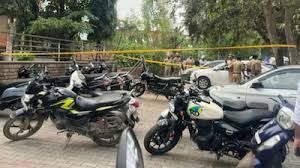
On April 1, a Chinese-made P-86 grenade, smuggled from Pakistan via drone, was hurled at the Punjab BJP headquarters in Chandigarh’s Sector 37. While it only resulted in shrapnel marks on the wall and no loss of life or injuries to anyone, it was not merely an act by a fringe terror outfit. It was a well-planned incident: a recorded attack, a claim of responsibility by the banned Babbar Khalsa International (BKI) on social media within two hours, and a pretext — the alleged encounter killing of a 19-year-old in Gurdaspur — engineered to frame counter-terrorism as anti-Sikh persecution and a threat of further attacks. Intelligence agencies assess that a meeting between Pakistani security officials and BKI leadership took place as recently as January 2026, after which the operational tempo has visibly increased.
Punjab has seen this before — grenade attacks, pro-Khalistani claims, and cross‑border links. What makes this incident different is its deliberate, digitally coordinated nature. It was not random violence, but part of a planned and continuing effort to revive Khalistani militancy, although such attempts have not gained any traction in Punjab.
Patterned Escalation
The Chandigarh blast is not an isolated incident. It followed just 36 hours after a grenade attack on a police station in Amritsar, claimed by the Khalistan Liberation Army, and fits into a broader pattern: grenade attacks on police stations across Punjab, vandalism of an Ambedkar statue in Hoshiarpur, which was claimed by the banned Sikhs for Justice, an earlier RPG strike on the Punjab Police Intelligence headquarters, blasts at a BJP leader’s residence — and now, a Union Territory targeted. In Chandigarh alone, three firing incidents were recorded in the fortnight before the blast. The pattern is indicative of a series of incidents intended to project insecurity, including in the state’s administrative hub.
Strategic Shift
This escalation indicates not only an operational uptick but also a shift in tactics. BKI appears to be focusing beyond its rural bases in Bathinda, Abohar, and the border belt to high‑visibility urban and institutional targets. The objective is not large casualties but reach: striking a Union Territory headquarters, filming it, and uploading footage within hours conveys a message more powerful than body count.
The choice of pretext is also calculated. BKI framed the blast as retaliation for the alleged encounter killing of Ranjit Singh, a 19‑year‑old from Gurdaspur accused of murdering an ASI and a Home Guard near the Pakistan border in February. By framing a counter‑terrorism operation as anti‑Sikh persecution, BKI’s objective is to transform legitimate state action into a grievance narrative for radicalisation.
ISI Footprint
Punjab Police, in a joint operation with Chandigarh Police, has established that the terror module behind the blast was backed by Pakistan’s ISI. Five persons have been arrested, the two perpetrators who carried out the attack have been formally identified, and foreign-based handlers have been traced to Portugal and Germany. The operational command geography of Pakistan-sponsored Khalistani terror modules has long been associated with Canada and the United Kingdom. Pro-Khalistani diaspora networks in Canada and UK continue to provide funding and propaganda amplification — though improved India-Canada counter-terrorism cooperation and a recent Canadian parliamentary bill targeting display of Khalistani group symbols are a new pain point for these outfits. The emergence of handlers in Portugal and Germany indicate efforts to diversify the network’s European footprint — spreading across jurisdictions, complicating extradition, and reducing exposure to the tightening India-Canada counter-terrorism cooperation.
The ISI’s playbook now combines three components into one strategy: cross‑border drone networks that smuggle weapons and narcotics together, with drugs funding terror operations and arms enabling them; a radicalisation pipeline that uses grievance‑driven social media to turn alienation into recruits; and a dispersed command structure — Islamabad, Lahore, Lisbon, Frankfurt, and Punjab’s towns — built to withstand any single law‑enforcement success.
Radicalisation Pipeline
Pro-Khalistan outfits like the BKI are specifically targeting Sikh youth born after the 1980s — those with no lived memory of Operation Blue Star, the decade of violence that followed, or the state’s eventual restoration of normalcy. For today’s generation, Khalistan is not a closed chapter but an unfinished cause — carried forward through social media that mixes radical religious sentiment with political grievance. Unemployment and identity anxiety render that mix more volatile. At the same time, moderate Sikh voices — community leaders, local influencers, even potential informers — are being targeted.
Prognosis
The Chandigarh blast is part of a sustained, Pakistan‑backed campaign to revive militancy in Punjab — not through a return to the insurgency of the 1980s, but through a more calibrated model. It reveals a hybrid threat: violence along with real‑time digital propaganda, cross‑border logistics, diaspora financing, and an ideological pipeline for recruitment. For the ISI, Babbar Khalsa International is a cost‑effective, deniable instrument to keep militancy alive. The message is clear: this is less about one spectacular attack, but more about keeping the pot boiling in Punjab. It is being calibrated to outlast quick fixes, steadily draining security resources, eroding institutional confidence, and unsettlin