


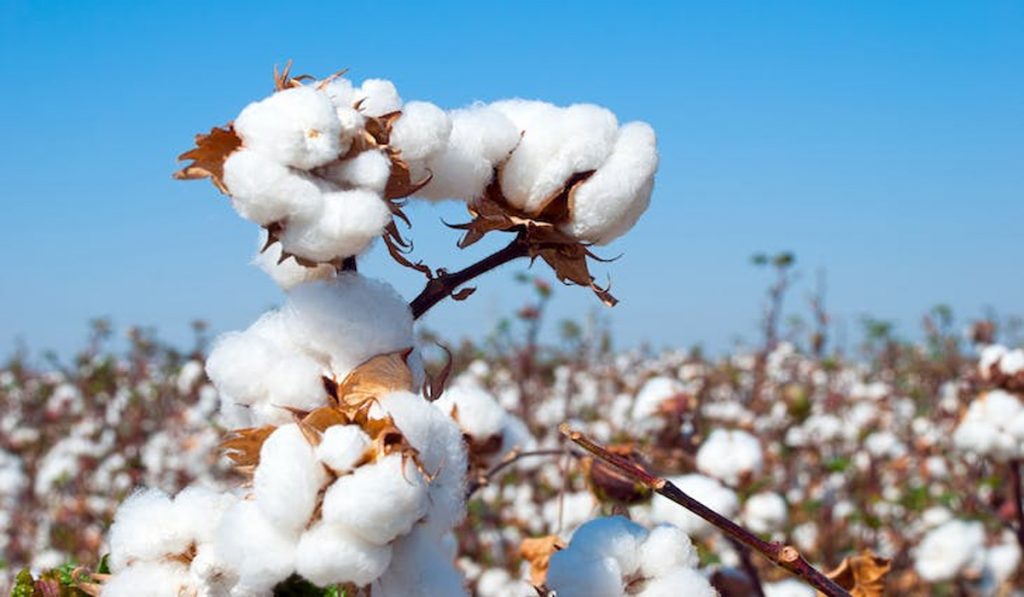
India ranks first globally in acreage and second in production and consumption of cotton. The country’s cotton production stood at 290.91 lakh bales in 2025–26, while domestic consumption reached 328 lakh bales during the same period.
The sector contributes nearly 19 per cent of global fibre production, according to the government. Recent interventions to promote cotton production have focused on productivity, quality, market access, and value addition.
Minimum Support Price (MSP) operations continue to provide price support during market downturns. The Mission for Cotton Productivity aims to increase output to 498 lakh bales by 2031.
Technology demonstrations, digital procurement, and traceability initiatives are strengthening the sector’s competitiveness. These efforts are enhancing productivity, improving quality, and reinforcing India’s position in the global cotton economy.
Due to its economic importance, cotton is often referred to as “White Gold” in India.
The crop supports the livelihoods of around 6 million cotton farmers, with 114.84 lakh hectares devoted to cotton cultivation across the country. It also provides employment to another 40–50 million people engaged in related activities such as cotton processing and trade.
Beyond clothing, cotton plays a vital role in earning foreign exchange through exports of fibre, yarn, fabrics, and garments. India continues to maintain a strong presence in the global cotton trade.
In 2024–25, India exported an estimated 18 lakh bales, equivalent to 0.31 million metric tonnes. This accounted for about 3.37 per cent of total global cotton exports, which stood at 541.69 lakh bales (9.21 million metric tonnes), reflecting India’s significant role in the international cotton market.
India exports cotton to several major global markets, reflecting strong and diversified international demand. In value terms, cotton exports reached $11.49 billion in FY25.
The United States emerged as the largest destination for Indian cotton fabrics and made-ups, accounting for 26.35 per cent of exports, followed by Bangladesh (19.81 per cent) and Sri Lanka (5.11 per cent).
Other important export destinations included the United Kingdom (2.38 per cent) and the United Arab Emirates (2.32 per cent).
These export trends highlight the broad global demand for Indian cotton.
Cotton production in India is largely concentrated in nine major states, grouped into three agro-ecological zones:
Northern Zone: Punjab, Haryana, and Rajasthan
Central Zone: Gujarat, Maharashtra, and Madhya Pradesh
Southern Zone: Telangana, Andhra Pradesh, and Karnataka
In addition, cotton is also cultivated in Odisha and Tamil Nadu.
Cotton occupies a unique position in India’s agricultural and industrial economy. India is the only country cultivating all four recognised cotton species. It ranks first globally in acreage and second in production and consumption.
Cotton production stood at 290.91 lakh bales in 2025–26 (provisional), while domestic consumption reached 328 lakh bales during the same period. The sector contributes nearly 19 per cent of global fibre production. Government initiatives continue to focus on productivity, quality, market access, and value addition.
MSP operations provide price support during market downturns, while the Mission for Cotton Productivity targets production of 498 lakh bales by 2031. Technology demonstrations, digital procurement, and traceability initiatives are improving competitiveness, productivity, and quality, further strengthening India’s position in the global cotton economy.
India’s association with cotton stretches back thousands of years. The subcontinent was once a global centre for cotton textiles, trading its fabrics across Eastern and European markets. In ancient times, cotton cloth even served as a medium of exchange, highlighting its economic value and widespread acceptance.