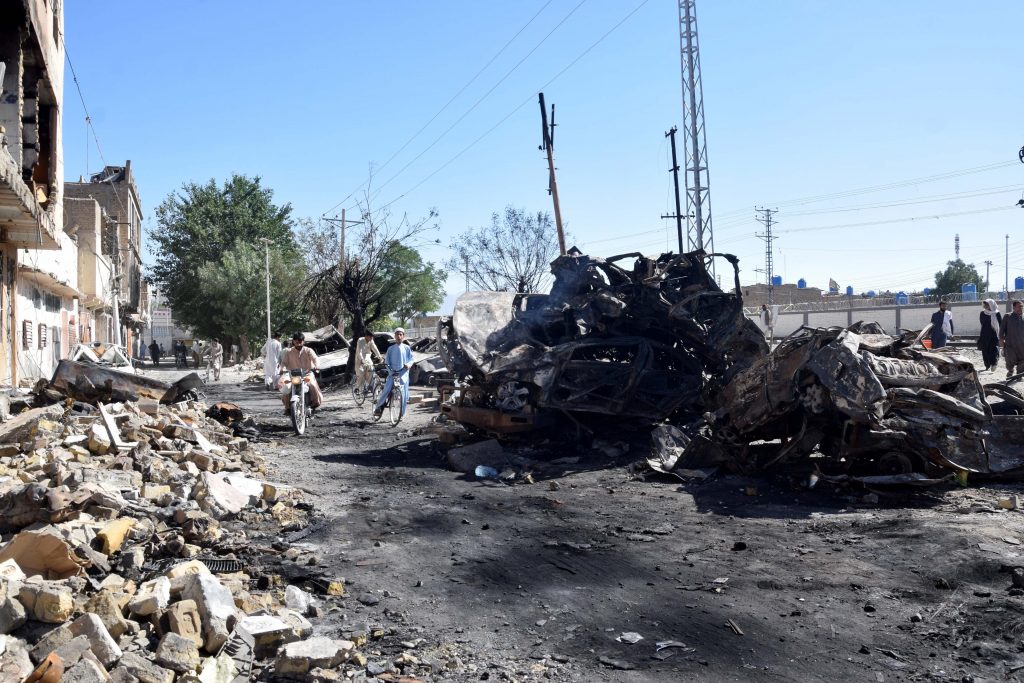
Pakistan is facing a crisis in Khyber Pakhtunkhwa and Balochistan and is in a state of war with Afghanistan under Pakistan’s Army Chief Field Marshal Asim Munir. More than a year ago, Pakistan’s Chief of Defence Forces (CDF) Field Marshal Asim Munir told a cheering group of Pakistanis how he would beat the hell out of Baloch fighters “very soon”. More than a year has since elapsed, but rather than improving, things have taken a turn for the worse. And this is why media reports of the CDF issuing a 72-hour ultimatum to his top military commanders and intelligence officials to either ‘control Balochistan or pack up’ indicate that the performance of the Pakistan army and intelligence agencies in Balochistan has been inordinately unsatisfactory. Munir’s statement exposes the ground reality that the Pakistan army has been attempting to hide through disinformation that Baloch fighters are hated by local residents. Baloch fighters have been resisting Pakistan’s attacks despite facing heavy artillery, armed drones and helicopter attacks, showcasing their commitment against illegal occupation by Pakistan. Notably, Baloch fighters are carrying out a war for independence, and their motivation is the liberation of their land and its people. Pakistan’s intelligence agencies have also failed to get actionable information and prevent largescale attacks involving a large number of fighters, like Operation Herof 2 and the Jaffar Express hijacking. The freedom struggle in Balochistan has been going on since 1948. More than 20 years ago, Pakistan’s then-Army Chief Pervez Musharraf threatened armed Baloch groups. However, the determination of the Baloch people to achieve independence continues. Munir did not learn from Musharraf and thought that he could bring things under control by using military force against armed groups, terrorising local residents by enforced disappearances and extrajudicial killings, and making the peaceful rights campaign ineffective by jailing its leadership using the judiciary. That the self-appointed field marshal’s grand plan to beat the hell out of Baloch groups would end in a damp squib was expected all along. Islamabadbased research and advocacy organisation Pakistan Institute of Peace Studies [PIPS] in its Pakistan Security Report 2025 has mentioned that as compared to 2024, Balochistan witnessed a 30 per cent increase in attacks by Baloch armed groups and a 26 per cent increase in fatalities – a poor report card for Field Marshal Munir. Resultantly, even though shifting blame for failure on subordinates is not a done thing in any army, the severely embarrassed CDF had no other choice but to issue the 72-hour ‘perform or pack-up’ ultimatum to his own brother-in-arms. And Balochistan isn’t the only huge black eye for him – while his army is yet to get the upper hand in Khyber Pakhtunkhwa [KP], New Delhi continues to hold the Indus Water Treaty in abeyance despite his high-decibel warnings and dire threats. Earlier this week, the Baloch Liberation Army (BLA) took responsibility for the attack targeting a Pakistani military convoy in Balochistan’s Mastung district, claiming that over 45 security personnel were killed and dozens injured during the operation. BLA spokesperson Jeeyand Baloch said that the attack was carried out on Thursday in the Khadkucha area of Mastung by the armed group’s unit, “Fatah Squad, while describing it as “coordinated and intense ” He said that the armed group attacked a convoy of buses transporting personnel of the “occupying” Pakistani army, their security details, and the military reinforcements that subsequently arrived at the scene.
Crisis in Khyber Pakhtunkhwa, Balochistan