


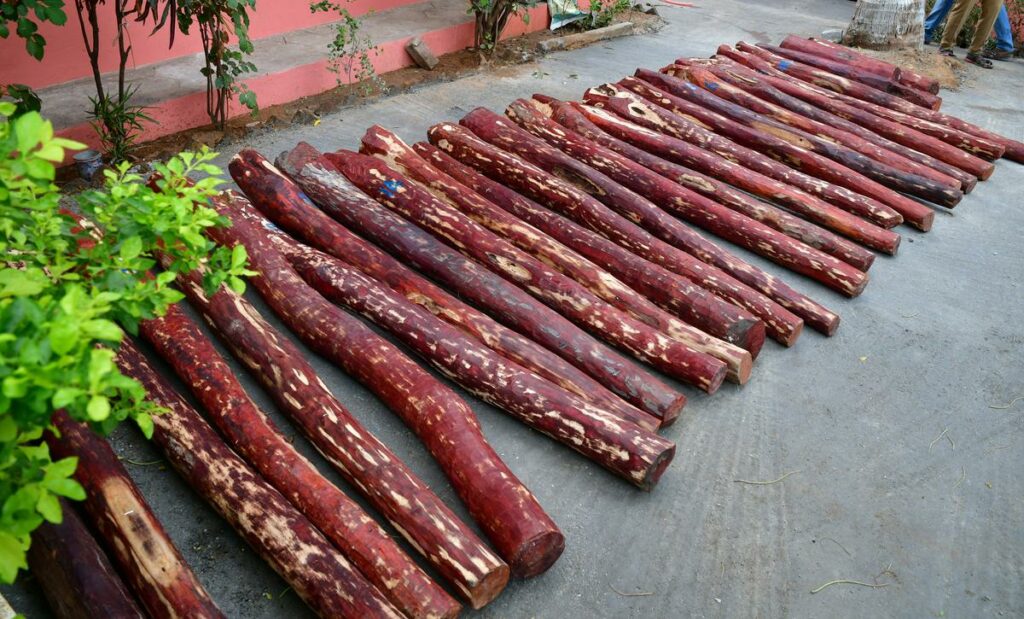
Red Sanders, a tree native to the dry forests of Andhra Pradesh’s southern ranges, has long carried a reputation shaped by scarcity, smuggling networks, and high global demand. But in recent years, a quieter shift has taken place. Farmers cultivating the species legally on private and community lands are beginning to see clearer economic opportunities, backed by regulatory reforms and benefit-sharing mechanisms.
The latest decision by the Directorate General of Foreign Trade to expand India’s export quota of cultivated Red Sanders adds momentum to that shift. The revised export quota, valid from April 1, 2025, to March 31, 2027, allocates 280 metric tonnes for Andhra Pradesh, 900 metric tonnes for Tamil Nadu, 10 metric tonnes for Karnataka, and 100 metric tonnes for Gujarat. This brings the total permissible export of cultivated Red Sanders to 1,290 metric tonnes. Earlier, only Andhra Pradesh and Tamil Nadu had export allowances.
The expansion signals recognition that cultivation-based production can coexist with conservation goals when monitored and regulated. Yet, the economic story is only one layer. Red Sanders occupies a complex ecological and cultural space. The tree is listed as Endangered by the International Union for Conservation of Nature and appears under Appendix II of the Convention on International Trade in Endangered Species.
This means its trade is permitted, but only when proven to be sourced sustainably and legally. The species is also protected under India’s Wildlife Protection Act. These protections are rooted in decades of overexploitation as the wood became highly prized for furniture, handicrafts, traditional instruments, and natural dye. Even today, illegal logging remains a serious challenge, driven by black market prices that can exceed most agricultural earnings.
To balance livelihood support with conservation, the National Biodiversity Authority under the Ministry of Environment, Forest and Climate Change has been transferring funds to farmers under the Access and Benefit Sharing mechanism. On November 4, 2025, a total of Rs 3 crore was disbursed to 198 farmers in Andhra Pradesh. The amounts farmers received varied widely depending on how much cultivated wood they supplied, with payouts ranging from Rs 33,000 to Rs 22 lakh.
Similar transfers were made in Tamil Nadu days earlier, and earlier funds have supported protection activities across Andhra Pradesh and Karnataka. These payments are meant to reinforce the idea that legal cultivation benefits both communities and conservation efforts. The broader shift began with the 2015 policy framework that promoted fair benefit-sharing and regulated sustainable use.
When DGFT allowed export of cultivated Red Sanders in 2019, it acknowledged that regulated cultivation could relieve pressure on wild populations. Farmers growing this species now occupy a space where economic value and ecological responsibility intersect. Their success depends on transparent r e g u l a t i o n , c o n t i n u e d conservation oversight, and reliable market pathways. The new export quota and recent benefit-sharing payments indicate that this balance may be slowly taking shape.