


The Sikh community today faces a serious paradox. There is no shortage of intelligence, courage, economic resources, professional excellence or commitment to public service among Sikhs. Sikhs have distinguished themselves in the judiciary, bureaucracy, armed forces, business, academia and public life across the world. Yet there is no individual or organisation capable of bringing these scattered pearls together into a necklace that can shine with collective strength. The fundamental problem is not the absence of talent but the absence of leadership capable of uniting it around a common purpose. History offers important lessons. Guru Gobind Singh Ji appointed Banda Singh Bahadur in 1708 to lead the Khalsa, punish the guilty and establish Khalsa Raj. In approximately seven years, Banda Singh Bahadur transformed this mandate into a formidable political and military movement before his martyrdom in 1716. His successors among the Sikhs organised themselves into Jathas and eventually the Dal Khalsa. The Sarbat Khalsa assemblies at Sri Akal Takht Sahib became the forum for collective deliberation and strategic decisions. The Khalsa was reorganised into Misls, while the Budha Dal and Taruna Dal represented its senior and younger military divisions. Sardar Kapur Singh emerged as the acknowledged leader of the Dal Khalsa. Sardar Jassa Singh Ahluwalia succeeded him as a prominent leader and became popularly known as Sultan-ul-Qaum. Sikh power expanded considerably, and Sikh forces entered Lahore and Delhi. However, territorial ambitions and disagreements over the distribution of conquered territories gradually weakened unity. Rivalries among the Misls sometimes developed into serious conflicts. Maharaja Ranjit Singh subsequently emerged as the supreme political authority and established Khalsa Raj, with Lahore as its capital. His reign from 1799 to 1839 represented the high point of Sikh political power. Yet the consolidation of this power under one ruler did not develop into a sufficiently strong and sustainable system of collective political and religious leadership. Several Misl Sardars preferred British protection and accommodation rather than integration into a united Sikh political arrangement. Nor did a coordinated movement emerge to research, preach and propagate the revolutionary message of universal human equality, One God and freedom from caste and religious discrimination. Religious institutions continued to depend substantially on traditional Udasi, Nirmala and Mahant establishments. Following the annexation of Punjab, the exile of Maharaja Duleep Singh and the gradual dismantling of Sikh sovereignty, the community lost its central political authority. The British extended their influence over Sikh institutions and political affairs. No universally accepted Sikh leadership emerged to combine political aspirations with religious revival. The Gurdwara Reform Movement of 1920–1925 was a historic opportunity. Sikhs rose against the mismanagement of religious institutions by Mahants and reclaimed their Gurdwaras. The SGPC and Akali Dal emerged as powerful institutions and political identities. However, political leadership gradually became dominant over religious institutional authority. The Akali Dal joined hands with the Congress in the freedom struggle, while the British encouraged alternative political and religious groupings, including princelystate interests and pro-British Sikh elements, to counterbalance the Akali movement. The SGPC, functioning under legislation, also became subject to statutory and governmental accountability. The distinction between religious authority and political control became increasingly blurred. Although the SGPC Act refers to Head Priests, the designation of Jathedar for the heads of the Sikh Takhts gained currency around 1940. In its subsequent institutional development, this position became closely associated with SGPC administrative control. Without an independent and transparent system of appointment, tenure and accountability, the authority of the institution gradually became vulnerable to political influence. Independence brought another disappointment. Several Akali leaders who had cooperated with the Congress, including some who had merged their political identities with it in 1948 and 1956, subsequently felt betrayed by the Congress leadership. The demand for a Punjabi-speaking state, despite earlier assurances about preserving Sikh identity and dignity, was portrayed as a communal demand. The Congress also absorbed prominent Sikh leaders into its political organisation. The 1957 elections reflected this division, with several former Akali leaders contesting on Congress tickets. Master Tara Singh became a principal target of this political contest. His differences with the Congress establishment and rivalry with Sant Fateh Singh, in the political environment associated with Chief Minister Partap Singh Kairon, contributed to his marginalisation. The struggle for leadership increasingly became a contest for political control rather than a movement for the larger interests of the community. Meanwhile, religious authority also suffered. Controversies involving the Nirankaris, Dera Sacha Sauda and other groups, together with incidents of sacrilege against Sri Guru Granth Sahib Ji, deeply wounded Sikh sentiments. When political leaders themselves disregarded Hukamnamas issued by the Jathedars, the sanctity of the institution was undermined. An institution whose decisions are selectively obeyed cannot command universal respect. The Akali Dal has governed Punjab under different leaders on numerous occasions. Yet the wounds associated with militancy, Operation Blue Star, the 1984 antiSikh massacres and subsequent sacrilege controversies have not received the healing, justice and institutional accountability that the community expected. The Rajiv–Longowal Accord of 1985 was not pursued effectively after Sant Harchand Singh Longowal’s assassination. The leadership vacuum is evident at two levels. At present, there is no universally accepted Sikh leader or representative institution that commands sufficient confidence to engage meaningfully with the Central Government and work towards resolving longstanding Sikh issues. Equally important, an ordinary Sikh has no recognised and trusted leadership to approach with confidence when seeking justice, assistance or support in times of difficulty. Thus, repeated political opportunities failed to restore public confidence. Consequently, a substantial section of the Sikh community gradually drifted away from the Akali Dal. At the same time, religious leadership fragmented into hundreds of deras and independent establishments. Many Babas undertake valuable religious and social activities, but there is no common platform or institutional direction to coordinate their contributions towards the larger Sikh mission. The institution of Jathedars, meanwhile, continues to suffer from questions concerning independence, appointment and credibility. Organisations such as the Alliance Israélite Universelle, B’nai B’rith and various Jewish philanthropic federations demonstrate the importance of organised community participation. Their emphasis on education, research, social welfare, professional excellence and international connections offers valuable lessons. The lesson for Sikhs is not to imitate another community but to understand that identity survives through institutions, knowledge, organised resources and intergenerational responsibility. Other minority communities, including Jains, Parsis and Muslims, have also invested in educational institutions, community development and the preparation of their young people for competitive examinations and services in government. These efforts demonstrate the importance of organised investment in human capital and future generations. The way forward must begin with a fundamental principle: to become a Sikh leader, one must first be a good Sikh. Leadership cannot be established merely through political office, religious robes, titles, wealth or control over institutions. It must emerge from personal conduct, commitment to Gurbani, integrity, service and the ability to inspire confidence. After Master Tara Singh, Jathedar Mohan Singh Tur and Sant Harchand Singh Longowal, the community has struggled to find leadership that commands comparable respect across different sections. The issue is not to glorify individuals of the past but to recognise that public conduct must reflect the principles one claims to represent. The guiding principle is: Satgur ki Baani Satsarup hai Gurbani Baniyae !! Ang 304 Gurbani is the embodiment of Truth; we must shape our lives according to its teachings. Recitation without practice cannot produce moral leadership. We must now bring together Sikh intellectuals, retired judges, senior bureaucrats, military officers, entrepreneurs, academicians, religious scholars, social workers and young professionals. They need not surrender their political affiliations or individual identities. They must agree on a common agenda for education, economic advancement, social harmony, preservation of Sikh heritage, institutional reform and the dignity of the community. A community cannot achieve its collective aspirations without direction, organisation and leadership. But leadership cannot be manufactured through appointments or political manoeuvring. It must earn its legitimacy through character, service and the trust of the people. The Sikh community possesses an extraordinary legacy, worldwide talent and the resources necessary to shape its future. What is missing is the thread that can bind these pearls together. Let us rise above personal ambitions, institutional rivalries and political differences. Let us contribute our knowledge, resources and experience for the future of our community and the generations to come. Our strength is not merely in our history, numbers or achievements. It lies in the universal message of our Gurus: Nanak Naam Chadhi kala Tere bhane Sarbat da bhala May the Name of the Almighty inspire eternal optimism, and may there be welfare and prosperity for all. The time has come not merely to ask where our leadership is, but to become part of the collective effort to create it.
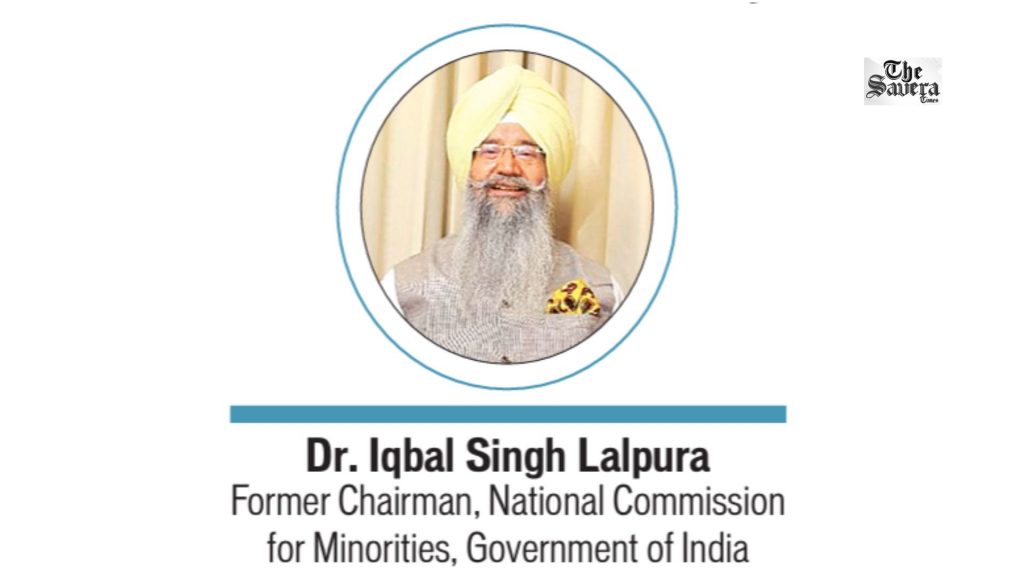
Dr Iqbal Singh Lalpura Former Chairman National Commission for Minorities Government of India