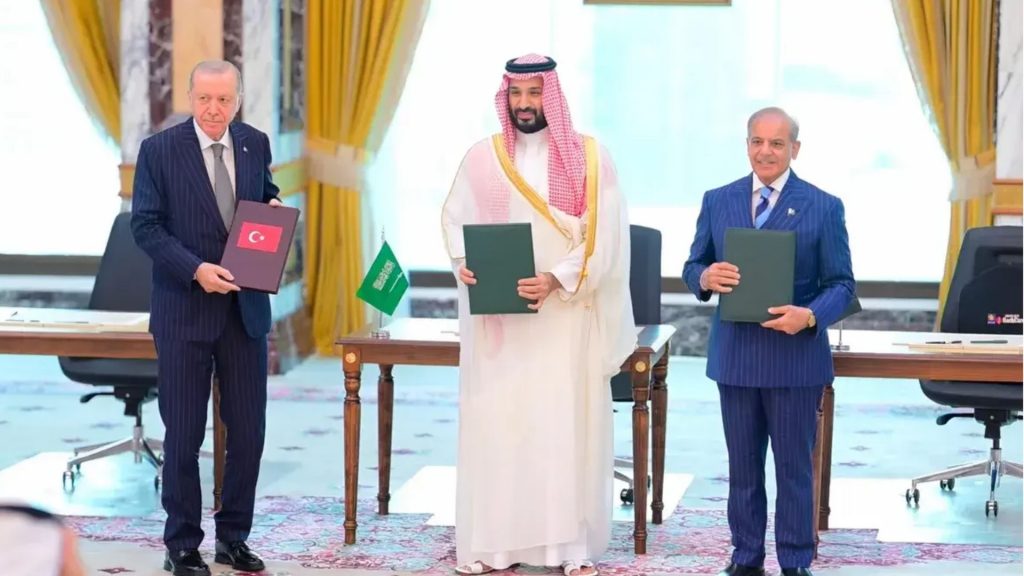
Saudi Arabia believed it had purchased the loyalty of two of the Islamic world’s largest armies. What it acquired instead were extraordinarily expensive security guards, contracted to stand watch, but never to leave their barracks. When Riyadh assembled the Mecca Joint Defence Agreement in August 2026, the arrangement was marketed as a NATO-style collective security architecture. An attack on one would be treated as an attack on all. Three Sunni-majority powers, including a nuclear-armed state and NATO’s second-largest military had bound themselves together in the birthplace of Islam. The symbolism was potent. The substance has proven far more modest. The first genuine test of the alliance has revealed that neither Ankara nor Islamabad has any intention of fighting Riyadh’s war. The distinction that matters is between defence and combat. Turkish Foreign Minister Hakan Fidan has been explicit: the Mecca agreement is “defensive, not offensive,” and Turkey “will not send forces to the territory of another state to launch an attack from there,” he told the media in Ankara on October 8. Defence Minister Yasar Guler was blunter still when asked a few days later whether Turkish soldiers would engage the Houthis: “We absolutely do not foresee entering into any conflict with the Houthis,” he told Turkey’s Star TV in an interview. Turkey’s contribution will consist of military technology, airdefence systems, drone operators, and intelligence-sharing rather than combat brigades. Ankara is leveraging the pact to deepen defense-industrial ties with Riyadh. In 2023, Turkey signed its largestever defense export contract with Saudi Arabia, centred on Akinci combat drones. The Mecca agreement extends that commercial and strategic logic. It is not a blank cheque for Saudi military adventures. Pakistan’s position is even more constrained. Islamabad has deployed roughly 8,000 troops to the Kingdom, including a squadron of JF-17 fighter jets and a Chinese HQ-9 air-defence system, but these forces are officially characterised as serving an advisory and training role. Pakistan has drawn a firm line at putting boots on the ground for offensive operations. It declined to join the Saudi war in Yemen in 2015, and it has ruled out sending troops to help Riyadh retake territory from the Houthis. The reason is not wanted of will but want of capacity and the sheer weight of competing interests. Pakistan’s economy remains acutely dependent on Saudi financial support. Islamabad cannot afford a rupture with Riyadh, but neither can it afford to be dragged into a war that would inflame domestic pressures, strain its military across multiple fronts, and damage its delicate relationship with Iran, with which it shares a long and volatile border. For Islamabad, an offensive strike against the Houthis would be an existential threat at home. Geography is the first constraint. Pakistan shares a porous 900-kilometre border with Iran. In early 2024, cross-border missile strikes between the two nations demonstrated just how fragile that frontier is. If Pakistan launches offensive operations against Tehran’s most active proxy in Yemen, Iran need not fight Pakistan in the Arabian Sea. It can destabilise Balochistan tomorrow. Domestic stability is the second constraint. Pakistan has the world’s second-largest Shia population, roughly 10 to 15 per cent of the country. Openly entering a Middle Eastern sectarian shooting war on behalf of Riyadh risks triggering violent internal strife across Pakistani cities. The Pakistani parliament unanimously rejected joining the Saudi-led Yemen intervention in 2015 for precisely this reason. Pakistan’s military doctrine exists to maintain deterrence on its eastern border with India, not to bleed in Arabian deserts. They will guard Saudi air bases to secure Riyadh’s bailout loans, but they will not fire into Yemen. Ankara’s refusal to go on the offensive is driven by cold pragmatic calculation. Turkey relies on Iranian natural gas pipelines to heat its cities and fuel its industrial grid. According to reports, Iran supplied roughly 13 per cent of Turkey’s natural gas imports in 2025, approximately 7.7 billion cubic meters. Antagonising Tehran by attacking its key regional asset jeopardises that energy supply. More importantly, Turkey requires tactical coordination with Iran in northern Iraq and Syria to contain Kurdish militant groups. Torching its relationship with Iran over Yemen dismantles Ankara’s primary national security priority on its own southern border. There is also the ideological paradox. Turkish leadership has built its regional soft power on being the vocal champion of the Palestinian cause. The Houthis have spent recent years framing every missile they launch into the Red Sea and Saudi Arabia as resistance against Western and Israeli trade. If Turkish forces conduct offensive strikes against the Houthis, Ankara completely destroys its standing with the wider Muslim public just to protect Saudi shipping lanes. This is why the defense pact is strictly, permanently defensive. Saudi Arabia’s allies are extracting maximum financial leverage while offering the bare minimum in return. Turkey and Pakistan will operate radar stations, maintain air-defence batteries, and cash Saudi investment cheques. Neither will risk their domestic stability, their borders, or their energy supplies to fight an offensive war against Iran’s axis. Saudi Arabia wanted an offensive coalition. What it got was a shield that refuses to swing a sword. If geography, sectarian balance and regional diplomacy explain why Ankara and Islamabad will not swing the sword, economics explains why they hold the shield so firmly. Their restraint is often read as reluctance, or as a way of drawing Saudi support while offering little in return. A closer look at the economic foundations of the Mecca agreement suggests something more deliberate. For both capitals, the pact is an instrument of economic security as much as military security, and the logic of that economic security points firmly towards defense rather than offense. Pakistan offers the clearest illustration. Its partnership with Saudi Arabia rests on deep and mutual economic interdependence. The Kingdom holds roughly $8 billion in deposits at the State Bank of Pakistan, and in 2026 it moved its $5 billion facility onto a three-year horizon running to December 2028, a sign of long-term confidence in Pakistan’s stabilisation programme. Pakistan, for its part, is implementing a $7 billion IMF programme and steadily rebuilding its reserves. For an economy in recovery, predictability is the most valuable asset of all. A defensive posture protects that predictability; an offensive war in Yemen would put it at risk, along with the reform gains Islamabad has worked hard to secure.
Defence Without Combat: Why Turkey and Pakistan will guard Saudi Arabia