


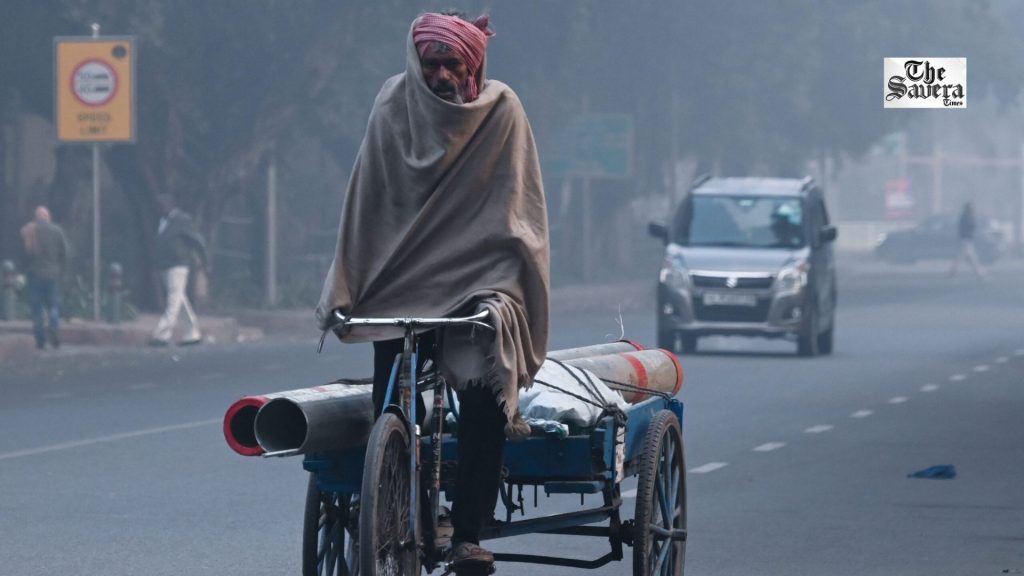
New Delhi: A slight chill has started to set in across Delhi-NCR during the early morning and evening hours, signalling the gradual shift towards winter. But as temperatures begin to ease, pollution is emerging as another concern, with Delhi’s air quality expected to slip into the poor category for the first time this season on Monday.
The change in weather follows the withdrawal of the monsoon from North India. Conditions have turned largely dry across Delhi and several neighbouring states, including Uttar Pradesh, Bihar, Rajasthan and Madhya Pradesh, while temperatures have started dipping during the cooler parts of the day.
The India Meteorological Department (IMD) has forecast mainly clear skies over Delhi in the coming days, with no rain expected during the next week. Minimum temperatures are likely to remain between 18 and 20 degrees Celsius, while daytime temperatures could range from 31 to 35 degrees Celsius.
Delhi’s Safdarjung weather station recorded a maximum temperature of 31.7 degrees Celsius on October 18, slightly below the seasonal average. The minimum temperature was 18.6 degrees Celsius. For Monday, the minimum is expected to remain around 18 to 19 degrees Celsius.
Cooler Mornings Ahead, but No Immediate Winter Spell
The IMD expects dry weather to continue across much of North India from October 18 to 24. Temperatures in Delhi-NCR and neighbouring areas of Punjab, Haryana, Uttar Pradesh, Bihar and Rajasthan could be up to two degrees above normal in some places.
Mornings and evenings are likely to become progressively cooler, although the region is not expected to experience intense winter conditions just yet. For now, the weather is set to remain mostly dry as the seasonal transition continues.
The lack of rain, however, could make the pollution situation worse. Without rainfall to help clear the air, pollutants from vehicles, construction work and other sources may continue to build up, particularly if winds remain weak.
Delhi recorded an Air Quality Index (AQI) of 187 on Sunday, placing the city in the moderate category. However, 22 monitoring stations reported poor air quality, showing that several parts of the capital were already experiencing higher pollution levels.
The overall AQI is expected to enter the poor category on Monday, marking a potential first for the current season.
Southern States Brace for More Rain
While North India is settling into a drier spell, the weather outlook is different across the southern peninsula, where rainfall is expected to continue over the coming days.
The IMD has forecast rain in Tamil Nadu, Puducherry, Kerala, Karnataka and Lakshadweep through the coming days. Isolated heavy showers are likely in Tamil Nadu and Puducherry during the week, while Kerala, Mahe and south interior Karnataka may receive heavy rainfall through October 23.
Heavy rain was also forecast in coastal Andhra Pradesh and Rayalaseema on Sunday.
The contrasting conditions reflect the different weather patterns currently affecting the country, with northern regions experiencing mostly dry weather while parts of the south remain under the influence of rain-bearing systems.
El Niño Adds Uncertainty to Winter Outlook
Attention is also turning to the possible influence of El Niño on the approaching winter season. Changes in Pacific Ocean temperatures associated with the climate pattern can affect weather conditions across India, but its impact on temperatures and rainfall varies from one season and region to another.
El Niño has been linked to weaker monsoon rainfall in some previous years, although the effects are not uniform across the country. Meteorologists have yet to establish how strongly it could influence the coming winter.
For Delhi-NCR, the immediate outlook points to cooler mornings, dry weather and a growing risk of air pollution as the monsoon season gives way to winter.