


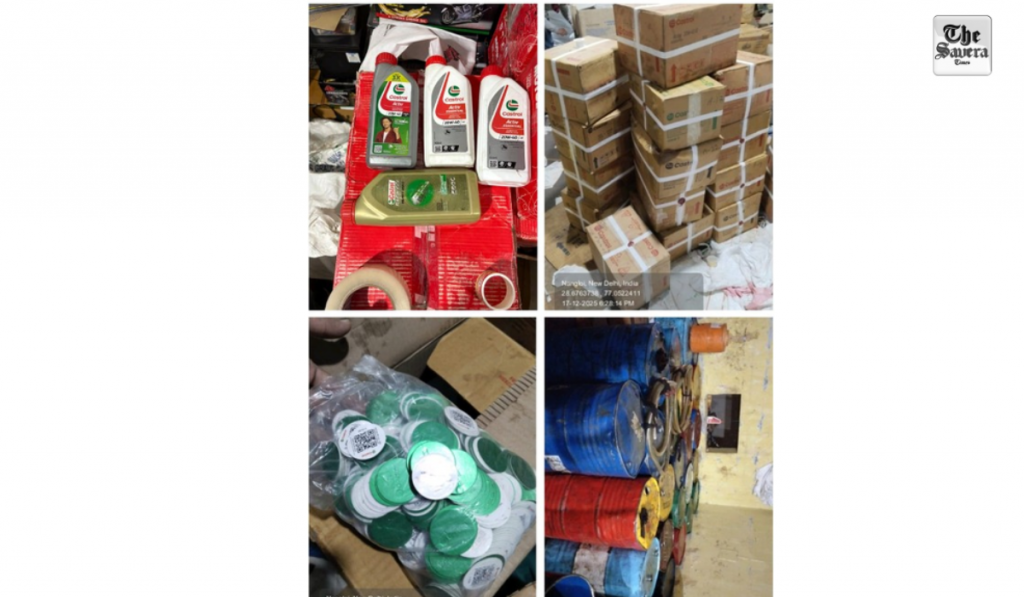
New Delhi: In a major crackdown against counterfeit goods, the Delhi Police Crime Branch’s Inter-State Cell busted a large-scale fake Castrol lubricant oil manufacturing unit in the Nangloi area of West Delhi and seized stock worth Rs 1 crore.
How the Operation Unfolded
The operation resulted in the seizure of approximately 3,950 liters of raw and counterfeit lubricant oil, nearly 12,000 empty Castrol bottles and buckets, along with machinery and packaging materials, valued at over Rs 1 crore.
The accused, 36-year-old Sandeep, a resident of Nangloi, was arrested from the spot. He was allegedly overseeing the illegal manufacturing process.
Police said the racket was misusing the brand name of Castrol lubricant oil, violating trademark and copyright laws and defrauding consumers across several states.
According to the Crime Branch, the operation was launched based on credible information received from the authorized representative of M/s Castrol Ltd., who reported the illegal manufacturing and distribution of counterfeit Castrol products.
Acting on these inputs, a special team raided a premises in Kamruddin Nagar, Nangloi, and unearthed a fully operational counterfeit lubricant unit.
During the raid, the unit was found to be engaged in filtering, coloring, filling, labeling, and sealing counterfeit lubricant oil to make it resemble genuine Castrol products.
Seized Goods and Machinery
The seized items included approximately 3,600 liters of raw lubricant oil, 370 liters of counterfeit Castrol oil, over 11,300 empty bottles, 464 empty Castrol buckets, fake labels, a sealing machine, packaging materials, and coloring chemicals.
Police said the counterfeit products were identified and verified by the company’s authorized representative and seized under due legal process. A secondary location in the same area was also searched, where additional empty drums and bottles were found. The investigation revealed that the accused procured cheap lubricant oil locally and sold it as genuine Castrol oil by applying counterfeit labels, packaging, and coloring. The counterfeit products were being supplied to buyers in other states, mostly through cash transactions, indicating an inter-state distribution network.
A case has been registered under Sections 349 and 318(4) of the Indian Penal Code and Sections 63 and 68 of the Copyright Act.
DCP Aditya Gautam said, “Further investigation is underway to identify the accomplices, transporters, financial handlers, and the full extent of the counterfeit network.”