


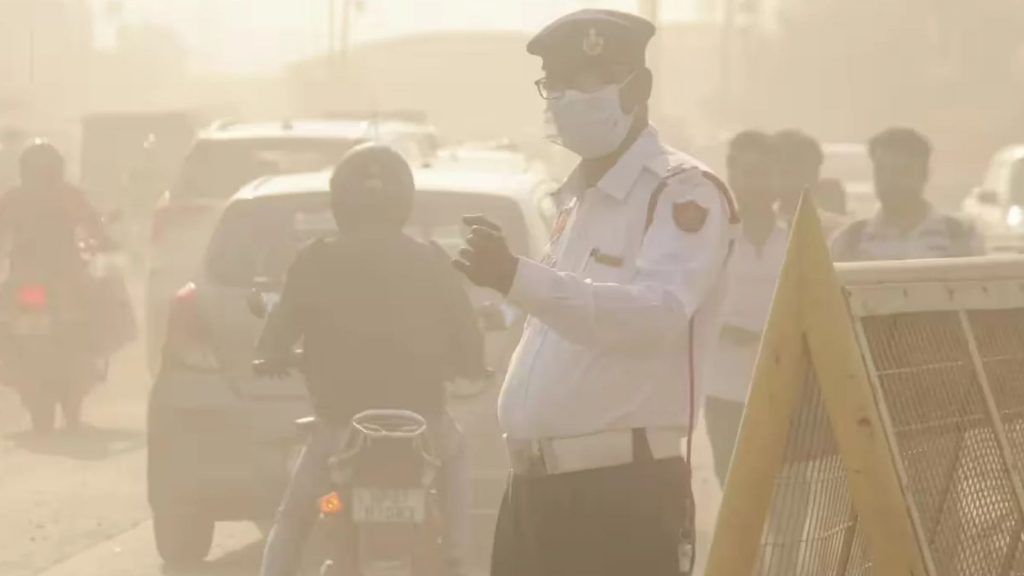
New Delhi: Air pollution levels have risen sharply in the national capital Delhi ahead of Diwali. At 8 am on Tuesday, Delhi’s average Air Quality Index (AQI) was recorded at 451, indicating a very severe and dangerous situation. The rising pollution levels have increased the concern of the people of the capital.
According to data from the Central Pollution Control Board (CPCB), the AQI in many areas of Delhi reached the severe category, while the air quality in many other areas remained very poor.
AQI exceeds 400 in Rohini and Punjabi Bagh
The highest AQI of 429 was recorded in Rohini area of Delhi, followed by 424 in Punjabi Bagh and 408 in Bawana. All three areas remained in the severe pollution category.
Meanwhile, the AQI was recorded at 379 in Patparganj, 374 in RK Puram, 373 in ITO, 355 in Jawaharlal Nehru Stadium, 352 each in Okhla Phase-2 and Chandni Chowk, and 328 in Jawaharlal Nehru University (JNU). Air quality remained in the very poor category in all these areas.
On the other hand, pollution levels remained relatively low in some parts of the capital. The AQI at Terminal-3 of IGI Airport was recorded at 287, Anand Vihar at 279, Uttam Nagar at 274, and IMD Lodhi Road at 226. Air quality in these areas remained in the poor category.
Delhi Police Checking at Ghazipur Border
In view of the rising pollution levels, the Delhi Police launched a vehicle checking drive at the Ghazipur border. This checking was carried out amid restrictions on vehicle entry under the second phase of the Graded Response Action Plan (GRAP).
Earlier on Monday, in response to the increase in air pollution, the Commission for Air Quality Management (CAQM) implemented the second phase of GRAP (Stage II) across the National Capital Region (NCR) with immediate effect.
Strictness in NCR, water sprinkling and cleaning of roads will be implemented
With the implementation of the second phase of GRAP, the restrictions imposed under the first phase will also continue. Municipal corporations, traffic police, and pollution control boards in Delhi, Haryana, Uttar Pradesh, and Rajasthan have been directed to take strict measures.
Under this, high-traffic routes and congested areas will be cleaned daily using mechanical or vacuum sweeping. Water and dust suppressants will be sprayed to control dust. These activities will be completed on a priority basis before peak traffic hours.
In addition, inspections will be increased at major pollution hotspots and construction and demolition sites. The concerned departments have been directed to take necessary corrective measures to reduce pollution.
As the pollution level in Delhi reached a serious level before Diwali, the administration has intensified pollution control measures.