


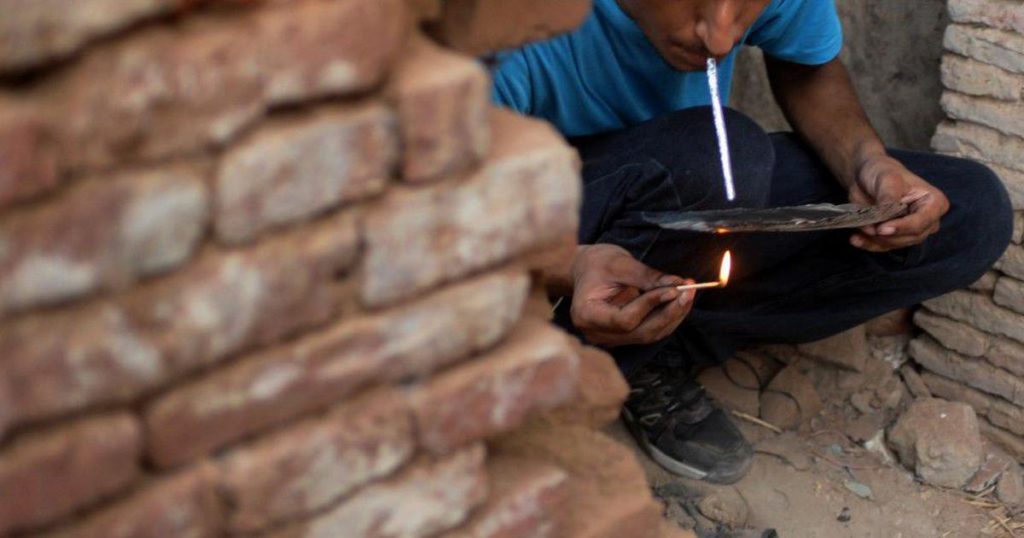
Drug menace in Punjab is not only Punjab’s problem, it is a national problem. Punjab shares 553 kms of border with Pakistan. Punjab’s border with Pakistan and geographical location place the state in a high-vulnerability drug inflow zone from the “Golden Crescent”, with spillover into neighbouring states.
Drug smuggling from across the border into Punjab needs analysis and countermeasures. Tackling the drug menace requires a coordinated, not split, response involving Punjab, the Union Government, neighbouring states and political parties. Unless the drug menace in Punjab is designated as a national priority, the scourge of drugs from Punjab will not end despite tall claims by governments.
Be it the Akali Dal-BJP combine, Congress, Aam Aadmi Party or the Union Government, all claim success in the war against drugs, coining catchy taglines for narrative building and spending millions on publicity campaigns without much transformation. Drug smuggling and addiction continue unchecked.
Political parties must stop exploiting the drug menace for garnering votes. Government and law enforcement efforts should be to prevent drug use among youth through inspirational social initiatives and not retributory measures that turn youth into criminals.
There is a close historical and geographical relationship between Punjab and Pakistan which helps narcotics smuggling from across the border. Both East and West Punjab were once one, with relatives and friends residing across borders. The emotional bond still exists.
Being geographically contiguous, with population concentrations close to the border, Punjab automatically becomes fertile ground for drugs from across the border, with a trilateral aim to weaken the national security architecture through rampant violation of border sovereignty by smuggling drugs and arms; destruction of societal architecture through drug addiction among youth, rendering them weak and easy to lure into crime; and spreading tentacles into neighbouring states, truly making drug spread a national problem.
The quantum of seizures made from Pakistan-contiguous states of J&K, Punjab, Rajasthan and Gujarat, and from Punjab-contiguous states, makes it a national problem. Government figures too magnify it as a national problem requiring a national response, not a split political response.
Narcotics Control Bureau (NCB) state-wise seizure data for 2024, covering drugs seized by law enforcement agencies, lists total seizures of all types of drugs in Punjab at 44,557.44 kg, along with 6,952 injections, 2,330 CBCS bottles and 29,423,513 tablets, with 9,025 cases and 12,301 arrests.
In Gujarat, 19,587.69 kg of drugs were seized, along with 16,509 CBCS bottles and 2,884 tablets, with 623 cases and 903 arrests. Rajasthan recorded 2,30,565.95 kg, along with nine injections, 13,701 CBCS bottles and 1,678,134 tablets, with 5,462 cases and 6,474 arrests.
J&K recorded seizures of 5,276.46 kg, along with 405 injections, 4,992 CBCS bottles and 155,614 tablets, with 1,539 cases and 2,158 arrests. Himachal Pradesh recorded 1,137.35 kg, along with 36 injections, 3,807 CBCS bottles and 53,723 tablets, with 1,624 cases and 2,495 arrests. Haryana recorded 21,414.98 kg and 612,912 tablets, with 3,062 cases and 4,040 arrests.
Total heroin seizures in the five states in 2024 stood at 1,547.36 kg. The normal principal benchmark is that seizures account for just about 20-25 per cent, while 75-80 per cent goes into society, fuelling addiction, militancy and separatism and rupturing societal architecture. These figures indicate that narcotic drugs have penetrated deep into society, becoming part and parcel of the societal architecture.
Herculean efforts are required to control the spread of drugs involving the political spectrum, society, children and youth from schools, colleges and universities. The Punjab government’s anti-drug campaign, “Yudh Nashian Virudh”, continues.
Punjab Police have arrested 81,107 drug smugglers and registered 73,541 NDPS cases between 2022 and 2026, seized 4,161 kg of heroin, 41,000 kg of poppy husk and more than 65.75 lakh intoxicant tablets.
Capt. Amarinder Singh, two-time former Chief Minister of Punjab, recently claimed that the drug business under the AAP government is growing. He credits his government with registering 48,107 cases under the NDPS Act between April 2017 and August 2021, making 62,535 arrests and seizing 2,216 kg of heroin.
He claimed that, in addition to Pakistan, drugs are also coming into Punjab from Gujarat and Jammu & Kashmir. He lamented that despite apprising the Prime Minister and Home Minister of the drone menace from across the border and the serious situation, he was told that DRDO was working on something.
He said that despite flagging the issue for three years, Delhi did not take it seriously. He also said that the BSF, like infantry, is trained for different tasks and engages man-to-man, and is not trained to shoot down drones. He called for an effective anti-drone response on the borders.
What Should Be the National Response?
What should be the national response to drug smuggling from across the border through drones, land and sea routes, and bulk pumping of drugs into Punjab and neighbouring states, afflicting society and youth with drugs?
Let us first consider drug smuggling and border security. Both are interconnected. A strong border surveillance grid will paralyse and incapacitate the cross-border smuggling architecture. Vice versa is also true.
There is an urgent need to strengthen deployment along the Line of Control and international border up to Gujarat by integrating manpower and technology and establishing a formidable surveillance grid to prevent smuggling through land and aerial routes.
National security must not be measured in terms of money and group interests, with national interest kept supreme. There is an urgent need for deployment of anti-drone command systems to neutralise drones coming from across the border.
There should be minimum withdrawal of troops from the border security role, lest it create gaps that are exploited by smugglers from across the border. Rather, the BSF needs additional troop reinforcements and infrastructure to protect the depth up to 50 km.
BSF is fighting a war against drones with personnel on the ground practically turning and acting as an anti-drone system. The same is not foolproof, and an anti-drone system is an urgent border security need. These systems must be deployed all along the front without delay.
BSF is deployed on the show window and must have technical surveillance software to monitor cross-border conversations, which is available to the anti-narcotics task force of Punjab Police and other state police forces. BSF is dependent on other agencies for surveillance despite being the lead intelligence agency.
If this surveillance software and the power to monitor are given to BSF, the cross-border drone menace may end in six months. The government must also consider an internet shutdown for two to four hours every night up to 10 kilometres. It will stop drone movement carrying drugs and arms automatically.
The second requirement is for political parties to come on one platform to integrate society as a unit to fight the drug menace. The fight has to be truly national. All must pitch in to stop the spread of drugs in society.
The key result area (KRA) must be the “BIG FISH” — the cartel operating on both sides and organising drug smuggling. Unless the cartel is incapacitated, the arrest of youth and petty addicts in the name of “Yudh Nashian Virudh” may not help.
Arrested youth limp out of jails as criminals with FIRs and police chasing them, making them unfit for employment and a positive societal role. Such arrests not only destroy youth but also stigmatise families, rendering them vulnerable to exploitation by drug kingpins and police, with all avenues of relevance closed.
The government must task district administrations and police to form anti-drug groups in every village, panchayat, school, college and university department. Such groups must have representatives of the civil administration, police, teachers and panchayats, and they must meet at least once a fortnight to spread the message of drug de-addiction and its ill effects.
It must be made into a movement.
Punjab, Haryana, Himachal Pradesh and Rajasthan youth have traditionally had a flair and liking for recruitment in the Army and CAPFs. As a strong national response, the quota-cum-percentage of these states’ intake into the forces could be increased and delinked from population. It could go a long way in helping the fight against drugs.
Punjab needs a coordinated national response to fight the drug menace involving the Union and state governments, political parties and civil society, and not an ad hoc, localised, perfunctory, split response.
Empowering BSF with technical surveillance software may prove key to ending drug smuggling from across the border. The nation must come on one platform to successfully fight the war against drugs.
Split responses will be an advantage to drug cartels despite tall claims of success by governments, both in the state and at the Centre. Now is the time to catch the drug menace by the horns and incapacitate it. Delay may prove suicidal and fratricidal for the nation and society.