


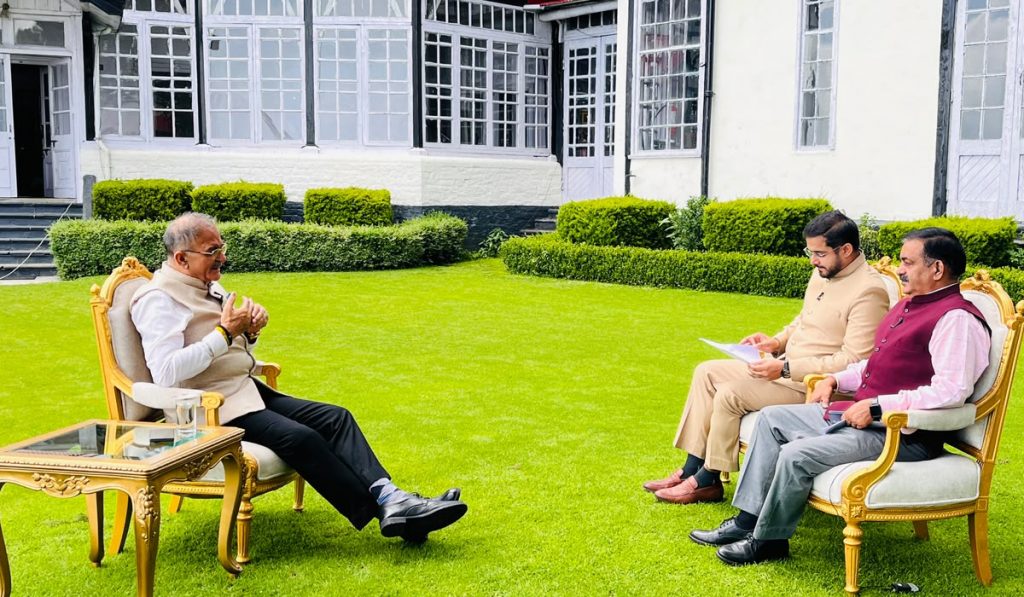
Governor of Himachal Pradesh Kavinder Gupta joined Dainik Savera for an exclusive interview. In this wide-ranging conversation with two senior journalists the Governor engaged in an insightful discussion on some of the most significant issues of the country and state.
The conversation delves into the political landscape of Himachal Pradesh, the changing dynamics of national politics, governance, and the challenges shaping India’s future. The Governor also shared his views on matters of national security and strategic importance, including the situation in Jammu & Kashmir, India’s relations with Pakistan, the issue of Pakistan-occupied Kashmir (PoK), and the broader geopolitical developments affecting the region.
Beyond politics and security, the interview offers a deeper understanding of the Governor’s perspectives on leadership, public policy, and the direction in which the state is progressing.
Marked by candid responses and thoughtful analysis, this discussion provides valuable insights into issues that continue to influence the public.
Question: You have a history of decades in active politics—what is known as ‘people’s politics’—followed by a tenure as a Governor and Lieutenant Governor. How do you view this journey, and what differences do you perceive between the two phases?
Answer: Well, I have been associated with the RSS since childhood, I feel. Even during my school and college days, that same spirit and mindset prevailed; there was always an effort to take the stage and deliver speeches or participate in declamation contests on various topics. That was the kind of person I was. Later, I worked as an activist for the Vidyarthi Parishad in Punjab. You might recall that when the Emergency was imposed in 1975, we used to put up posters against the government—against the regime in power at the time.
We even used cyclostyle machines to print those posters. It is a long story, but one day we were caught and beaten severely. Later, we were imprisoned, and I spent time in the Gurdaspur and Patiala jails. When the Emergency ended and the 1977 elections took place—marking the first time the opposition contested as the Janata Party—I began participating in politics as an active worker.
So, I feel that during the 1977 elections—amidst the nationwide political shift—my political journey began with tasks ranging from voter mobilization and influencing public opinion to persuading people to vote for the Janata Party. After moving on from student leadership, I had the opportunity to work with the Bharatiya Janata Yuva Morcha (the BJP’s youth wing) and eventually enter electoral politics.
The journey continued steadily from there. Looking at where I stand today, I have certainly witnessed many ups and downs—both personally and within my party. However, by consistently adhering to the principle of Charaeveti, Charaeveti (keep going, keep going), I believe the work I have done is the reason I am here with you in Himachal today.
Question: Governor, when did your interest in politics begin? When did the thought first occur to you? Looking at your political journey—spanning from elected roles to nominated positions—when did you decide, “I want to enter politics”?
Answer: As I mentioned, I used to attend RSS gatherings right from my childhood, It was like this: when I was very young—around the first or second grade, after my father was transferred to Sangrur—he had a habit of standing at a street corner in the evenings.
If he spotted someone wearing the RSS uniform, he would invite them home and say, “Please take my children along with you to the Shakha as well.” So, I believe that is where I started—joining as a Swayamsevak (volunteer) of the Rashtriya Swayamsevak Sangh. I did have an interest in politics, especially given the events following the Emergency; I feel that period provided an opportunity to enter the political arena.
My father worked in the Post and Telegraph Department. He served in Punjab, Haryana, and Himachal Pradesh; his penultimate posting was here in Shimla.
Question: Now, speaking of Himachal, what vision do you hold for the state? Previous Governors have each focused on a specific issue and tried to address it comprehensively. For instance, Acharya Devvrat introduced the concept of natural farming, and Pratap Shukla, who served in between, raised awareness about the drug menace. I was observing that whenever you travelled—even outside the state—you incorporated tourism into your agenda; I watched your speeches from both Jaipur and Nagpur. When you visited the South, you urged people there—even going so far as to say that just as they visit Vaishno Devi, they should come here too, as there are Shaktipeeths here as well. So, are you moving forward with a specific vision?
Answer: I wish to work on two specific areas here. As for Acharya Devvrat ji, he took up a very important cause—organic farming, which is a necessity today—and worked on it. Regarding the issue of making Himachal drug-free, the Governors who served here before me had already worked on this. However, there are two or three challenges we face today.
We want to improve the economy of our state, Himachal Pradesh, and we recognize that the youth are currently focusing on their education. However, once they complete their studies, the question of livelihood inevitably arises. It is simply not possible for everyone to secure a government job. There are other avenues available. Himachal holds immense potential; for instance, cultivating medicinal plants could serve as a viable means of livelihood. I actually met with the Forest Secretary today to discuss this very matter. He informed me that if someone undertakes a plantation project on one hectare of land—even on government land—and tends to it for a year, they receive a grant of ₹50,000, in addition to retaining the rights to any produce, such as fruits, harvested from the site. Anyone can avail themselves of this opportunity.
Upon learning this, I felt that if this information were shared with the public, people would realize it could become a reliable source of income. Secondly, there is the aspect of religious tourism; there is hardly any region in Himachal that is not home to various deities. I intend to discuss this with the Prime Minister, as he pays close attention to such matters. Given how he has promoted religious tourism across the country, why shouldn’t the same be done in Himachal?
The state is currently advancing in terms of infrastructure, with road networks being developed. We need to create a corridor that connects these sites; for example, a visitor arriving in Kangra district or its neighboring areas could easily access the ancient and revered Mahalakshmi temple in Chamba, as well as shrines like Jwala Ji, Chamunda Ji, Naina Devi, Baglamukhi Mata, and the Baijnath temple, among many others.
I believe that by creating a tourism circuit, we can boost tourism here. I also feel that, through the government, we can invite people to invest here. It is crucial to provide adequate infrastructure for the tourists who visit. Whenever tourists travel through our region, I often notice severe traffic congestion on the roads; furthermore, hotels get so packed that some tourists are forced to sleep in their vehicles. If there is scope to improve this situation, why shouldn’t we expand and enhance these facilities?
I think we need to focus on two aspects to manage this influx. Regarding medicinal plants, the entire world—including the US and other nations—can benefit from our products and sell them globally at premium prices. There is immense scope to train our local youth in areas like packaging and innovation to capitalize on this opportunity.
Question: Let me talk about religious tourism. If we look at the country’s major centers, the Mata Vaishno Devi Shrine Board stands out. You have been deeply involved in politics there at the grassroots level; you served as Deputy CM and also as the Speaker. Having witnessed every aspect of operations there first-hand, can we expect to see that experience translated into action here in the coming years?
Answer: Absolutely. I think this is something worth considering. There are many enlightened individuals—religious leaders and prominent figures within our faith communities—with whom we could sit down and discuss this. We could devise a plan so that when people visit our temples and stay nearby, they don’t simply offer a quick prayer and leave. Instead, there should be proper accommodation facilities. Furthermore, for those visiting with their families, we could plan itineraries that include visits to other temples in the vicinity. If we approach this by involving the local community, elected representatives, and key local figures, we could find a significant solution. Through collective discussion and deliberation, we can move forward.
Question: You speak of promoting tourism, and we are indeed witnessing infrastructure growth—new roads, highways, and improved rail connectivity. Consequently, people are increasingly interested in spending their holidays at hill stations. While tourism is expanding, it is simultaneously exerting considerable pressure on the state’s environment and natural landscape. Does this present a dual challenge for the government and the administration? On one hand, you must promote the industry, while on the other, you must preserve its beauty and natural environment.
Answer: Look, I have no hesitation in saying this: if we are alive, it is because of nature. We should not leave behind a legacy for our future generations—whether it concerns water conservation, global warming, or it is about climate control.
Work is being done on these issues worldwide, and I feel we are fortunate that Himachal Pradesh enjoys such pleasant weather, attracting people from all over India. Regarding this potential—if specific measures need to be taken to harness it, I see no objection. There are excellent laws here—especially concerning forests and the environment—to curb the use of single-use plastic, which damages our surroundings.
Trees cannot be felled easily; permission is granted only based on necessity. This is good; the practice of planting trees must continue. The Prime Minister has launched the “Ek Ped Maa Ke Naam” (A Tree in Mother’s Name) campaign, which is currently underway, and it needs to be taken forward.
Question: Sir, you mentioned that the participation of leaders and public representatives is essential. In your tenure of three or four months, you must have observed the local representatives—that is, the government. Do you think that cooperation will be forthcoming, or will the issue get stuck simply because the Governor comes from a different background compared to the government? How do you view the government? Do they respond? Are the policies in place? Do you feel they have the right intent?
Answer: I feel that occupying this position means there is no priority greater for me than the betterment of Himachal. It is good if work is carried out through the government, but I repeatedly emphasize that this should also become a people’s movement. The government always provides support. It has been nearly four months now, and I have never felt that the government is trying to hinder my efforts or create obstacles.
I am approaching this in my own way; for instance, I have the university platform, and we have established a ‘Swarojgar Dham’ (Self-Employment Hub) there. This initiative aims to promote products made by local people and provide them with the necessary training. We have set this up specifically for that purpose.
Similarly, we have created a ‘Nakshatra Vatika’ (a garden based on the 28 lunar constellations) there; we developed a model incorporating the specific trees associated with each of these constellations. That is just one example regarding the university. Beyond that, there is immense scope for work at the agriculture university, and there are other avenues as well. Regarding the environmental protection issues we are discussing, I do not feel there is any lack of support from the government—contrary to what you might have implied. In fact, when I invited forestry experts today, they themselves asked me to guide them so they could work on these initiatives.
Question: what is the nature of your rapport with the Sukhu government? What has your personal experience been?
Answer: Look, any issue can be resolved through dialogue. In my view—based on the last four months—we have been communicating in a cordial atmosphere. We have met on several occasions. Things will likely improve further in the future because the government is committed to the welfare of the people, and I share that same belief. If sitting down together can lead to positive outcomes, then I see no reason to refuse such a dialogue
Question: Speaking of the common man, the image of the Raj Bhavan in their minds is often that of a merely formal institution; we regard the Governor as our ‘First Citizen.’ However, through this platform, I would like you to explain to our viewers how the Raj Bhavan views the government and its operations—how it rectifies errors when they occur and facilitates positive initiatives.
Answer: Well, for starters, we have transformed the very concept of the Raj Bhavan; today, we know it as ‘Lok Bhavan’ (People’s House). I believe I was the one who personally replaced the old signboard with the new one in Ladakh, marking the beginning of this shift. When our Prime Minister renamed ‘Rajpath’ to ‘Kartavya Path’ in Delhi, it underscored the need to cultivate the sentiment that the country gives us everything—so, shouldn’t we give something back? We constantly talk about our rights, but what about our duties towards this country, this nation, and this society? After all, rights and duties are always taught together.
Just as these concepts are discussed in political science, I feel it is essential for us to truly grasp them. Significant changes have indeed taken place. However, the reality is that India is a vast country with diverse mindsets, and there are still those who attempt to create trouble or cause harm. Foreign powers constantly attempt to undermine the growing global stature of India. In this context, appropriate laws need to be implemented; the government has taken a positive step to address the issue of the large number of infiltrators in the country—a problem that has been causing frequent complications.
Enacting a citizenship law for the country was crucial, and the government has worked on that. Everyone should register themselves; it makes no difference otherwise. India is not a dharamshala (open inn) where anyone can just walk in at will. That is why it is necessary—and I tell my officials in Himachal the same—to ensure that the situation witnessed in Jammu & Kashmir does not spill over into Himachal. Anyone entering the state must be registered—strictly so—and we must have their data on record.
Question: That is a significant point. Have you offered this advice or issued instructions to the government regarding this? Is the government indicating to you that they might implement the UCC soon?
Answer: Absolutely; I have discussed this with the Honorable Chief Minister as well. While India is one nation and there is no issue with outsiders coming here to earn a livelihood, they must not arrive with malicious intent or as part of a conspiracy.
It is essential to curb such activities. Whenever I visit a district, I instruct the Deputy Commissioner (DC) and the Superintendent of Police (SP) to keep a close watch on this matter.
Question: Sir, you mentioned Ladakh. Since you have come here from Ladakh, we would like to know if there is any specific concept or practice from there that you feel could be implemented here as well—setting aside geographical conditions or tourism-related aspects
Answer: Look, Ladakh is a vast region with a sparse population, yet it holds great strategic importance. It shares its borders directly with China and Pakistan. Given its remote location, the current government has made significant efforts—as, presumably, did previous administrations—to address the challenges faced by the local people. They had long desired the establishment of a Hill Council, and the government at the time set up Hill Councils in both areas.
Today, this serves as a direct channel for central funds to reach the region, facilitating numerous development projects that have ultimately benefited the people. It is a large region; previously, there were only two districts, but now there are five. Although the population is around 300,000—with approximately 184,000 voters—it constitutes a single parliamentary constituency. When it was part of Jammu & Kashmir, there used to be four MLAs representing the area. However, after the people began demanding Union Territory (UT) status and eventually received it, the budget has grown from ₹250 crore to ₹6,400 crore.
Significant infrastructure development has taken place. A major focus today is promoting tourism in Ladakh; for people living in such remote areas, ‘homestays’ have become a vital source of livelihood. They cater to the bikers and other travelers visiting every village. Similarly, homestays exist here as well, though the population density here is higher.
Regarding forests and the environment, the conditions in Ladakh are quite different; furthermore, I do not believe that activities like horticulture would be appropriate there. One must preserve the inherent character of the region exactly as nature has shaped it. Ultimately, every region faces its own unique challenges. I feel that certain parts of Ladakh share similarities with regions like Lahaul-Spiti or Kinnaur.
Similar efforts should be made in that regard as well. When bikers travel here from all over the country—from Kanyakumari and other places—they should encounter a welcoming atmosphere along the way; and since many foreigners also visit, they too should carry back a positive message. I believe this is how we can achieve parity.
Question: When you were posted there as the Lieutenant Governor, there were intense protests regarding development—specifically involving Sonam Wangchuk and the people of Ladakh—where they argued against development and the influx of outsiders. It was a massive protest, yet you managed to resolve the issue. Just how sensitive had the situation become, and how did you go about resolving it?
Answer: Look, that day—September 24th—was truly unfortunate. Attempts were made to vitiate the atmosphere and incite arson by instigating certain people. I feel that while the actual instigators fled the scene, others were provoked and incited; there were even attempts to snatch weapons from the CRPF and other security forces present, which ultimately led to the firing incident. Such things should not have happened. However, despite the barrage of threats and ultimatums that followed, we held meetings with local citizens and security forces to determine how to resolve the crisis.
I believe we managed to lift the curfew within just three or four days, and things returned to normal. Regarding the public’s demands—not all of them were in the national interest—the Central Government and officials from the Ministry of Home Affairs handled the situation very effectively.
Many of their demands were accepted. However, the mindset that suggests the Government of India must consult local residents regarding national security matters—especially in a border state like Ladakh, which shares a border with China—needs to change. The government acceded to the demand for seven districts, and those districts were created. Furthermore, the government has promised to establish a setup similar to a legislative assembly; such processes take time. The Central Government always keeps the people of Ladakh in mind, so I believe the agreements reached during recent talks will soon be implemented on the ground.
Regarding the earlier agitation, the government engaged in dialogue, and many of the demands were largely addressed. However, there are some who prefer to maintain a confrontational stance against the government. An uncompromising attitude never works; decisions must be made by prioritizing the national interest and considering the prevailing local conditions. I feel that a counter-voice has now emerged—an organization called ‘Voice of Ladakh’—with people standing up to challenge those who were previously acting under the influence of the wrong elements.
Question: Sir, we—and many others—feel that the issue of Article 370 was far more challenging and significant for the national interest than the matters we have just discussed. You were part of the government at the time when the move to abrogate Article 370 was underway. You were a key figure—a central architect, so to speak, representing the government or the BJP—responsible for driving this entire process. How challenging was it? How did you coordinate and execute these measures? And now that the results of the abrogation are visible, do they align with what was originally envisioned?
Answer: Article 370 was a festering sore that caused the rift between the rest of the country and Jammu & Kashmir to widen over nearly 65 to 70 years. Separatism, terrorism, pro-Pakistan sentiments, and slogans demanding ‘Azadi’ (freedom)—these were the narratives instilled in the people. It is ironic that while the central governments of that time might or might not have prioritized the safety of the common citizen, they allowed militant figures—like Yasin Malik, Shabir Shah, and Ali Shah Geelani, who constantly championed Pakistan’s cause—to hold sway.
Masarat Alam would sit in Pakistan and issue orders here, and his words would be broadcast from local mosques. This was completely wrong. It was precisely over this issue—the demand to abrogate Article 370—that Dr. Syama Prasad Mukherjee traveled from Bengal to Jammu & Kashmir in 1953. I feel that from 1953 to 2019, as I mentioned earlier, it fostered pro-Pakistan sentiment there. The people were handled through a form of blackmail—much like how parents might give in to a stubborn child. That approach was not in the national interest.
I served there as Deputy Chief Minister until 2018, and I was the one who withdrew support from Mehbooba Mufti’s government at that time. I believe that was a major, decisive, and positive step. Following that, developments took place—Article 370 was abrogated. This served as a resounding slap in the face to those who claimed that no one there would speak up for India or hoist the Indian flag.
Today, the Indian flag is hoisted openly there, and the Tricolour commands respect; the situation is bound to improve further in the future. I believe the people of Jammu and Kashmir appreciate the excellent decision taken by the Ministry of Home Affairs under the leadership of the Honourable Prime Minister. The global narrative has shifted; no one speaks of Kashmir as ‘disputed’ anymore—that is no longer the case. The only remaining dispute concerns when Pakistan-occupied Kashmir will be reclaimed.
Question: So, work is underway on that front?
Answer: Absolutely. You have seen the situation unfolding in Pakistan yourself. In a country where flour sells for ₹160 per kilogram, and where there is palpable tension between the common people and the bureaucrats, elites, and politicians—where people are struggling just to secure food, and where the atmosphere in Karachi, Balochistan, Sindh, and Pakistan-occupied Kashmir mirrors the pre-1971 climate in Bangladesh—I do not think Pakistan will survive much longer. As for those who used to champion Pakistan, Yes, there might be; some keep making attempts from time to time, but it is unlikely they will survive. So, I would simply say that if one wishes to live in India… regarding the people in Pakistan—whose incompetence (and it can only be called incompetence) led to all these events—today, no one can imagine that such an atmosphere will ever be created in Kashmir again.
Question: You are speaking about Jammu & Kashmir and the actions taken by the Central Government. What is the Central Government’s stance regarding Himachal Pradesh? What is its vision for the state?
Answer: Look, I believe the Central Government holds a strong commitment to infrastructure development for everyone, including Himachal. We are especially grateful to the Prime Minister, as he knows Himachal intimately. He worked extensively here as a party worker—traversing streets and roads, often traveling on a scooter to reach even the most remote villages. He has clear thoughts and a vision regarding issues like preventing migration from villages and managing forest resources, which we aim to implement here. He regards Himachal as a ‘home state’—much like he views Gujarat—because he spent a significant amount of time working here.
Question: But Sukhu ji is constantly complaining on our channels and in newspapers, claiming that funds have been withheld, the RDG [Rural Development Grant] has been stopped, and that they receive nothing. He keeps saying, “We are ruined.”
Answer: Look, regarding the RDG issue, that was a decision applicable to the entire country, not just Himachal Pradesh. In its place, various additional funds and provisions are made. However, I want to state clearly that running any household requires budgeting according to one’s income. When we stretch beyond our means…It means Sukhu ji is overextending himself—living beyond his means.
The government needs to consider what our income is and how we can increase it. Things don’t happen just by relying on the central government. You can look at the Gujarat model for this; Gujarat has made itself self-reliant today. They don’t depend on the central government, so they must have made some efforts to achieve that. Can’t we adopt that same model? There are many such states… and here, too, an IT hub could be established. I am also talking about tourism. We need to have a focus beyond just the usual sectors.
Look at places like Lakshadweep or the Maldives—they invite the whole world and drive their economies based on that. We have been blessed by nature; we can do so much with it. We need to give this some thought. Just yesterday, I was discussing how Shimla is expanding, yet there is no traffic management system in place. We should bring in IIT students to conduct research—specifically on traffic management—and a lot of good could come of it. We need to determine which roads to open and for how long, and which routes to use for traffic flow. When tourists visit, they contribute to our economy; why shouldn’t we provide better facilities for them? Traffic is a major challenge here, and it needs to be addressed. This applies to the systems in various cities as well. We certainly don’t lack potential here, but I feel there is still a lack of proper management
Question: As I speak with you, what comes to mind is the vast experience you’ve gained—ranging from the grassroots level all the way to constitutional posts. You started as a councilor then to mayor, then to speaker, Deputy CM, Lieutenant Governor, and Governor. Which role suited Ravindra Gupta the best? Which years were the most comfortable for you? After all, the role of a Governor is considered a quiet one; you sit at the very top, looking down at the entire state. Do you ever miss that earlier phase of politics—the work of a councilor, where you were constantly getting things done for the people?
Answer: Well, the journey from the politics of local streets and drains to holding constitutional office… it’s only natural. One gathers experiences along every step of the path one travels. The first time I contested the councilor election, I lost in six out of the seven polling booths in my ward, yet I managed to win by a margin of 58 votes overall. In a house of 71 members, my party held only 25 seats. Back then, there was a provision for annual elections, yet I kept winning; I would secure the necessary 36 or 37 votes—up from the initial 25. The point is, when I lost those six booths, I realized that my previous political experience had been at a different level. I had served as the state president of the Bharatiya Janata Yuva Morcha; I used to drive out from home and travel from one district to another.
But when I got the opportunity to work at the grassroots level, I learned that there was still so much to be done. Since then, alongside addressing local civic issues—like streets and drains—I would walk through my wards and connect with people personally.
I feel that, overall, it gave me an opportunity to learn. One ought to learn in politics and develop a mindset regarding what people expect from us as we move forward. As the saying goes—”of the people, for the people, by the people”—we have to work for them.
Question: Because ordinary people want to understand—since you are sharing your experience—what it is like to always be among the public. We learned that Modi-ji called you to say you were being sent somewhere outside Jammu; perhaps you didn’t know where, but then you were appointed Lieutenant Governor.
Answer: True, the facilities are good, and the position carries significant stature, but the direct connection with the public gets broken. For your information, as Lieutenant Governor, I had the opportunity to work in Ladakh for about seven and a quarter to seven and a half months. I travelled 11,000 kilometers by road and spent the entire winter there.
If a village Lambardar came to see us, we would meet them; that was the approach we maintained. During my travels, I would interact with people every fifty kilometers.
Question: Any interesting anecdote from there? People must have remarked, “Oh, you used to be the Deputy Chief Minister, and now you have appeared in a new role.”
Answer: Look, I have served as the Deputy Chief Minister of Jammu and Kashmir. At that time, Ladakh was also part of Jammu & Kashmir. The Prime Minister had laid the foundation stone for the Zojila Tunnel, which connects Kashmir and Ladakh. I was with the Prime Minister back then, and I never imagined that I would one day get the chance to go seven kilometers deep into that very tunnel to inspect the work.
Naturally, I enjoyed visiting Ladakh; the people there felt like my own. Given the existing setup, students from there still travel to Jammu for their studies; the ‘Ladakh Sarai’ and the Kargil facility are still there. They remain deeply connected to Jammu. They responded to me as if I were one of their own.
Although—as you mentioned regarding September 24th—there was some bitterness for a few days, and officials would advise me not to go into the markets or do certain things, I went anyway. No one opposed me. There wasn’t a single person who opposed me because of my position as Lieutenant Governor. So, I feel I had a great opportunity to work in Ladakh. As you noted, there is no ostentation or grandeur associated with the constitutional office of Governor; even today, I go among the people and meet them.
Question: Sir, we also heard that you took four, five, or six days before actually taking the oath. What was the reason for that? Many people must have thought you didn’t want to become the LG. Did you hold a high-ranking position previously, or was there another reason for the delay in taking the oath? The announcement was made on the 14th, yet you waited until the 18th.
Answer: One has to wait that long; one needs to prepare oneself. It’s not just that for me, it was the matter of Nakshatras (astrological constellations). Sometimes, the Nakshatras dictate the timing.
Question: In off-the-record conversations, several Union Ministers have mentioned that Modi-ji often seeks feedback on various issues. We want to know if something similar happens at Lok Bhawan—say, you are asleep early in the morning or late at night, and suddenly you get a call from Modi-ji asking, “Gupta-ji, what is the matter regarding that issue?”
Answer: Look, when I was active in politics in Jammu & Kashmir, such calls were quite frequent. He used to call regarding the Amarnath Yatra. You might recall the incident at Mata Vaishno Devi—I believe it was in 2023 or 2024—where many people were affected; he called me right then. I answered the call, and he gathered all the details.
He immediately instructed that there should be no shortage of blood for the victims and that all necessary resources be made available. I reached the site—in fact, I believe I arrived there even before the local administration officials—and spoke to our party workers, who were actively involved in the relief efforts. See, expectations exist, and one strives to live up to them. However, I must say that no such incident has occurred in the last two or three months. There was a minor mistake I made regarding Ladakh; he asked about it, noting that such things shouldn’t happen and advising me to be more careful. He spoke to me like an elder brother would. I believe we keep that in mind for the future as well. But I would like to sit down with the Governor and brief him on the work I’ve done over the past three months
Question: You have a connection to Punjab, don’t you? I recall you mentioning a link to Punjab.
Answer: Yes. Childhood friendships tend to last a lifetime. I had the opportunity to study in various cities across Punjab—Sangrur, Ferozepur, and Gurdaspur. Even today, most of my friendships are with people from Punjab. While one meets many new people as life goes on, the camaraderie I share with friends from Punjab is special; whenever we get together in our spare time, it is a joy to reminisce and share old memories.
I studied in Sangrur from the first to the fourth grade—though I don’t really remember that time. After that, we moved to Ferozepur. The tenure there was about three or four years. But I spent the longest period—the majority of my time—in and around Gurdaspur; I completed my entire education there, from the eighth grade onwards, including school and college. Because of this, and also due to my involvement in politics—I was the secretary of the Punjab Vidyarthi Parishad—I built friendships across the Gurdaspur district, Pathankot, and the surrounding areas. I also had the opportunity to visit various other districts.
Question: You have vast political experience, and having served as the Governor of Himachal Pradesh—a border state, much like Jammu—you understand the dynamics well. How do you view the BJP’s position amidst Punjab’s politics? Punjab is considered the BJP’s next major target. I am asking a political question, but based on your experience: do you think the people of Punjab have been unable to accept the BJP or the central government’s policies since 2014, and will this persist leading up to 2027 or the near future?
Answer: Look, I must say that regarding the era of the Khalistan movement in Punjab, we have to acknowledge the reality today. Hindus, Muslims, and Sikhs are all children of the same motherland; yet, because some people tried to sow discord among them, we have had to bear the consequences to this day. Even now, people continue to play politics over that issue. I have no hesitation in saying that foreign forces tried to sabotage the farmers’ protest that took place in this country.
Although the Prime Minister did withdraw the laws he had introduced—so that the country would take note and no one would feel aggrieved—those measures were actually in the national interest. However, some people were operating via a ‘toolkit’ to vitiate the atmosphere here—trying to destroy Punjab and revive the Khalistan movement.
Yet, amidst all this, Punjab—once known as a prosperous state and the land of the Gurus—has unfortunately become a land plagued by drugs. Powerful figures have tried various strategies, but I feel that—given the efforts being made by different parties—a new revolution is on the horizon.
We need to restore Punjab’s identity as the land of the Gurus and eliminate its current image as a hub of drug abuse. Just as a revolution swept through Bengal, a similar revolution needs to take place in Punjab, given its status as a border state.
Question: Governor Sahib, in your capacity as the Governor of Himachal Pradesh… Recently, we witnessed a strain in relations between Himachal Pradesh and Punjab; the Himachal government imposed a tax, which the people of Punjab opposed. There were protests and sit-ins. How do you, as the Governor of Himachal Pradesh, view this bitterness that has crept into the relationship?
Answer: Look being adjoining states… there are often major issues—such as the water dispute involving Haryana, Punjab, and Himachal—but all such matters are resolved through dialogue. I believe efforts should be made to address this friction; the government likely has discussed it, though I cannot issue specific directives myself. But it is the government that determines the approach to dialogue.
Question: How do you view the decision?
Answer: Different governments impose taxes in their own ways. I don’t think there is any issue with that; taxes are levied when the situation demands it. However, if anyone feels there is room for improvement, then improvements should be made. There is no point in being obstinate; I believe such matters are best resolved through mutual discussion.
Question: Sir, let’s shift the topic slightly—taking a bit of a detour, so to speak. Please tell us about your family. Viewers from our state are keen to know about your family—who is in it and what they do.
Answer: I have two daughters and a son. All three are married, and my family lives in Jammu. One daughter is in Jammu, and the other is in Gurgaon. My son has completed his MBA and is trying to make his way in the world; he is busy with his work and is constantly on the move. He doesn’t have an established personal business yet, but he is striving to set one up. I believe that in the future, he will work as an entrepreneur. Whenever my family needs my advice, I make sure to offer it.
I feel that… as an active political worker, one should try to maintain a connection with one’s family, the party, and society. However, one’s livelihood shouldn’t suffer because of it. Yet, I have personally faced the consequences of this.
After serving as the Mayor of Jammu three times, I had to open a shop. I opened a shop selling inverter batteries and electrical goods.
I used to struggle greatly just to pay my children’s school fees. I have lived through those times. It wasn’t the party’s fault; perhaps there were some shortcomings in my own management. I became the president of the Bharatiya Janata Yuva Morcha (BJP’s youth wing) in 1993.
Then, just two or three months later, I met with an accident. I was bedridden for about a year and a half to two years. During that time, I suffered a broken leg and a severe head injury; the entire family was affected by this ordeal. Yet, I managed to bounce back; I feel that no matter what the circumstances were, I never gave up.
Question: How does your wife support you in all of this?
Answer: You see, my family doesn’t interfere at all in my politics or my work.
She supports me completely in every way possible. She works quietly at home like a dedicated worker. Since I am a politician, people were constantly visiting our house; she would handle everything—serving tea, keeping them happy, or ensuring they left satisfied even if I wasn’t home. Of course, during elections, she would also make an effort to visit people’s homes, but otherwise, her involvement in politics would end right there.
Question: You mentioned that despite being the Mayor, you didn’t engage in any shady dealings; in those days, that could be considered a ‘side effect’ of honesty. So, how did the marriage happen? Love marriages weren’t common back then. How did you agree to an arranged marriage? I mean, a family agreeing to give their daughter to a politician
Answer: It was actually a love marriage. If you find someone within the family circle whom you like, there’s no harm in marrying them. It has been a very successful marriage.
Question: You are the Governor right now. Once you step out, everyone stands at attention—everyone does. But how much sway do you hold at home?
Answer: Look, such positions are meant for the public sphere. When I go home… well, I’ll tell you this: my daughter even scolds me. She tells me, “Papa, that’s not right.” I send her my daily health reports—whether it’s blood sugar or blood pressure—since she is a doctor.
I send her my reports every day. If there’s even a slight variation, she asks, “What did you do? What did you eat?” That’s how children are.
Question: Does Madam impose any restrictions regarding your diet? Is there any scrutiny or do’s and don’ts? What do you like to eat?
Answer: I’m a man who eats simple dal-roti. I have never eaten eggs or meat in my life.
Question: Apart from politics, what are our Governor’s hobbies? Movies, music, reading books—what do you enjoy?
Answer: I write poetry and listen to comedy. I am very fond of listening to comedy. I watch comedy from Pakistan [sound of laughter], and I also read humorous poetry. Apart from that, I struggle to read books with the level of concentration required. I usually just read newspaper headlines, and if a story catches my interest, I’ll go in and read the full article.
Question: Do you also write poems about society or politics? Have you ever written any?
Answer: I write all kinds of poetry. Let me recite a short one for you. I often write what are known as ‘chutkiyan’ (witty quips)—for instance, “I am a board at a petrol pump; it says ‘No Smoking’ on me, yet I remember the person writing it was smoking a cigarette.” Then there’s another poem: “I am Abhimanyu, ready to leap into the Chakravyuha knowing death is certain; but is there an Arjuna among you who will vow to slay Jayadratha before the sun sets?” Short poems like that.
Question: When you recite these poems to your wife at home, what is her reaction? Does she have an interest in poetry?
Answer: I can’t say much about that, but when you write short poems, everyone is eager to listen. They don’t listen when the poems are long.
Question: I’d like to know if you ever go on outings with your wife. Do you still go? what was the first movie you watched?
Answer: We didn’t go to the cinema together; we used to sit together at hotels or restaurants. I often didn’t have time for movies. I was busy right from the start. Even when I was working, I used to commute 70 kilometers each way daily to my workplace. That’s why I’ve always been short on time and had to manage it carefully.
Question: I’ve had a question on my mind for a long time: you’ve been a state Governor, a Lieutenant Governor, a Deputy CM, and a Speaker—holding such high political offices—yet your son is still trying to figure out what work to do. Such a situation within a family is rarely seen among politicians
Answer: You see, there is a saying: if a son is worthy, why hoard wealth for him? If he is unworthy, why hoard wealth for him? If the son is unworthy, he is bound to squander it; if he is worthy, he will earn his own living. I remember when my father was in service—there were five of us siblings—we struggled to make ends meet. There were times when his salary would run out by the 20th of the month. By the time he retired, none of us five siblings owned a house or even a bicycle, and none of us were married yet. But thanks to his blessings, everyone is doing well now, I feel.
Question: Does our Governor ever feel like going into the kitchen to cook something?
Answer: Even today, when I am in Jammu, I make the morning tea myself because many people have a habit of waking up late, whereas I wake up early.
Question: From our conversation, Sir, I gathered that while a Governor’s life is often perceived as one of luxury and grandeur, your family continues to lead their routine life back in Jammu rather than being here with you.
Answer: They came once on the day of the oath-taking ceremony. They visited again when the President arrived. Aside from that, they’ve visited once more; I feel it is better if I go to Jammu to meet them.
Look, I don’t really have a choice; I remain busy here. They should focus on their own work. If I consider that aspect, it is only natural that the focus is there.
Question: You know, Sir, we’ve had a Governor here—I won’t name him—whose entire large family moved in; the Governor House actually became too small for them, and they had to shift to Peter House. So, it is quite interesting that this Governor doesn’t keep his family with him.
Answer: I often look at this huge house—even when someone comes to visit me… I wonder, what am I doing living in such a massive place?
Question: So, what do you do in your spare time?
Answer: In my spare time… well, I have a fondness for watching TV. I watch quite a bit of television. Apart from that, it’s mostly about checking for messages. As I said, I have a habit of looking at a book without necessarily reading it cover to cover—things like that
Question: Let’s come back to Himachal Pradesh. There is a major problem in Himachal Pradesh these days—one that affects the entire country. You mentioned the drug abuse issue in Punjab; you must have seen similar things happening here too, especially among the youth. Where is the problem arising? It’s not that no one is trying to tackle it. The issue is that we are targeting the patient rather than the disease. The people who actually sell the drugs are a different group altogether, and they aren’t really being brought to justice effectively
Answer: On behalf of the Government of India, fencing has been installed along the entire border, yet we must acknowledge that the majority of drugs originate from across the border. There is a need for greater concern regarding this issue. It is destroying our future generations; it is becoming a festering sore. I see so many families—given the current trend of having just one or two children—where the very child in whom parents place their hopes destroys himself through drug abuse. I have seen people from affluent backgrounds who have lost their children.
They had everything, yet they failed to instill the right values. Today, a social campaign needs to be launched. I recall that when we were young, there used to be a book dedicated to ‘Dharm Shiksha’. We need to reintroduce certain things.
Question: Before we wrap up this interview… You mentioned that once a goal was achieved, you set your sights on a new one. You also spoke about PoK. Since this has been a dream of yours—having championed nationalism since your student days and fought against Pakistan and Pakistan-backed terror—if PoK were to be integrated and elections held for those seats, would you want to return to active politics?
Answer: Well, I have served as the Speaker of the Jammu & Kashmir Legislative Assembly. Those seats are currently lying vacant. I believe the government has already made a provision to nominate representatives for those seats until Pakistan-occupied Kashmir is integrated into India.
It is not a good thing when the career progression of people in politics stalls. I believe new people should be elected; they deserve a chance too. Back when there were others ahead of us, we used to wonder when our turn would come; others have similar expectations.
Some parties have done a great job in this regard by bringing their youth leaders to the forefront, and I think that sends a message to everyone.