


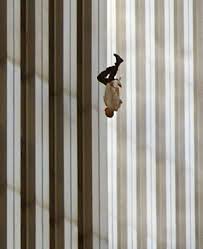
Among the many images that defined September 11, 2001, few remain as haunting as the photograph known as the ‘Falling Man’. Captured in the minutes after hijacked planes struck the World Trade Center in New York, the picture shows a lone figure plunging to his death against the backdrop of the towers. Nearly 3,000 people were killed that day when 19 al-Qaeda terrorists carried out coordinated suicide attacks, hijacking four commercial planes. Two of the planes hit the twin towers, one struck the Pentagon, and another crashed in a Pennsylvania field after passengers resisted the hijackers. The scale of the destruction was vast, yet it is often individual images that bring the tragedy into sharp focus. The ‘Falling Man’ is one such image, stark in its simplicity and deeply unsettling in what it depicts.
A man in free fall
The photograph shows a single figure, head pointed downward, arms at his sides, one leg bent at the knee, descending in apparent stillness. Unlike other images from that morning, in which those who jumped appeared to flail or struggle, this man’s body seems aligned with the vertical structure of the towers behind him. His posture, almost composed, suggested to some an acceptance of the inevitable.The power of the picture lies in its combination of stillness and finality. It captures a moment between life and death, at once ordinary in its composition yet extraordinary in what it reveals: a human being forced into an unimaginable choice.
How the picture was taken
The image was taken by Richard Drew, a photographer with the Associated Press. Drew had been assigned to cover a fashion show in Manhattan when news of the attacks broke. He left the venue and boarded an empty subway train headed toward Lower Manhattan. Emerging from the station, he found himself amid chaos. By then, both towers had already been struck.From the street, Drew joined others who noticed figures beginning to fall from the upper floors of the towers. Trapped by fire, smoke, and blocked stairwells, many faced a desperate decision. Drew raised his camera and began to shoot. He took dozens of photographs of people falling that morning, but one image stood apart. It was taken at 9:41 a.m., showing the man in near-perfect vertical descent with the steel frame of the North Tower behind him.
The controversy
The following day, the photograph appeared in several American newspapers, including The New York Times. The reaction was immediate. Many readers called the image exploitative, accusing the media of sensationalism at a moment of national grief. Others described it as voyeuristic, objecting to the intrusion into a private final moment. The backlash was strong enough that the image disappeared from most publications and was not widely republished for two years. Yet the photograph continued to resurface in discussions about 9/11, not least because of its stark representation of a truth that was difficult to confront: hundreds of people in the towers had leapt or fallen before the buildings collapsed.
The search for identity
Despite extensive effort, the identity of the Falling Man has never been conclusively established. Time Magazine has reported that he may have been an employee at Windows on the World, the restaurant located on the 106th and 107th floors of the North Tower. The Sun has suggested he was Latino. More than 100 restaurant workers were killed that morning, making the venue the focus of much of the speculation. One frequently mentioned name is Norberto Hernandez, a pastry chef at Windows on the World. His brother and sister said they believed the photo showed him, but other members of the Hernandez family rejected that identification. The uncertainty has persisted, with no definitive match ever made.
A lasting image
Two decades on, the ‘Falling Man’ remains one of the most recognisable photographs of September 11. For some, it is unbearable to look at. For others, it is an essential reminder of the human cost of the attacks, stripping away politics and symbolism to reveal one man’s final moments. Richard Drew has continued to defend the image, describing it not as exploitative but as a truthful document of what happened that morning. For him, the picture honours the reality of those who were forced into impossible choices.The Falling Man’s name may never be known. What endures is the image itself: a stark silhouette suspended between earth and sky, embodying both the horror and the humanity of that day.