


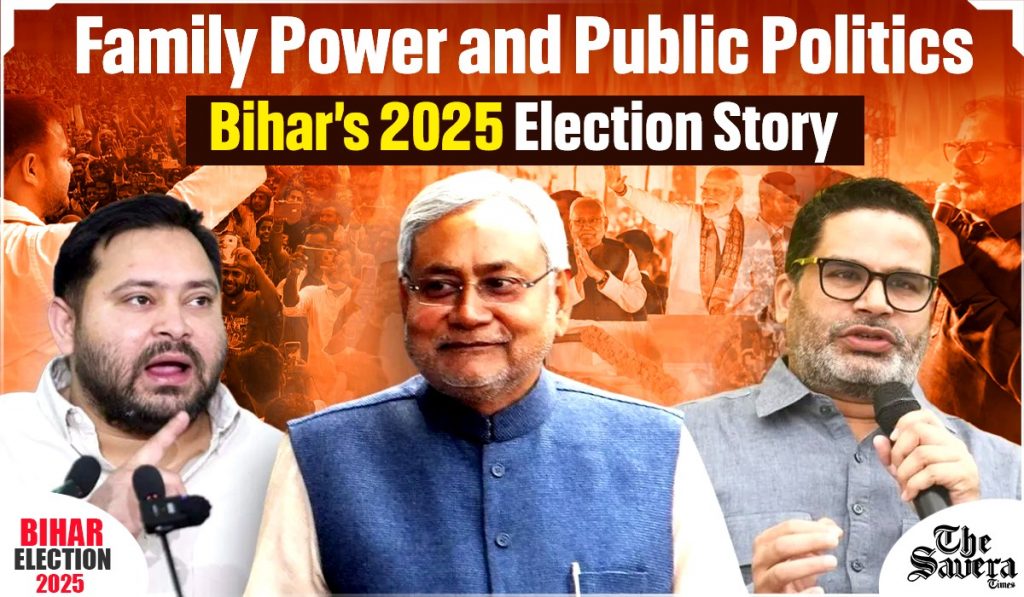
Patna: As Bihar gears up for its Assembly elections on November 6 and 11, with counting scheduled for November 14, the state’s political stage is buzzing with familiar faces — not just leaders, but their family members too.
With 243 seats at stake, the contest between the formidable alliances is fierce.
Beyond manifestos and rallies, one theme stands tall:
The enduring power of family legacies
In Bihar, where politics often runs in the blood, relatives of top leaders are stepping into the ring, influencing voters and steering campaigns.
This “family first” trend underscores how personal bonds still shape public trust in a state yearning for jobs, growth, and stability.
The Big Players: Alliances Locking Horns


The battle lines are drawn between the ruling National Democratic Alliance (NDA) and the opposition Mahagathbandhan, which is aligned with the national-level INDIA bloc but operates as a distinct Bihar alliance.
NDA (Led by BJP and JD(U)):
-
Bharatiya Janata Party (BJP): Contesting 101 seats, focusing on development, infrastructure, and anti-corruption.
-
Janata Dal (United) [JD(U)]: Also contesting 101 seats, fielding familiar faces like ministers Leshi Singh and Jayant Raj — though Raj briefly made headlines for missing a nomination deadline before being cleared to contest.
-
Lok Janshakti Party (Ram Vilas) [LJP(RV)]: Allocated 29 seats, led by Chirag Paswan, who also serves as a Union Minister in the NDA government.
-
Smaller partners like the Hindustani Awam Morcha (Secular) and Vikassheel Insaan Party (VIP) fill the remaining slots.
Mahagathbandhan (Led by RJD):
-
Rashtriya Janata Dal (RJD): The principal force, with Tejashwi Yadav contesting again from Raghopur.
-
Congress: Contesting around 60 seats, including candidates like Jayesh Mangal Singh from Bagaha.
-
CPI(ML) Liberation and other Left allies round out the alliance.
Opinion polls give the NDA a narrow lead in several pre-election surveys, though margins are tight and findings vary across agencies. The opposition is focusing heavily on job creation, migration, and youth issues to close the gap.
Why Family Matters in Bihar’s Poll Drama
Elections in Bihar are not just about policies — they’re about trust built over generations.

Many candidates are sons, daughters, or spouses of veteran politicians, turning electoral battles into family sagas.
This dynastic grip helps parties mobilise loyal caste and regional vote banks, but also raises the perennial question: does lineage outweigh merit?
According to ADR and multiple election analyses, around 30–40% of candidates from major regional parties in Bihar come from political families, higher than the 21% national average for sitting MPs and MLAs.
Dynastic influence, it seems, remains a defining feature of Bihar’s democracy.
Spotlight on Leaders’ Families: Power Behind the Throne
Nitish Kumar’s “No-Family” Card
Chief Minister Nitish Kumar, the JD(U) leader, remains one of the few major politicians in Bihar who keeps family out of politics.

At rallies, Nitish contrasts his record with rivals’ “family rule,” promoting an image of a selfless, disciplined administrator. His wife and son stay entirely out of the spotlight, reinforcing his clean, “no dynasty” brand.
The Yadav Clan: RJD’s Heartbeat — and Its Cracks

No family defines Bihar politics like Lalu Prasad Yadav’s. Though age and illness keep Lalu away from daily campaigning, his children dominate the RJD’s strategy.
-
Tejashwi Yadav, RJD’s face of change, is contesting from Raghopur for the fourth time. He’s betting big on his promise of “one government job per family” to stop youth migration. His declared assets — around ₹8.1 crore — have drawn scrutiny but haven’t dimmed his popularity among younger voters.
-
Tej Pratap Yadav, the elder brother, remains outspoken. He recently accused Tejashwi of “greed” during seat-sharing tussles, revealing rifts within the family, though he continues to campaign for the party.
-
Misa Bharti (MP) and Rabri Devi (former CM) support quietly behind the scenes, while cousin Sanjay Yadav plays a key role in strategy.
Despite occasional infighting, the Yadav clan’s reach across the heartland remains unmatched — especially in the RJD’s traditional strongholds.
The Paswan Legacy: Chirag’s Balancing Act
For Chirag Paswan, politics is both inheritance and mission. As LJP(RV) chief and NDA ally, he proudly carries forward the legacy of his late father, Ram Vilas Paswan, a Dalit icon.

His mix of Bollywood charisma and populist messaging helps him attract younger Dalit voters while staying firmly in the NDA fold.
Dynasts Everywhere: Beyond the Big Three
-
Leshi Singh (JD(U)) — daughter of a veteran leader, contesting again from Wajirganj.
-
Sushil Kumar Modi’s relatives (BJP) and several Congress and Left party scions are also on ballots.
-
Reports suggest that roughly one in three candidates this election hails from a political family — underscoring how “bloodline politics” still drives Bihar’s power structures.
On the Campaign Trail: Kin as Vote Magnets
Families are campaign assets as much as candidates:
-
Rallies & Roadshows: Tejashwi’s siblings headline youth meets, while Chirag’s events often resemble family gatherings.
-
Social Media: Posts by Misa Bharti and Tej Pratap amplify the RJD’s employment pitch.
-
Grassroots Connect: In villages, local relatives campaign door-to-door, invoking “our family’s story” to build emotional voter links.
Meanwhile, Nitish Kumar flips the narrative — warning voters against “family rule” to appeal to independents and first-time voters.
Road Shows and Rallies Organised
What’s at Stake: Change or Continuity?
With the NDA chasing a third straight term and the Mahagathbandhan banking on youth anger, Bihar’s 2025 elections could hinge on both jobs and genes.
For voters, employment and inflation dominate the agenda — but in a state where surnames still command loyalty, family networks may quietly decide swing seats like Raghopur, Hajipur, and Begusarai.
As the countdown to polling day begins, Bihar’s biggest political families are proving once again: in this state, elections are never just contests of ideology — they’re contests of inheritance.