


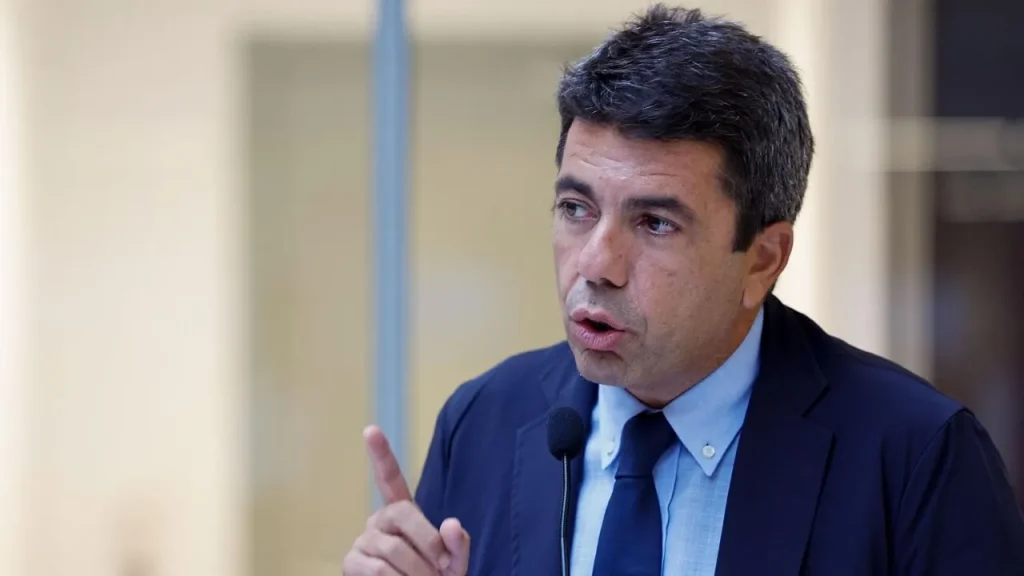
For more than a year, Carlos Mazón clung to his post as president of Spain’s eastern region of Valencia, weathering waves of criticism and political outrage. The devastating floods of late 2024, which claimed 229 lives, left a permanent scar on the region and, ultimately, ended Mazón’s political career. His resignation this week was not just a political retreat but the culmination of public fury, moral outrage, and accusations of gross negligence that refused to fade with time.
A Leader Under Siege
When Mazón, a prominent figure in Spain’s conservative People’s Party (PP), addressed reporters on Monday, his voice carried the weight of defeat. “I can’t go on anymore,” he said, conceding to the pressure that had built steadily over months. Yet, even in resignation, he struck a defensive tone, turning his remarks into a rebuke of Spain’s national government, which he accused of mishandling the postdisaster recovery.
Mazón’s statement failed to pacify the anger that had defined his final year in office. At a recent state memorial service for the flood victims, the atmosphere had turned openly hostile. Shouts of “murderer” and “coward” echoed through the crowd as he appeared to pay tribute to the dead. The anger was deeply personal and rooted in a belief shared by many Valencians that their leader had abandoned them at their darkest hour.
A Lunch That Became a Symbol
The controversy that engulfed Mazón centered on a single day—October 29, 2024—when torrential rains turned rivers into raging torrents, swallowing homes, vehicles, and entire neighborhoods. As the floods reached their peak, it was later revealed that the regional president had spent more than three hours at lunch with a journalist.
For many, this revelation transformed public frustration into fury. While citizens were trapped and dying, the man responsible for coordinating emergency efforts was reportedly dining, insisting later that he had remained informed through phone updates. His justification did little to calm outrage. Critics argued that leadership in times of crisis demands presence and visibility, not phone calls from a restaurant table.
Mazón defended his conduct repeatedly, saying that no government in the world could have prevented such a catastrophe. “There was no government in the world that has the tools to alter, stop or avoid an episode of torrential rains,” he told reporters in the months following the floods. But as the scale of human loss became clear, his words rang hollow to the grieving families.
A Response Too Late
Perhaps the most damning aspect of the crisis was the failure of the region’s emergency response system. Investigations revealed that the mobile phone alert meant to warn residents of the incoming floods was not issued until 8:11 p.m.—hours after floodwaters had engulfed much of the region. By then, most of the victims had already drowned. The timeline only worsened the perception of official incompetence. Mazón did not arrive at the Integrated Operational Coordination Centre, the nerve center for managing emergencies, until 8:28 p.m. For many Valencians, that delay became an unforgivable symbol of negligence. Public anger soon spilled into the streets. Massive demonstrations swept through Valencia, with banners carrying the slogan, “Mud on our hands, blood on his.” A survey released shortly before his resignation showed that 75 percent of residents believed Mazón should step down. Even within his own party, voices began to whisper that his continued presence was untenable.
The Legal Reckoning
Mazón’s resignation comes as legal proceedings intensify. In Madrid, a congressional inquiry is examining the events of October 29, 2024, and the failures that compounded the disaster. Simultaneously, in Valencia, Judge Nuria Ruiz Tobarra is leading a judicial investigation to determine whether the regional administration’s handling of the floods constitutes reckless homicide or injury by negligence. Judge Ruiz Tobarra has described the tragedy in searing terms, calling it “a Dantesque episode, a real hell of destruction.” Her remarks underscore the gravity of what happened and point to what she described as “overwhelming evidence of negligent conduct” and “an unbearable delay in sending alerts to people.” The findings from her court could have far-reaching implications, not only for Mazón but for the broader political system that oversaw the disaster response.
The Political Cost of Tragedy
The floods of 2024 were among the deadliest natural disasters in modern Spanish history. They exposed the fragility of regional emergency infrastructure and the human cost of political misjudgment. For Mazón, who once embodied the PP’s ambitions to strengthen its hold in eastern Spain, the disaster became a personal and political catastrophe. The aftermath of the floods laid bare the disconnect between government leaders and ordinary citizens. Survivors spoke of unanswered calls for help, chaotic evacuation orders, and a sense that officialdom had vanished when it was needed most. The PP’s regional administration was accused of complacency and delay, while opposition parties seized the moment to demand accountability.
For more than a year, Mazón refused to bow to pressure. He maintained that he had acted to the best of his ability under extraordinary circumstances. Yet, as inquiries deepened and evidence mounted, his position became increasingly isolated. His own colleagues began to view his resignation as inevitable. A n E n d i n g W i t h o u t Redemption Carlos Mazón’s downfall is a reminder of how leadership can unravel in the face of public outrage.
What began as a natural disaster evolved into a moral and political reckoning. The floods claimed hundreds of lives, but they also reshaped the political landscape of Valencia, sweeping away a leader whose decisions— both during and after the crisis—came to symbolize failure. When Mazón finally said, “I can’t go on anymore,” it was less an act of humility than an acknowledgment of defeat. His departure closes one chapter in Valencia’s struggle with the disaster, but the investigations and the anger of the bereaved families will continue to echo. For many, justice is still to be served, and the memory of that night remains an open wound.