


Sheena Sandhu
A retired civil servant
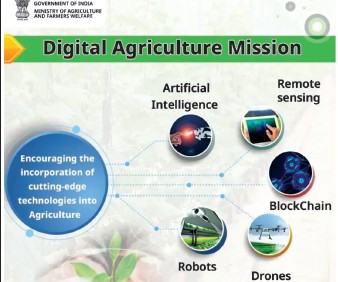
Punjab does not need another slogan about “smart farming.” It needs a new operating system for agriculture one that reduces risk, rewards diversification, and repairs a dangerously overdrawn water economy. That is why the Union government’s move to significantly scale up funding for the Digital Agriculture Mission, reportedly to around Rs7,500 crore as part of an AI-led push for farming, matters more for Punjab than for most states. If done right, this is not about creating more apps. It is about building public digital infrastructure for agriculture—much like UPI did for payments—so that farmers, scientists, governments and markets can all operate on the same, reliable data rails.
Why Punjab is the real test case
Punjab’s agricultural crisis is no longer hidden. Groundwater is being pumped far faster than it is replenished. Large parts of the state are officially classified as over-exploited aquifers. The rice–wheat monoculture has delivered food security for India, but it has also locked farmers into a cropping pattern that is ecologically unsustainable and financially fragile. At the same time, climate volatility has increased. Heat waves during wheat grain-filling, unseasonal rains, pest and disease outbreaks, and erratic monsoons have made farming a higher-risk enterprise even for well-capitalised cultivators. This is where digital public infrastructure can quietly become transformative.
What the Digital Agriculture Mission is really about
The Digital Agriculture Mission is meant to create a foundational digital layer for Indian farming. Its core building blocks include:
• A farmer registry (Farmer ID or AgriStack) that gives each farmer a verifiable digital identity, linked in a federated way to land and cropping data.
• A Krishi Decision Support System, which integrates satellite imagery, weather data, soil information and crop models to generate maps, forecasts and risk alerts.
When policymakers talk about “AI for agriculture,” this is the backbone they mean: algorithms sitting on top of massive, high-quality datasets that can predict yields, detect stress, warn of pest or disease outbreaks and guide resource use. Punjab, which has already been part of the early piloting of farmer registries, is better placed than many states to convert this into real-world gains.
How Punjab’s farmers can actually benefit
1. Turning uncertainty into early warning
Punjab’s farmers are often hit not by ignorance, but by late information. Diseases like wheat rust, pest flare-ups, and weather-related crop stress need to be detected early to be managed cheaply and effectively. An AI-enabled decision system can move advisories from generic district-level messages to hyperlocal, time-sensitive warnings—telling farmers not just what might happen, but when and where it is likely to happen. This means fewer unnecessary sprays, better-timed irrigation, and a higher probability that problems are stopped before they become yield disasters.
2. Making diversification financially credible
Everyone agrees Punjab must reduce its dependence on paddy. The problem has always been trust: farmers do not believe that diversification will be reliably rewarded. Digital infrastructure can change this. With verified data on who grows what and on how much land, the state can shift from slow, paperwork-heavy subsidy schemes to automatic, outcome-based payments. If a farmer switches a certain number of acres from paddy to a less water-intensive crop, the incentive can be credited quickly and transparently. This turns diversification from a political slogan into a bankable decision.
3. Fixing the stubble problem through logistics, not just policing
Punjab has made progress in reducing stubble burning, but the problem has not disappeared. The core issue is not farmer intent; it is the brutal time constraint between paddy harvest and wheat sowing. When machines are unavailable, broken, or too expensive at the critical moment, burning becomes the default. Digital tools can treat crop residue management as a logistics challenge. A live inventory of functional machines, booking systems, village-level maps of straw load and machine capacity, and performance tracking can ensure that equipment is where it is needed, when it is needed. Subsidies can then be tied to actual use and outcomes, not just to the purchase of hardware.
4. Reducing friction in credit, insurance and schemes
A reliable farmer registry can also streamline crop insurance, credit through Kisan Credit Cards, and government schemes. Fewer verification delays, fewer disputes over land or cropping, and faster claims settlement mean less working capital stress for farmers. The caution, of course, is inclusion. Tenant farmers, women cultivators and those with imperfect land records must not be pushed out by digital gatekeeping. Punjab should insist on a system that is “digital by default but assisted by design,” with offline help, strong grievance redressal and clear consent rules on how farmer data is used.
What Punjab should demand from Delhi
If the Digital Agriculture Mission is being scaled up to Rs 7,500 crore, Punjab should push for three concrete outcomes: a water-and-cropping dashboard that makes diversification measurable, a residue-management logistics platform that actually prevents burning, and a science-driven early warning system that brings PAU’s expertise directly to farmers’ phones and extension workers.This is how digital money becomes ecological and economic reform.
The real promise
Punjab does not need more technology for its own sake. It needs less risk, less waste, and more confidence to change. If India’s digital agriculture push is built as true public infrastructure—open, accountable and farmer-centric—it can give Punjab’s farmers exactly that: the tools to step out of a destructive status quo and into a more resilient future.