


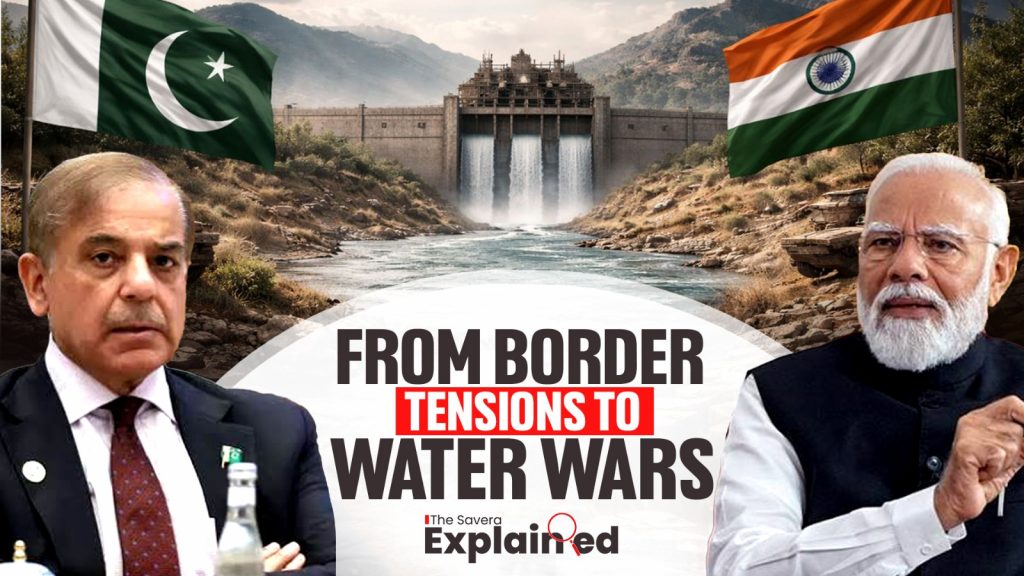
A river does not understand borders. But when two countries sharing that river are locked in a long-running conflict, even water can become a flashpoint.
That is exactly where India and Pakistan find themselves today.
Addressing the United Nations General Assembly, Pakistan Prime Minister Shehbaz Sharif warned that any attempt to stop, impede or divert Pakistan’s share of the Indus waters would be treated as an “act of war”. His remarks came amid already strained India-Pakistan relations and the continuing dispute over the Indus Waters Treaty.
So, what does this mean beyond diplomatic statements? And more importantly, what happens to the ordinary people living along these borders and depending on these rivers?
Pakistan’s UN warning: What happened?
Pakistan says the Indus waters are vital to its people and has opposed India’s decision to hold the 1960 Indus Waters Treaty in abeyance.
India, meanwhile, has maintained that the treaty remains in abeyance and has linked its position to concerns over cross-border terrorism.
The dispute has now moved beyond a technical disagreement over dams and water-sharing. Water has become part of a much larger India-Pakistan security confrontation.
Why is the Indus so important?
The Indus river system is the lifeline of a vast region.
The 1960 treaty divided the six rivers between the two countries: the western rivers — Indus, Jhelum and Chenab — were allocated primarily for Pakistan’s use, while the eastern rivers — Ravi, Beas and Sutlej — were allocated to India, with specific provisions allowing certain uses by both sides.
FACT BOX | Indus Waters Treaty
- Signed: September 19, 1960
- Facilitated by: World Bank
- Rivers covered: Indus, Jhelum, Chenab, Ravi, Beas and Sutlej
- Western rivers: Indus, Jhelum, Chenab — allocated primarily for Pakistan
- Eastern rivers: Ravi, Beas, Sutlej — allocated primarily for India
- Why it matters: Irrigation, agriculture, hydropower and livelihoods across the Indus Basin
For millions, these are not just lines on a map. They mean drinking water, irrigation, electricity, crops and livelihoods.
Border conflicts: When geopolitics reaches homes
India and Pakistan have repeatedly faced military crises and cross-border firing.
The human cost became visible again during the intense military confrontation in May 2025. Reuters reported that Indian border villagers returned to damaged homes, lost livestock and temporary shelters after shelling, with residents seeking compensation and a lasting peace.
For families living close to the border, conflict can mean something very simple: leaving home, abandoning a field, moving children to safety or wondering when it will be safe to return.
Farmers: The first people to feel a water crisis?
Now add water to that equation.
For a farmer, water is not diplomacy. It is the difference between a crop surviving and a season being lost.
Pakistan’s Indus Basin irrigation system supports millions of hectares of farmland, while groundwater also plays a major role in agriculture and rural domestic supply. The World Bank says groundwater provides more than half of agricultural water in Pakistan.
Any prolonged uncertainty around water therefore raises questions about agriculture, incomes and food security.
Could tensions disrupt livelihoods and food security?
This is where the story becomes bigger than India and Pakistan.
A disruption in water availability can affect farming, food prices, rural employment and household incomes. But it is also important not to suggest that India can simply “switch off” the Indus. Water flows, infrastructure and treaty provisions are far more complicated.
The real concern is what happens when a shared natural resource becomes part of a wider security confrontation.