


K SIVA PRASAD
Retired senior IAS officer in
the Punjab Government
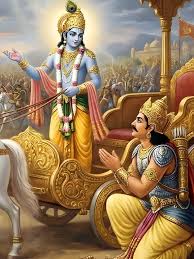
The Art of Surrender Lord Krishna tells Arjuna, “Surrendering all actions to Me—the indwelling Supreme Spirit—with a mind fixed upon Me, and becoming free from hope, attachment, and agitation, engage in battle” (3.30). This verse serves as the essence of the Gita and resolves many of the doubts we encounter in our daily lives.
Our first doubt is, “What should we do?” This arises because we are often unhappy with what we are currently doing, as we harbor the belief that true happiness lies elsewhere, within some other activity. However, this verse inspires us to perform the task at hand—whether chosen by us or imposed upon us—to the very best of our ability.
Such a task may be as brutal and complex as the Battle of Kurukshetra, a conflict in which one must either prevail over the adversary or perish oneself. Scientifically speaking, our complex human body evolved from a single cell, wherein every action (mutation) is inextricably linked to the action that preceded it. This implies that the work currently before us is invariably the outcome of a chain of past actions; no action ever occurs in isolation.
The next question is, “How should we perform our actions?” This verse advises us to perform our duties while casting aside the ego, desires, and feverish agitation—the very stresses and conflicts—that Arjuna himself faced. Relinquishing our desires liberates us from suffering, for the two go hand in hand. As for how to overcome the obstacles that confront us, Lord Krishna provides the answer by counseling us to surrender all our actions—and the obstacles accompanying them—entirely unto Him. Here, Lord Krishna reveals Himself in the form of the “Paramatma” (the Supreme Spirit).
When the task at hand becomes complex, we naturally seek additional resourcesin terms of knowledge, strength, and experience—from those who possess them. The ultimate requirement, however, is complete surrender to the “Paramatma”—especially when the solution lies beyond the scope of our own understanding. The ego is a symbol of weakness and fear, constantly seeking the support of material possessions and external validation to sustain its existence; conversely, surrendering everything to the “Paramatma” demands immense inner strength and courage.