


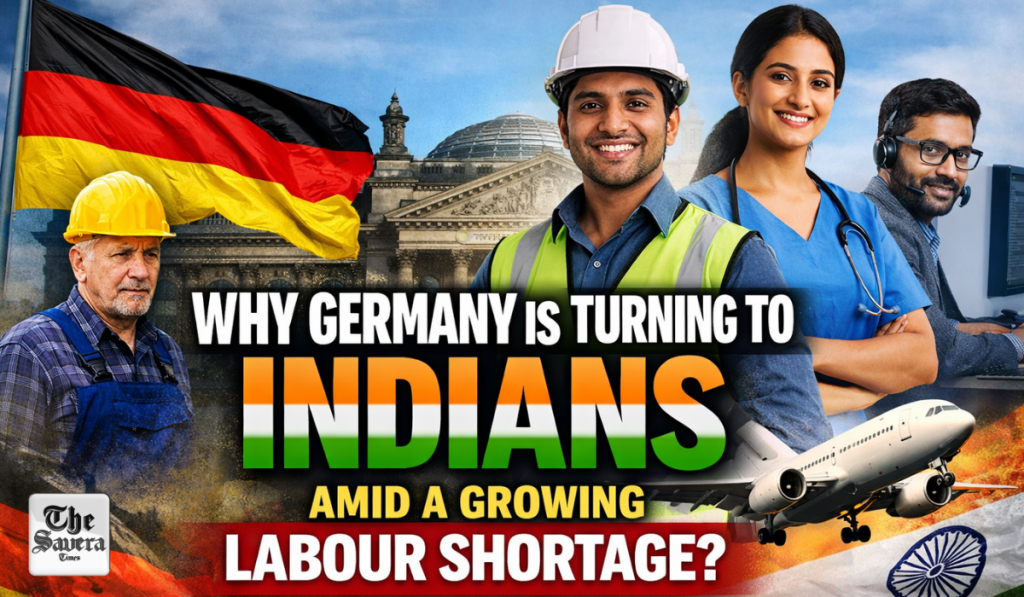
Germany is actively easing visa rules and expanding work opportunities for Indians — a move driven by a deepening workforce crisis that now threatens Europe’s largest economy. With a rapidly ageing population and shrinking domestic labour pool, Berlin is increasingly looking toward India’s young and skilled workforce as a long-term solution.
The Core Problem: A Demographic Time Bomb
Germany’s population stood at around 83.6 million in 2025, but growth has nearly stagnated. The country grew by just 0.1% in 2024, down from 0.4% the year before. More concerning is the age structure: over 30% of Germans are now aged 60 or above.
At the same time, Germany’s fertility rate remains between 1.35 and 1.39 — far below the replacement level of 2.1. This means fewer young people are entering the workforce while a large segment is retiring. As a result, deaths consistently outnumber births, and population stability now depends heavily on immigration.
A 2024 estimate suggests Germany needs roughly 288,000 foreign workers annually to sustain its economy. Without this inflow, the tax-paying workforce could shrink by 10% by 2040.
Why India Fits the Gap
India presents a stark demographic contrast. With nearly two-thirds of its 1.46 billion population in the working-age group (15–64 years), it offers a vast talent pool. Millions of young Indians are actively seeking employment opportunities, both domestically and abroad.
Recognising this, Germany and India signed a Migration and Mobility Partnership Agreement in 2022. Building on this, Germany significantly increased its skilled worker visa quota for Indians — from 20,000 to 90,000 annually by late 2024. Additionally, language requirements and visa procedures have been relaxed to make relocation easier.
Sectors Facing Acute Shortages
Germany’s labour shortage is not limited to high-tech roles. It spans across critical sectors, including:
- Healthcare: nursing, elderly care, medical specialists
- Skilled trades: construction, carpentry, butchery, baking
- Logistics and transportation
- Hospitality and childcare
Many of these jobs have seen declining interest among German youth over the past decades. For example, traditional trades like butchery and baking are struggling to attract local workers, forcing businesses to look abroad.
Mutual Benefits: A Two-Way Advantage
For Germany, Indian workers are becoming structurally essential — not just a temporary fix. Employers across sectors report improved stability and continuity due to foreign hires.
For Indians, the move offers significant economic benefits. A 2024 study by the Institute of the German Economy found that Indian workers in Germany earn a median monthly salary of €5,393 — higher than both German workers (€4,177) and the overall foreign workforce (€3,204). This is largely due to Indians being concentrated in high-skilled sectors like IT, engineering, and academia.
Additionally, vocational training programs (Ausbildung) are opening doors for Indian youth in non-traditional careers, offering stable incomes and long-term residency prospects.
The Ground Reality
On the ground, the shift is already visible. Small businesses, especially in regions like southwest Germany, are increasingly dependent on Indian workers to survive. In some cases, employers admit they would have shut down without foreign labour.
Local administrations are also actively recruiting Indian professionals, particularly in areas like education and childcare, where shortages are severe nationwide.
Germany’s outreach to India reflects a broader global trend — developed economies turning to younger nations to offset demographic decline. For Germany, immigration is no longer optional; it is essential for economic survival.
For India, this presents both an opportunity and a challenge: to channel its demographic dividend into global demand while ensuring skill readiness and workforce mobility.
In essence, the Germany-India labour partnership is not just a short-term fix — it is fast becoming a cornerstone of future economic cooperation.