


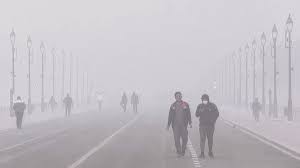
Authorities in Delhi and the National Capital Region (NCR) invoked Stage IV of the Graded Response Action Plan (GRAP) on December 13, 2025, after air quality levels deteriorated sharply, entering the hazardous category.
The Graded Response Action Plan, approved by the Supreme Court in 2016, serves as a structured emergency framework to curb air pollution in Delhi-NCR. Its implementation is overseen by the Commission for Air Quality Management (CAQM), which mandates region-wide restrictions based on the Air Quality Index (AQI).
GRAP is divided into four stages, each linked to worsening pollution levels. GRAP-I is enforced when air quality is classified as “poor,” with AQI ranging between 201 and 300. GRAP-II comes into effect when conditions turn “very poor,” corresponding to an AQI of 301 to 400. GRAP-III is triggered under “severe” air quality conditions, when AQI levels reach between 401 and 450. GRAP-IV, the strictest stage, is imposed when air quality enters the “severe plus” category, with AQI exceeding 450. According to the Central Pollution Control Board’s Daily AQI Bulletin, Delhi’s average AQI stood at 431 at 4 pm on Friday and further rose to 441 by 6 pm, showing a sharp upward trend.
In response to the deteriorating conditions and unfavourable meteorological factors, the GRAP Sub-Committee of the CAQM convened an emergency meeting. “In view of the rising trend in AQI and to prevent further deterioration of air quality in the region, the Sub-Committee has decided to invoke all actions under Stage IV of GRAP with immediate effect across the entire NCR,” the Press Information Bureau said in a statement. Under GRAP-IV, a series of stringent measures have been implemented. The entry of BS-IV diesel trucks into Delhi has been banned, except for vehicles carrying essential goods or providing essential services. All construction and demolition activities have been halted, including work on highways, flyovers, power transmission lines, pipelines, and telecom infrastructure.