


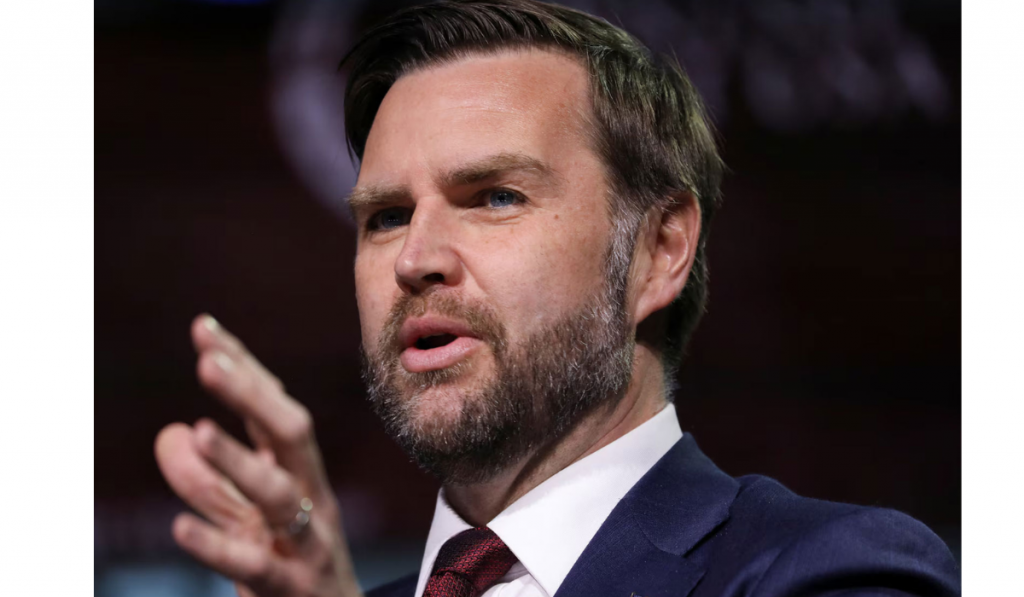
New Delhi: India’s Ministry of External Affairs (MEA) on Friday strongly criticized US Vice President J.D. Vance’s remark, in which he referred to workers on H-1B visas as “indentured servants.” The Ministry of External Affairs (MEA) termed the term “highly offensive” and said it stems from a painful historical and colonial legacy.
The MEA stated that such comments undermine the contributions of Indian professionals to the US economy and innovation sector. The Ministry also emphasized that the movement of skilled professionals benefits both India and the US.
In its statement, the Ministry of External Affairs said, “We have also seen some of the US Vice President’s comments in this context. We believe that such descriptions are inappropriate and ignore the fact that Indian professionals in the US are highly educated and skilled and make significant contributions to the economy and innovation ecosystem.”
The Ministry further stated that America’s history has been shaped by the labor, enterprise, and innovation of immigrants for generations. Therefore, using terms associated with a painful historical and colonial legacy is deeply offensive.
JD Vance called H-1B workers “bonded laborers”
The State Department’s response follows JD Vance’s remarks at a press conference on visa fraud on Thursday. Vance described workers on H-1B visas as “bonded laborers” and accused foreign outsourcing companies of undermining the wages of American workers.
Vance claimed that a person working in the US on an H-1B visa earns $20,000 less than an American citizen employed in the same position. He also stated that the difference in wages for employees employed by foreign outsourcing companies can be as much as $48,000 compared to American citizens working in the same position.
Vance alleged that some companies bring foreign workers to the US, replacing American workers, and earn higher profits by paying lower wages. He also said that such companies are reducing the wages of American workers.
MEA Clarifies Position on PERM Program
The Ministry of External Affairs also clarified the US Department of Labor’s decision regarding the Permanent Labor Certification (PERM) program involving certain companies. The Ministry stated that the PERM program and the H-1B visa scheme are separate.
According to the MEA, the suspension of PERM applications does not automatically affect the validity of existing H-1B visas or the status of visa holders and their dependents. However, it may have some impact on the process of obtaining permanent residence, or green cards, for eligible employees of the affected companies.
India Says Movement of Skilled Professionals Benefits Both Countries
The Ministry of External Affairs stated that the movement of skilled professionals benefits the economies of both countries. This provides opportunities for Indian professionals, while helping US companies access superior talent, innovation, research, productivity, and competitiveness. This also benefits job creation and company shareholders in the US.
The Ministry of External Affairs stated that talent movement is an important area of mutual benefit for India and the US. According to the ministry, the actions announced by the US are not conducive to advancing the shared ambitions of both countries.
The Ministry of External Affairs stated that it will continue to monitor developments related to this issue.
Several companies, including Cognizant, Infosys, and TCS, suspended from the PERM program
Earlier, US Labor Secretary Keith Sonderling announced that the US government was suspending some of the world’s largest IT outsourcing companies from the Permanent Labor Certification program. These include Cognizant, Infosys, Tata, Wipro, HCL, and Capgemini.
The US Department of Labor cited several ongoing federal investigations as the reason for this action. American tech companies like Microsoft and Adobe were also suspended from the program.
According to Sonderling, these companies had collectively requested millions of foreign workers and received hundreds of thousands of H-1B visa approvals and a large number of permanent labor certifications.
The US Secretary of Labor claimed that since 2009, these companies had requested nearly 3 million foreign workers and received over 230,000 H-1B visa approvals and over 100,000 permanent labor certifications. He alleged that this impacted the jobs available for American workers.
New fees also proposed for F-1 visa holders’ OPT
This announcement came a day after the US Department of Homeland Security proposed new fees for F-1 nonimmigrant student visa holders to participate in the Optional Practical Training (OPT) program.
The department described this proposal as a step toward protecting the interests of American workers and strengthening the credibility of the immigration system.