


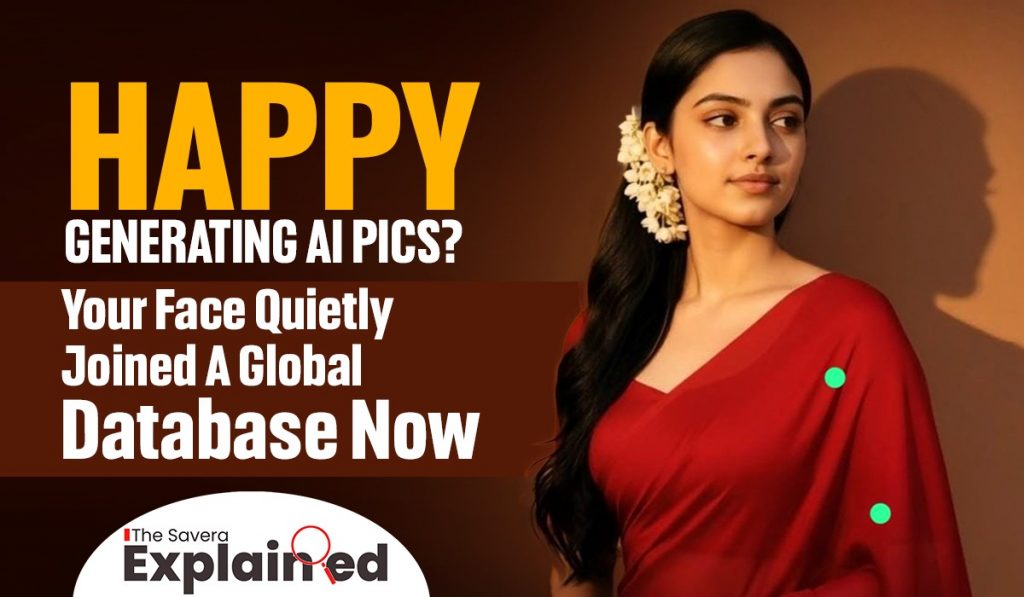
If you’ve scrolled Instagram or TikTok lately, you’ve probably seen it—the Nano Banana craze. It’s blowing up, with millions turning their selfies into hyper-realistic 3D models or vintage Bollywood posters.
Sounds fun, right? But here’s the hook: while you’re happily generating these AI pics, your face might be quietly slipping into a global database you never signed up for. Stick around—I’ll break it down, share the data, and reveal what’s really at stake. Let’s dive in.
First, the buzz: What even is Nano Banana?
It’s not some fruit-themed gadget—it’s the viral nickname for Google’s Gemini 2.5 Flash Image tool, launched earlier this month.
Nicknamed after a quirky prompt that went mega-viral, it lets you upload a photo and spit out stylized edits in seconds.
Think: your face as a pastel kawaii character, a lo-fi retro ad, or that exploding “Red Saree” trend where everyday folks pose like 90s Bollywood icons.
Since hitting the scene in early September 2025, it’s exploded—social feeds are flooded, with #NanoBanana racking up over 5 million views on TikTok alone in the first week. It’s part of the bigger 2025 AI pic wave: hyperrealism, weird-angle experiments, and biophilic art that’s making everyone an instant creator.
No fancy setup needed—just the free Gemini app. Easy, addictive, and zero cost. Who’s not jumping in?
The Hidden Catch: Your Face in the Wild
Sure, it’s a blast sharing that 3D mini-me. But what’s wrong with this picture? When you upload your selfie to generate these, you’re handing over biometric gold—your facial data. And guess what? It doesn’t vanish after the edit.
Many AI tools, including knockoffs mimicking Gemini, store your images in unsecured databases for “training” or resale. Boom—your face joins a global pool ripe for misuse.
Recent data is chilling: In April 2025, a breach exposed over 10,000 AI-generated deepfakes from an unprotected database, including explicit celeb fakes and even minors—proving how fast this stuff spreads.
Another leak that same month dumped thousands more illicit images online. Experts say uploading even one photo can feed facial recognition systems worldwide, without your consent.
Key Risks You Need to Know
Let’s bullet this out quick—because these aren’t hypotheticals:
- Deepfake Nightmares: Your pic trains models for fakes, fueling misinformation or revenge porn.
- Zero Control: Metadata reveals your location, home details, or even background people—perfect for stalkers or biased AI training.
- Commercial Hijack: Terms of service? They often let companies sell your data to advertisers or datasets, no royalties for you.
- Authenticity Erosion: As AI gets better, real vs. fake blurs—goodbye, trust in photos.
- Hack City: Breaches happen; your private shots end up leaked, inviting identity theft.
And get this: Indian IPS officer VC Sajjanar just sounded the alarm on Nano Banana specifically—fake sites are scamming users by stealing uploaded data to drain bank accounts with one click. One victim lost thousands trying to join the trend.
Google adds invisible watermarks to flag AI edits, but experts like UC Berkeley’s Hany Farid call it “not enough”—they’re easy to strip or fake.
Beyond the Basics: Bigger Picture Threats
This isn’t just about Nano Banana—it’s symptomatic. AI’s slurping up family albums for training, eroding privacy for kids’ faces too. Ethically? It amplifies biases if datasets skew toward certain looks. Legally, regs like the EU AI Act are cracking down, but enforcement lags. And scams? They’re evolving—phishers pose as “Nano Banana pros” to snag your uploads.
Quick Fixes to Stay Safe
- Stick to official apps like Gemini—ditch shady sites.
- Strip photo metadata with tools like ExifTool before uploading.
- Read those TOS (yeah, all 10 pages).
- Lock down social privacy settings.
- Opt for offline AI if you can.
Wrapping Up
Nano Banana’s a creative high, but that dopamine hit shouldn’t cost your privacy. Next time you generate, ask: Is this pic worth the database dive? Drop your wildest AI edits in the comments—safely, of course. Hit like if this opened your eyes, subscribe for more tech truths, and I’ll catch you in the next one. Stay savvy out there!