


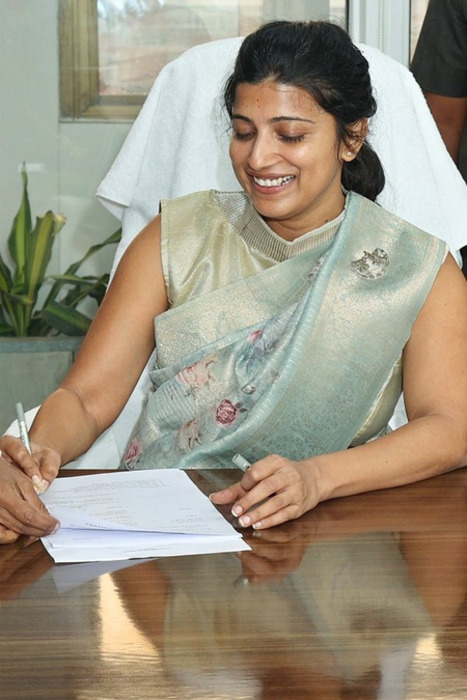
The Telangana High Court has granted an interim stay on the April 2025 order of the Central Administrative Tribunal (CAT), which had directed that senior IAS officer D. Ronald Rose be allotted to the Telangana cadre. The stay was issued by a division bench comprising Chief Justice Aparesh Kumar Singh and Justice Ghouse Meera Mohiuddin, after the Union Government’s Department of Personnel and Training (DoPT) challenged CAT’s decision. With this, CAT’s order will not be implemented until the High Court completes its hearing on the matter.
Background: Officer’s cadre dispute since 2014
The cadre dispute traces back to the bifurcation of Andhra Pradesh in 2014, when officers of the unified state were allocated between the newly formed states of Telangana and Andhra Pradesh. Ronald Rose was assigned to the Andhra Pradesh cadre, though he had been serving in Telangana for years. Rose sought to continue in Telangana, citing long service, administrative continuity, and personal grounds. After years of representations and legal pursuit, CAT finally ruled in April 2025 that he should be shifted from the AP cadre to Telangana, overturning DoPT’s earlier allocation order.
Centre argues CAT exceeded its jurisdiction
The Union Government strongly opposed CAT’s decision, asserting that cadre allocation of All-India Service officers is an exclusive administrative power of DoPT and cannot be rewritten by judicial bodies. The Additional Solicitor-General pointed out that the High Court had previously reversed a similar CAT decision in the Somesh Kumar case, establishing that the Tribunal cannot override cadre rules framed under the All-India Services Act.
DoPT also highlighted that Rose’s earlier proposal to swap cadres with other officers could not be entertained, as the officers he suggested were themselves firmly allotted to the Andhra Pradesh cadre.
Court allows submission of key bifurcation documents
During the hearing, the High Court permitted the Union Government to place on record the Pratyush Sinha Committee report, which originally guided cadre allocation after the 2014 bifurcation. This report is expected to play a crucial role in determining whether CAT’s direction aligned with the framework established during the division of officers between the two states.
States to respond as matter moves forward
The High Court has issued notices to all stakeholders the Union Government, the Telangana Government, the Andhra Pradesh Government, and Ronald Rose — directing them to file counter-affidavits within four weeks. The DoPT will then get an additional two weeks to respond to all submissions.
Until these filings are complete and arguments are concluded, the stay will continue, meaning that Ronald Rose will not be formally shifted to the Telangana cadre despite the CAT ruling.
Implications: Larger issues of cadre authority and state interests
The case has broader administrative implications, as it once again raises questions about the limits of judicial oversight in cadre distribution, a sensitive issue in federal service structures. It also impacts Telangana and Andhra Pradesh, both of which have been dealing with officer shortages and cadre imbalances since bifurcation. The final judgment is expected to clarify how far tribunals can intervene in cadre matters and may influence future disputes involving All-India Service officers.