


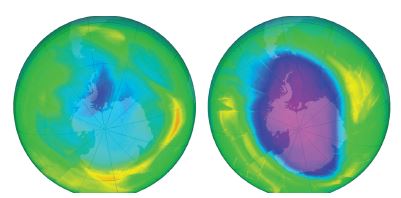
The World Meteorological Organization has reported encouraging signs that the Earth’s protective ozone layer is recovering. Published on World Ozone Day, the WMO’s Ozone Bulletin notes that the Antarctic ozone hole in 2024 was smaller than in recent years and that, if current policies continue, global recovery to 1980 levels is on track by the middle of this century.
Scientists point to sustained international action under the Vienna Convention and the Montreal Protocol as the decisive factor. Agreed measures to phase out the vast majority of ozone-depleting substances have sharply reduced the chemicals that once thinned the stratospheric ozone layer. United Nations secretary general António Guterres described the agreements as “a landmark of multilateral success,” adding that the healing ozone layer shows that when nations heed scientific warnings, progress is possible.
The bulletin offers specific metrics to support a cautious optimism. The maximum ozone mass deficit over Antarctica in 2024 reached 46.1 million tonnes on September 29, 2024. That figure falls below the 1990–2020 average. The 2024 season began more slowly than in recent years, with depletion delayed through September and a rapid recovery thereafter. The WMO characterised the later onset of depletion as a robust indication of initial recovery of the Antarctic ozone hole.
Projections from the most recent global scientific assessment, published in 2022, set out likely timelines for a return to 1980 ozone conditions. Under current policies, the ozone layer is expected to recover to 1980 levels over Antarctica by 2066, over the Arctic by 2045, and across the rest of the world by 2040. The WMO has scheduled the next comprehensive assessment for 2026, underlining that these timelines depend on continued policy implementation and monitoring.
Recovery matters for public health and ecosystems. A healed ozone layer reduces exposure to harmful ultraviolet radiation, cutting risks of skin cancer and cataracts and lessening ecological damage to terrestrial and marine life. Those benefits, experts say, are direct outcomes of long-term reductions in ozone-depleting chemicals.
WMO secretary general Celeste Saulo emphasised the cooperative foundations of the success, saying the recovery demonstrated the value of trust, international collaboration and free data exchange. At the same time, the bulletin cautioned that the task is not complete. Matt Tully, chair of the WMO’s Scientific Advisory Group on Ozone and Solar UV Radiation, stressed the need for continued monitoring of both stratospheric ozone and replacement substances that have been used as alternatives to phased-out chemicals.
The Montreal Protocol, adopted in 1987, has eliminated more than 99 percent of controlled ozone-depleting substances once used in refrigeration, air conditioning, firefighting foam and a range of consumer products. Complementary action arrived with the Kigali Amendment, which commits parties to phase down hydrofluorocarbons, powerful greenhouse gases used as replacements. Ratified by 164 parties, the Kigali Amendment is projected to prevent up to 0.5 degrees Celsius of global warming by the end of the century.
The WMO bulletin therefore frames the ozone story as a rare environmental success driven by coordinated policy, sustained scientific monitoring and international compliance. It also issues a clear caveat: continued vigilance is essential. Ongoing observation of stratospheric ozone, careful assessment of substitute chemicals and steadfast policy implementation will determine whether the tentative recovery becomes a permanent reversal of decades of damage.
The report’s message is practical as well as symbolic. It shows that concerted global action can reverse an environmental threat, while underscoring the need for the same persistence and scientific guidance to address other planetary challenges.