


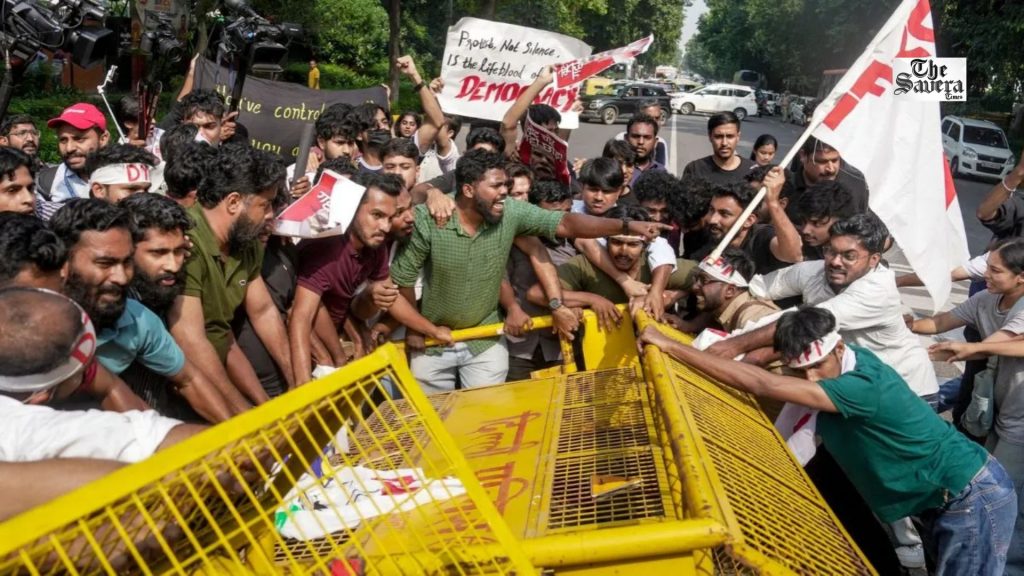
New Delhi: Union Home Secretary Govind Mohan has tendered an unconditional and unqualified apology to the Supreme Court over alleged non-compliance with its October 9 order concerning restrictions imposed in Delhi during protests on October 10. However, he maintained that there was no wilful or deliberate violation of the court’s directions.
In an affidavit submitted in response to a contempt notice, Mohan said the Centre’s communication imposing restrictions was intended to maintain peace and prevent any disturbance of public order in the national capital.
The submission comes after the Supreme Court raised concerns over restrictions affecting public transport and other services ahead of protests demanding the resignation of Chief Election Commissioner Gyanesh Kumar.
Home Secretary Explains Reason for Delhi Restrictions
Mohan said the restrictions were imposed in view of a proposed protest that authorities believed was being planned without the necessary permission. He also referred to the Delhi Police’s experience during a July 20 protest over the NEET paper leak.
The Supreme Court’s October 9 order had directed the Centre to ensure that there was no complete prohibition on the movement of Metro and other trains coming into Delhi. The court had emphasised that security measures should not bring public life to a halt or cause unnecessary inconvenience to ordinary citizens.
The Home Secretary maintained that the measures were intended to prevent disturbances and preserve public order, rather than deliberately disregard the court’s directions.
Cellular Internet Suspended for 24 Hours
Explaining the internet restrictions, Mohan said the Delhi Police had sought a one-day suspension of cellular internet services. The request was processed in accordance with the law and considered proportionate to the prevailing situation, he submitted.
According to the affidavit, the suspension remained in force from 10 pm on October 9 to 10 pm on October 10 within a four-kilometre radius of Raisina Hill.
The restriction applied only to cellular internet services and did not extend to Wi-Fi or broadband connections.
Mohan argued that a limited internet suspension within a defined geographical area could be used to maintain public order when necessary, provided the applicable legal requirements and safeguards were followed.
Centre Seeks Relief From Contempt Notice
The Supreme Court had issued contempt notices to the Union Home Secretary, Delhi Police Commissioner Anurag Kumar and Delhi Metro Rail Corporation (DMRC) Chairperson D. Thara over alleged violations of its directions concerning restrictions during the protests.
In his response, Mohan sought the discharge of the contempt notice, maintaining that there had been no wilful or deliberate non-compliance.
He also requested that the Supreme Court modify its October 11 order to permit internet suspensions in situations where they are necessary, subject to statutory requirements and safeguards.
The matter follows the court’s concerns about the impact of broad restrictions on commuters and other residents of Delhi. The proceedings concern whether the measures taken by authorities complied with the court’s directions and the legal requirements governing such restrictions.