


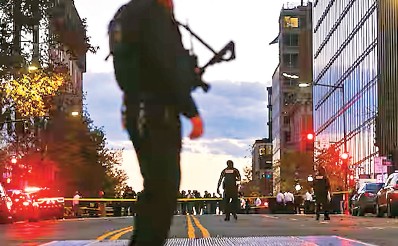
United States President Donald Trump has intensified his actions on immigration after an Afghan national was accused of shooting two members of the National Guard in Washington DC on November 26. The attack, which took place near a busy transit area in the capital, has triggered strong political reactions and renewed debate over America’s immigration policies. One of the two injured National Guard personnel, Sarah Beckstrom, died a day after the incident. The president confirmed her death while addressing reporters at the White House. The second victim, Andrew Wolfe, 24, remains in critical condition and is undergoing treatment.
The shooting has led to a fierce response from the president, who has described the incident as a direct consequence of what he called weak immigration controls. Trump has threatened to suspend immigration from what he referred to as all Third World countries. This declaration comes at a time when his administration has already instructed federal agencies to re-examine all green card applications filed by citizens from 19 countries that he has labelled as “countries of concern”. Officials have been directed to undertake a fresh security review and reassess the vetting procedures that apply to applicants from these nations.
Trump’s comments have drawn considerable attention because of his choice of terminology, particularly his reference to the Third World. The term has a long and complex history and does not originate from economic classifications, even though it is now widely used to describe poorer nations. The phrase was first introduced during the Cold War period, when the global political landscape was sharply divided. It was coined by French demographer Alfred Sauvy in a 1952 article published under the title Three Worlds, One Planet. Sauvy used the term to describe countries that did not align themselves with either of the two major superpower blocs of that era.
At the time, the world was seen as divided into three broad categories. The First World consisted of the United States and its capitalist allies. This group included Western Europe, Japan, Australia, Canada and other nations that supported the Western economic and political model. The Second World referred to the Soviet Union and the communist states of Eastern Europe, which were aligned with Moscow. The Third World was made up of countries that did not join either bloc. Many of these were recently decolonised states in Asia, Africa, West Asia and Latin America. Their shared characteristic during that period was political non alignment rather than economic poverty.
Over the decades, the meaning of the term has undergone a shift. With the end of the Cold War and the collapse of the Soviet Union, the original political categories no longer held the same relevance. As global economic disparities widened, the term Third World gradually came to be associated with developing or underdeveloped countries. It became a shorthand reference for nations facing persistent challenges such as low income levels, limited industrial development, inadequate infrastructure and lower human development indicators. Although the expression remains in public use, many scholars and policymakers now consider it outdated or imprecise.
Today, the term First World is still used informally to describe developed Western economies. The expression Third World is often applied to countries in Asia, Africa, Latin America and parts of West Asia, although international institutions prefer the terms developing nations, low income countries or Global South. Critics argue that the label Third World carries negative connotations and fails to reflect the diverse conditions and rapid economic progress seen in many countries that fall under this broad category.
Trump’s remarks have revived debate over the relevance of such terminology in contemporary political discourse. Analysts point out that framing immigration policy around classifications that originated in the Cold War oversimplifies complex global realities. Many of the nations commonly referred to as Third World today have strong diplomatic ties with the United States, expanding economies and growing strategic importance. Immigration specialists also warn that blanket restrictions framed around broad categories may affect genuine applicants, including students, workers and families, and could have long term implications for America’s international relationships.
Meanwhile, the investigation into the Washington DC shooting continues. Federal agencies are examining the background of the accused Afghan national, including his immigration status and any possible links to previous criminal activity. Authorities have not released additional details about the suspect, citing the ongoing nature of the inquiry. Security around key government installations in the capital has been increased, and National Guard units have been instructed to follow enhanced safety protocols.
The death of Sarah Beckstrom has led to tributes from political leaders, defence officials and members of the National Guard. Her colleagues have described her as a committed service member who played an important role in public safety operations. Andrew Wolfe’s condition remains a matter of concern, and medical teams are reportedly working to stabilise him.
As public debate intensifies, the president is expected to announce further immigration related measures in the coming days. Observers note that the incident is likely to influence the broader national conversation on security, immigration policy and foreign relations, particularly as the political climate in the United States remains highly charged.