


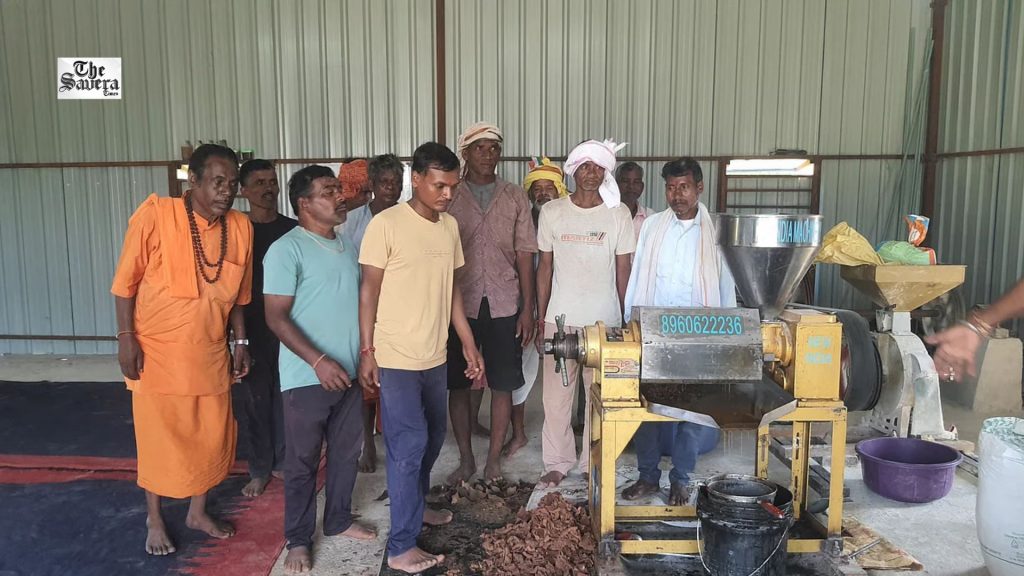
Bhandwa village in Madhya Pradesh has set up a communityled processing unit to revive traditional mahua oil extraction, help Gond Adivasi households retain more value from mahua seeds and open up new livelihood opportunities. In Madhya Pradesh’s Bhimpur block, tribal communities that once extracted their own oil from mahua began depending on makret-bought resources. Residents of Bhandwa village have revived traditional mahua oil extraction by establishing a local processing unit. This initiative aims to retain the value of mahua within the village, and create new income streams, fostering self-sufficiency and community-led development. In the remote, tribal-dominated landscape of Madhya Pradesh’s Bhimpur block, communities have long lived under a sweeping canopy of mahua trees. The sweet, fragrant blossoms of the tropical mahua, known as Madhuca longifolia in scientific lexicon, has been an important source of food and income for forest-fringed regions like Bhimpur, located in Betul district. There was a time when mahua was not merely an economic crop, but the very foundation of daily survival for the Gond Adivasi communities here. It was a commons resource, gathered from the forests as well as from trees on private farmland. mahua flowers and seeds have traditionally been shared and used in ways that sustain households and connect the community to the forest. Among all that mahua gave, oil has mattered the most. Pressed from the gulli or seed that falls from the mahua tree, the oil was used in kitchens across the block every day. By many tribal communities’ old understanding, gulli belongs to everyone, allowing all households the opportunity to make the oil. Over the years, though, the use of mahua oil has declined as village ghanis (traditional oil processors) disappeared and packaged oil from the markets replaced it in household consumption. In fact, in as many as 25 villages of Bhimpur, families either take their gulli for private oil extraction or sell it to traders. They use the money earned to buy edible oil, mostly soyabean, from the market. But the residents of Bhandwa, a tribal village in Bhimpur, decided to change their oil economy and revive the practice of mahua oil extraction, by setting up an oilprocessing unit on panchayat land. The unit is intended to not only meet local household needs but also facilitate commercial sales of mahua oil, opening new income streams for residents and making the enterprise financially independent. Bringing back the value of mahua For around five decades, Bhandwa, a village of 348 Gond Adivasi families, relied on two main sources of oil: mahua gul li and jagni or ramtil (niger), cultivated in their fields. The village has an old way of treating mahua. Almost every household has trees on its own farm, and residents also gather mahua from the forest each season. The village follows one staunch principle: what falls from the tree belongs to everyone, even if it lands on someone else’s land. When asked how they divide or measure the mahua gulli, villagers say they do not weigh it: nobody counts it as belonging to one person. Their relationship with mahua goes well beyond the oil pressed from its seeds. Residents recall a time when it was among their principal foods, particularly when grain was scarce. Mahua flowers are consumed directly and also fermented to make alcohol. The seeds, apart from giving oil, are also eaten roasted or ground into a paste to make roti and kudum (a sweet, similar to gulab jamun). Mahua was also used to make soup, puri, bhujia, laddu an d kheer.
How a tribal village in Madhya Pradesh is reclaiming Mahua economy
How a tribal village in Madhya Pradesh is reclaiming Mahua economy