


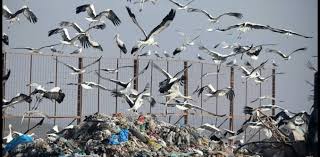
Hungry gulls do not only steal our chips and sandwiches. They learn our habits, and look for reliable sources of food. That includes waste treatment centres, landfill or anywhere food waste is concentrated. Many gull populations have moved inland from the coast to exploit these sources of food.
Wherever our waste is processed, gulls and other birds can forage. At landfills, gulls feed on waste before it is covered up. If there are plastic or glass pieces covered in food that are small enough, gulls will swallow them whole. Only the food itself gets digested, and when the gull flies back to its roost site, the waste gets regurgitated, polluting that site. This movement of pollutants is known as “biovectoring”.
For the first time, scientists like me are now quantifying just how much plastic and other waste is being leaked into important nature areas through the daily movements of birds.
Many lesser black-backed gulls breeding in the UK and other parts of northern Europe migrate to Andalusia in southern Spain, where they form a wintering population of over 100,000 feeding mainly in rice fields and landfills. Fortunately, many of these birds are fitted with GPS tags while breeding. This enables detailed tracking of their movements.
Fuente de Piedra lake in Málaga is a hotspot for migrating lesser black-backed gulls. This wetland has such special natural significance, it’s designated as an internationally important site under a global convention known as Ramsar. It’s most famous for the largest breeding colony of flamingos in Spain. Gulls fly up to 50 miles to landfills to feed, then fly back to roost.
By combining GPS data with waterbird counts, and analyses of regurgitated pellets, scientists have estimated that an average of 400kg of plastics, plus more than two tonnes of other debris such as glass, textiles or ceramics, are deposited by this gull species into the lake each year. This lake has no outflow, making it salty and hence flamingo friendly. Those imported plastics remain in the lake, breaking down into microplastics. They can be ingested by flamingo chicks, aquatic insects and other animals.