


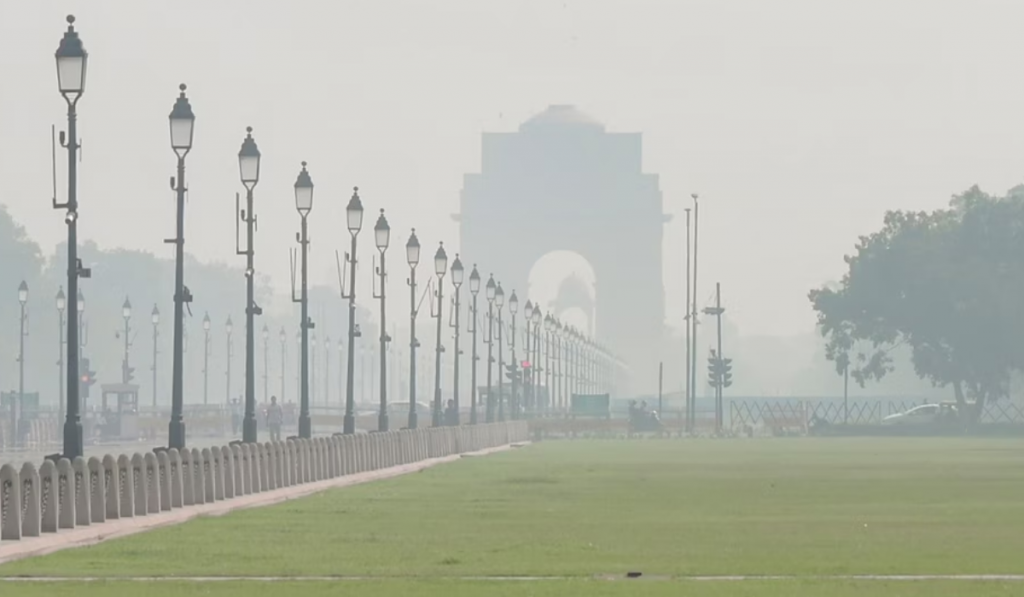
The national capital of Delhi recorded only one ‘Good’ air day despite receiving plentiful rainfall this monsoon, an assessment of summer (April-May 2026) and monsoon months (June-August 2026) this year by the Centre for Science and Environment (CSE), New Delhi, has shown.
The analysis, released last month, showed that even during the monsoon season — when natural atmospheric “washout” and wet deposition effects are at their annual peak — Delhi’s ambient air quality fails to achieve ‘Good’ air days. Despite heavy precipitation, baseline pollution remains elevated, and particulate matter rebounds rapidly within 48 hours of rainfall.
While monsoon rains bring temporary relief, they only mask the underlying crisis. The fact that even heavy rainfall failed to bring consistent ‘Good’ air quality, and that pollution rebounded within 48 hours during dry spells, shows that the baseline emissions remain dangerously high. As the city enter winter, people are starting from a baseline where continuous, elevated emissions will inevitably trigger severe seasonal spikes,” said CSR Executive Director.
Delhi cannot rely on nature’s washout in the monsoon or emergency bans in winter to manage its air. What we need is ambitious, year-round, airshed-wide action to permanently cut emissions at their source across all sectors in the NCR.
CSE researchers considered ‘Summer’ as the days from April 1 to May 31, 2026 (61 days), and ‘Monsoon’ as the days from June 1 to August 31, 2026 (92 days). ‘Daily precipitation’ represented the combined arithmetic mean of official measurements recorded at the India Meteorological Department (IMD)’s Safdarjung and Palam monitoring stations.
An ‘isolated event’ comprised one or more consecutive rainy days bounded by at least one prior dry day and followed by at least three consecutive dry days.
“This three-day post-rain tracking window isolates PM2.5 recovery dynamics from secondary rain interventions. For rainfall events spanning multiple consecutive days, the “during rain” value reflects the mean PM2.5 level across the entire rainy period.
Out of 12 isolated rainfall events identified across the study period, six occurred during the monsoon. The study identified statistical associations between rainfall and ambient PM2.5 changes; it does not isolate rainfall from other concurrent meteorological variables (such as mixing height, wind speed, wind direction and relative humidity) or localised changes in baseline emission fluxes.
According to researchers, Delhi recorded only one ‘Good’ AQI day during the entire 92-day monsoon season — on July 9, 2026 — when the combined mean rainfall across the Safdarjung and Palam meteorological stations reached 67.75 mm.
Conversely, the season’s single highest daily rainfall event (101.05 mm on August 8, 2026) yielded only a ‘Satisfactory’ AQI designation. Despite the drop, the monsoon seasonal average of 40.2 μg/m3 barely dropped further to reach the ‘Good’ air quality day that principally, as per the AQI, is half of the National Ambient Air Quality Standard (NAAQS).
This proves, beyond doubt, that even extreme, localised precipitation events are not cleaning adequately due to underlying baseline emissions.
Moreover, as soon as precipitation stopped, the PM2.5 trajectory curved upward. Even during the peak of the monsoon, daily PM2.5 spiked to a high of 64.5 μg/m3, while the daily AQI peaked at 261 (classified in the ‘Poor’ category).
Between summer (April-May 2026) and monsoon (June-August 2026) periods, Delhi’s average PM2.5 concentration dropped from 60.2 μg/m3 to 40.2 μg/m3, representing a seasonal decline of approximately 33.2 per cent.
To evaluate the persistence of atmospheric cleaning induced by wet scavenging, the assessment tracked isolated rainfall events during the monsoon. Across the six isolated monsoon rainfall events identified, PM2.5 dynamics exhibited a distinct “washout and quick rebound” pattern.
Prior to the onset of rain, the average baseline PM2.5 level stood at 40.6 μg/m3. During active precipitation, wet scavenging drove PM2.5 concentrations down to 32.7 μg/m3, marking an immediate reduction of approximately 19.5 per cent.
However, this relief was short-lived: 24 hours post-rain PM2.5 concentrations rebounded to 36.2 μg/m3 (a 10.7 per cent increase from the washout phase); 48 hours post-rain PM2.5 levels climbed rapidly to 45.1 μg/m3 — a 37.9 per cent surge above the washout concentration: it stood 11.1 per cent higher than the pre-rain baseline (40.6 μg/m3).
The rapid bounce-back proves that while rainfall temporarily washes out particulate matter present in the lower atmosphere, it leaves background anthropogenic emissions completely unchecked. The moment ambient surfaces dry and atmospheric mixing normalises, ongoing emissions from vehicles, industry, waste burning and power generation rapidly rebuild ambient pollution loads.
During summer, of 61 analysed days, 38 (62.3 per cent) fell into the ‘Moderate’ air quality category (AQI range 101-200). Seventeen (27.9 per cent) were ‘Poor’, 6 (9.8 per cent) were ‘Satisfactory’, and zero days (0.0 per cent) were ‘Good’.