


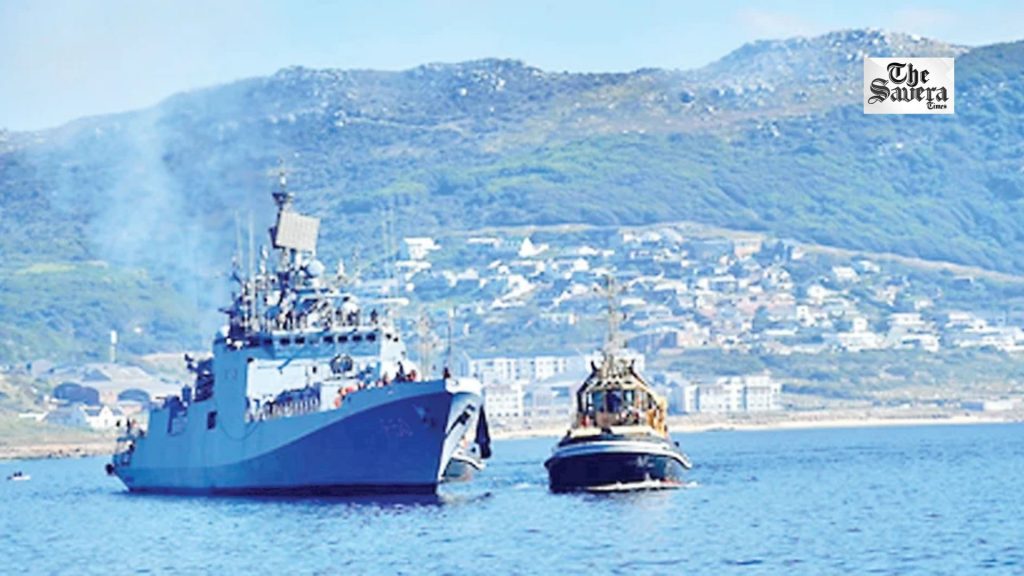
The India-BrazilSouth Africa Maritime Exercise (IBSAMAR) remains an important platform for strengthening naval interoperability, maritime security cooperation and SouthSouth strategic engagement. The ninth edition, IBSAMAR IX, has brought the three navies together at Simon’s Town, South Africa, in 2026. IBSAMAR is a biennial trilateral maritime exercise involving the Indian Navy, Brazilian Navy and South African Navy.
Established in 2008, it represents the maritimesecurity dimension of the IBSA Dialogue Forum, bringing together three major democracies from Asia, Africa and South America, the exercise is designed to strengthen interoperability, mutual understanding, operational cooperation and the exchange of best practices between the three navies.
The importance of IBSAMAR goes beyond conventional naval training, India, Brazil and South Africa are geographically separated and operate in different strategic environments, yet all three have extensive maritime interests and depend on secure oceans for trade, economic activity and national security.
IBSAMAR provides them with a practical mechanism to develop common operating procedures and build familiarity between their personnel and naval forces. The Indian Ministry of Defence has consistently described the exercise as a means of collective training, building interoperability and mutual understanding, and sharing best practices.
Previous editions have incorporated both harbour and sea phases, combining professional exchanges with increasingly complex maritime training. IBSAMAR has evolved considerably since its first edition. It is no longer limited to basic naval interaction, but has developed into a complex multinational maritime exercise involving warships, aircraft, special forces and a range of operational activities, the previous editions have included navigation and seamanship exercises, tactical manoeuvres, maritime-security operations, surface warfare, anti-air warfare, anti-submarine warfare, aviation operations, replenishment-at-sea training, maritime interdiction and Visit, Board, Search and Seizure (VBSS) activities.
Harbour phases have also included damage-control and firefighting drills, crossdeck interactions, professional exchanges and Special Forces cooperation. These activities are important because interoperability cannot be established simply through diplomatic agreements, Naval forces have different communication systems, procedures, command structures and operational cultures. Repeated exercises allow personnel to understand these differences and develop the practical ability to operate alongside one another.
IBSAMAR therefore acts as a training mechanism, confidencebuilding instrument and naval-diplomacy platform at the same time. IBSAMAR expands naval engagement with partners beyond the immediate Indian Ocean Region. Brazil provides an important link with the South Atlantic, while South Africa occupies a strategically significant position between the Atlantic and Indian Oceans. Participation allows the Indian Navy to operate with two technologically and operationally different partner navies while strengthening India’s wider maritime diplomacy.
For Brazil, the exercise provides an opportunity to deepen cooperation with India and South Africa while increasing its engagement with maritime partners outside the South Atlantic. It also supports Brazil’s broader interest in maintaining a secure maritime environment and developing naval interoperability.
For South Africa, IBSAMAR reinforces the country’s role as an important maritime partner and host in the southern African maritime environment. Simon’s Town provides an established naval infrastructure from which multinational exercises can be conducted, while South Africa benefits from interaction with two larger navies possessing extensive operational experience.
The exercise consequently produces benefits for all three participants India gains greater exposure to South Atlantic maritime cooperation, Brazil strengthens its engagement with Indian Ocean partners, and South Africa reinforces its position as a maritime bridge between the two oceanic regions.
The larger significance of IBSAMAR lies in its character as South-South maritime cooperation. India, Brazil and South Africa are not formal military allies, and IBSAMAR does not create a collectivedefence commitment between them, instead it establishes a practical framework through which the three countries can cooperate while retaining independent foreign and defence policies.
This distinction is important as the exercise demonstrates that maritime cooperation does not necessarily require a formal alliance structure, regular naval interaction can improve trust, communication and operational familiarity without requiring the participants to adopt identical strategic positions. The exercise also has relevance to common maritime-security concerns, including piracy, trafficking, illegal exploitation of marine resources, maritime terrorism, threats to commercial shipping and the wider requirement for a stable maritime environment. The 2024 edition, for example, combined naval warfare training with maritimesecurity and boarding activities, the strategic value therefore extends beyond the exercise itself. Every successful iteration contributes to a larger network of professional relationships between the three navies.