


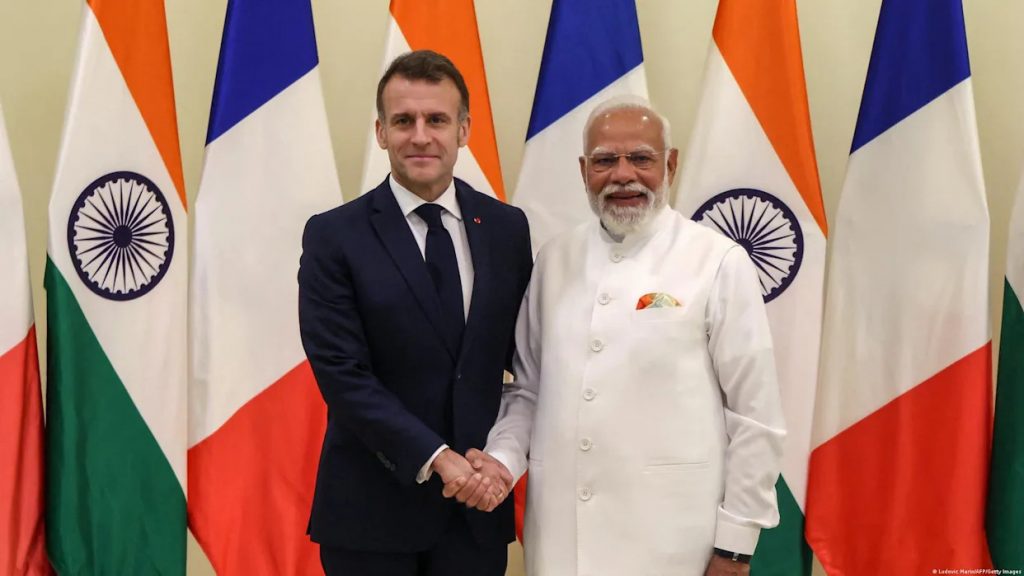
During Prime Minister Narendra Modi’s visit to France, he and host President Emmanuel Macron discussed a new vision for Artificial Intelligence (AI). This vision has been termed the ‘open-source model.’
Until now, two major AI models have dominated the global landscape:
The American model, driven entirely by the profit motives of private corporations
The Chinese model, based on state control
However, India and France have decided to offer the world a third model distinct from these two.
Both nations have made significant strides in the field of AI; France has established itself as a leader in AI within Europe, while India has transitioned from being a mere technology adopter to a technology provider on the global stage.
The vision PM Modi articulated—and which Macron embraced—is ‘AI for All.’ This means that the expansion and dissemination of AI should not be confined within the silos of private corporate interests or state-imposed boundaries, but rather opened up to everyone.
French President Macron has acknowledged India’s emergence as a global leader in innovation. The key question now is who will have the opportunity to collaborate on innovation with them. It is worth noting that India produces one million engineers annually—a figure comparable to the combined output of Europe and the United States. Consequently, India is well-positioned to partner with France—a European leader—to create a model for the open expansion of AI.
This implies that the model will be downloadable and open-source. The benefit of this approach is that it creates immense scope for the next generation to drive innovation in the field. In a young nation like India, the potential for new inventions and innovations in this area is vast; this is precisely why France has decided to join hands with India.
France has already been pursuing this policy with its startups; indeed, the startup often referred to as “Europe’s OpenAI” was established in 2023 specifically to break the American monopoly. Currently, this startup is valued at Rs 1.15 lakh crore, and the code for most of its AI models has been made open to the world. India stands to gain significantly from collaborating with France.
If both nations work together on such open models—and if developing nations also join in—they can effectively address the risks associated with AI misuse, such as deepfakes, cyberattacks, and data theft. By uniting to tackle these challenges through an open-model approach, India and France could soon find solutions to the problems spawned by artificial intelligence.
Undoubtedly, the vision of expanding and developing AI through cooperation and coordination is a democratic ideal—one that is natural given that France is a pioneer of progressive thought and India is a vibrant, open democracy.
If both countries commit to actively countering the misuse of AI, it would provide a major solution to a global crisis. However, this requires engaging the public in the use of AI on a massive scale. To achieve this, India will need comprehensive training, adequate energy resources, and the effective dissemination of knowledge. The country’s education system must also be adapted to an AI-driven framework; curricula will need to be revised and qualified educators recruited for this initiative to move forward.