


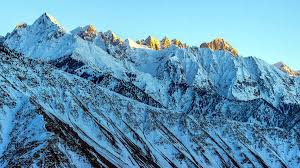
For much of his childhood, Mushtaq Ahmad Shah remembers winter in Srinagar as a season defined by snow. Now 64, Shah grew up in Lal Chowk, in the heart of the city, at a time when heavy snowfall was routine.“We would wake up and find the courtyard covered with snow,” he recalls. “Before we could go outside, we had to clear it.”
When the snow began to soften in March, he and other children would scoop up handfuls and eat it like ice cream. However, this year — like several in recent memory — passed with little snowfall across much of the Kashmir Valley. Shah says the change has become increasingly noticeable. “It is not just this winter,” he said. “For nearly seven winters now we have seen inadequate snowfall and long dry spells. I am shocked and worried to see back-to-back warm winters.”
The shift is raising wider concerns about the region’s ecology. Many native plant and animal species depend on sustained cold conditions, Shah says, warning that warmer winters could gradually alter the Valley’s ecological balance. “Some species may disappear while new ones may appear,” he says.
The lack of snowfall also has implications for water security. Snow and glaciers act as natural reservoirs in the Himalayas, releasing water slowly into rivers and streams during the summer months. Reduced snow accumulation could therefore lead to shortages later in the year, affecting both agriculture and drinking water supplies.
Tourism — a key source of income in the region — may also be at risk if winter snowfall continues to decline.
Shah believes human activity may be contributing to the changes. “There is more construction, more vehicles and more activity in places that used to remain quiet in winter,” he says, pointing to rapid tourism and infrastructure growth in Gulmarg, Sonamarg and Pahalgam. “If this continues, the consequences for Kashmir could be serious.”
The unusually warm winter is also worrying agricultural scientists, who say the shift could have far-reaching consequences for farming in the Valley.
Sameera Qayoom, professor and head of the Division of Agrometeorology at Sher-e-Kashmir University of Agricultural Sciences and Technology (SKUAST) Kashmir, says the region’s agriculture depends heavily on winter snowfall in surrounding mountains. Snow accumulated during winter gradually melts in spring, feeding rivers such as the Jhelum and sustaining irrigation during the growing season.“When winters are warmer and snowfall is reduced, it disrupts this entire system,” she says. “Less snow means less water available for irrigation in spring, streams begin to dry earlier and crops can experience water stress during critical growth stages.”
The implications are particularly serious for Kashmir’s horticulture sector, which forms the backbone of the rural economy. Fruit crops such as apples, cherries and walnuts require a certain number of chilling hours during winter dormancy.
“When winters are unusually warm, the chilling requirement may not be fulfilled,” Qayoom explains. “This can lead to delayed or uneven flowering, poor fruit set and ultimately lower yields and fruit quality.”
Warmer winters can also allow pests and pathogens that would normally be killed by cold temperatures to survive and multiply. “This can lead to early outbreaks of aphids and mites, as well as increased fungal diseases in orchards,” she says, adding that farmers may be forced to use more pesticides.
Field crops such as wheat and mustard are also vulnerable. Higher temperatures can trigger early germination and accelerate plant development, shortening the grain-filling stage and reducing yields. There is also the risk of frost damage. (Courtesy: DTE)