


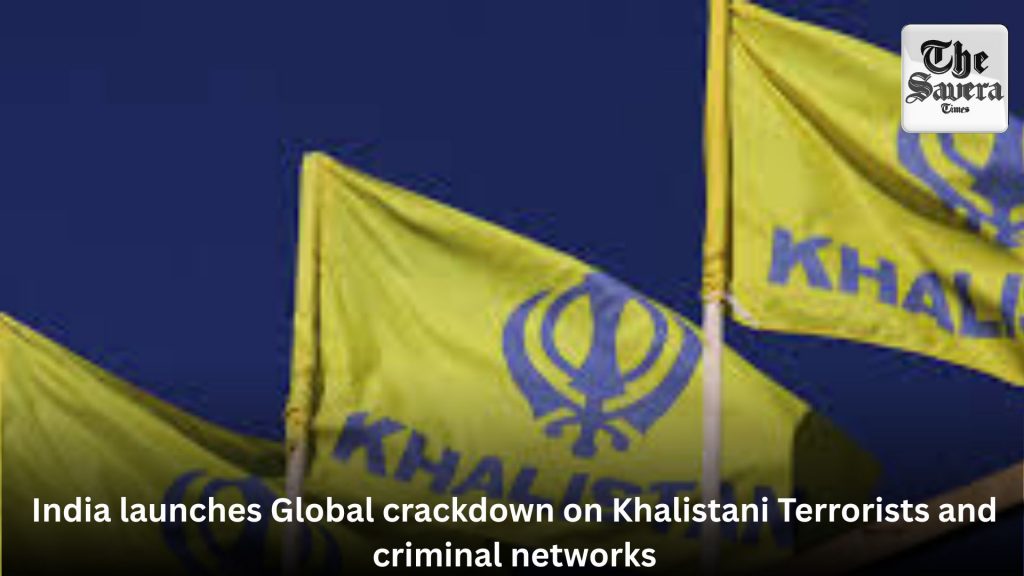
New Delhi: The Indian government has launched a robust international campaign to combat Khalistani terrorism and its associated criminal networks, signaling a proactive approach to address threats from foreign soil.
Driven by the Ministry of External Affairs (MEA) and the Ministry of Home Affairs, this strategy targets Khalistani terrorists and criminals hiding in countries like the United States, Canada, Britain, Australia, and other European nations, often shielded by fake identities or fraudulently obtained citizenship. Here’s a detailed breakdown of this initiative, its origins, objectives, and implications.
Rising Concerns Over Khalistani Networks
The Khalistan movement, which seeks a separate Sikh state in India’s Punjab region, has been a persistent security concern since the 1980s. While the insurgency was largely suppressed in India by the early 1990s, the movement has gained traction among sections of the Sikh diaspora, particularly in Canada. India has long accused countries like Canada of providing a safe haven for Khalistani separatists involved in promoting violence, fundraising, and planning attacks targeting India.
Recent cases, such as the 2023 killing of Hardeep Singh Nijjar in Canada and the 2025 arrest of Babbar Khalsa International (BKI) terrorist Lazar Masih in India, have exposed the depth and international reach of these networks. Evidence of fake identities and organized crime has prompted India to escalate its response.
Trigger for Action: Intelligence Bureau’s National Security Conference
The catalyst for this strategy was a two-day National Security Conference organized by the Intelligence Bureau (IB) in Delhi, attended by Home Minister Amit Shah. Shah emphasized the need to identify and target terrorists and criminals hiding abroad using fake passports, visas, or other fraudulent documents. This directive has set the stage for a coordinated effort between the MEA and the Home Ministry to pursue these individuals through international cooperation.
India’s Strategy: Evidence-Based Diplomacy
India’s approach focuses on presenting irrefutable evidence to foreign governments to secure the extradition or deportation of wanted Khalistani terrorists and criminals. Key elements include:
Comprehensive Evidence Collection: The government is compiling detailed dossiers on each wanted individual, including fake documents, financial transactions linked to terrorism or organized crime, social media activities, anti-India rhetoric, and involvement in arms smuggling, cyber networks, and narco-terrorism. This evidence will demonstrate that these individuals threaten not only India but also the host countries’ security.
Diplomatic Engagement: India will raise the issue through bilateral meetings, diplomatic channels, and international forums like law enforcement conferences. The MEA and Home Ministry will jointly present evidence to urge action under international law.
Collaboration with Foreign Law Enforcement: India aims to work with agencies like the FBI (United States), CSIS (Canada), and counterparts in Britain, Australia, and Europe to investigate cross-border criminal networks, focusing on disrupting financial networks, arms smuggling, and cyber operations.
Targeting Narco-Terrorism: Beyond terrorism, the government is cracking down on drug smuggling networks with international connections. Home Minister Shah has directed agencies to identify and list major drug syndicates operating abroad, pursuing their extradition through diplomatic and legal channels.
Key Cases Highlighting the Threat
Several high-profile cases have exposed the sophistication and international scope of Khalistani networks:
Hardeep Singh Nijjar (Canada): Killed in June 2023 in Surrey, Canada, Nijjar entered the country in 1997 using a fake identity (“Ravi Sharma”). Accused by India of leading the Khalistan Tiger Force (KTF), a designated terrorist group, he allegedly orchestrated violent activities. Despite India’s extradition requests, Canada did not act, citing the political nature of the offenses. His killing sparked a diplomatic row, with Canada alleging Indian involvement (denied by India as “absurd”), highlighting Canada’s perceived leniency toward Khalistani elements.
Lazar Masih (India): In March 2025, Uttar Pradesh Police arrested BKI terrorist Lazar Masih, who was planning to flee abroad using a fake passport facilitated by a Delhi-based gang.
Pilibhit Fake Document Racket: In February 2025, a racket in Pilibhit was busted for producing fake visas, passports, and identity cards for Khalistani supporters, revealing a well-organized network with international links.
Canada as a Focal Point
Canada is a primary focus due to its significant Khalistani diaspora and perceived leniency toward separatist activities. The Canadian Security Intelligence Service (CSIS) acknowledged in its 2024 annual report, released on June 18, 2025, that Khalistani elements on Canadian soil are planning violent activities against India. India’s MEA highlighted this in Parliament on July 24, 2025, noting it as the first public acknowledgment by a Canadian agency that Khalistani militants threaten both India and Canada’s national security. This validation strengthens India’s case for international cooperation.
Implications and Challenges
This strategy marks a shift from India’s earlier reliance on diplomatic protests to a proactive, evidence-based approach. By presenting concrete evidence and seeking collaboration, India aims to pressure host countries to act against Khalistani elements. However, challenges remain:
Diplomatic Sensitivities: Countries like Canada may resist extradition due to domestic political pressures or human rights concerns, as seen in the Nijjar case.
Legal Hurdles: Proving the criminality of individuals with foreign citizenship, especially those obtained fraudulently, requires navigating complex international legal frameworks.
Operational Coordination: Effective collaboration with foreign law enforcement agencies depends on mutual trust and shared priorities, which may vary.