


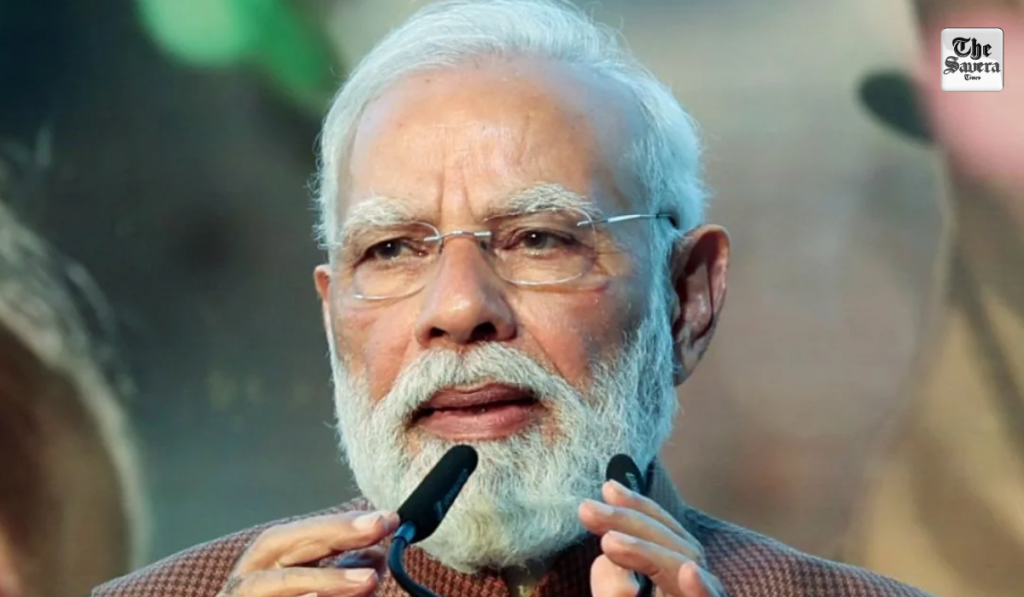
HOW PM MODI HAS STEERED INDIA THROUGH TURBULENCE
Parneet Sachdev
Chairman of Real Estate Regulatory Authority and a leading author
Look at the map of South Asia today. You’ll find something strange and inexplicable. Nepal, Pakistan, Afghanistan, Bangladesh, Sri Lank. Every country wrestles with political upheaval, currency collapse, fiscal strain. Then look at India. An economy chugging forward inspite of sanctions. Forex reserves at $700 bn and last quarter GDP growth at 8.2%.
This calm is not born of luck. It is the result of structural shifts, deep reforms and prudent macroeconomic management built over decades. When compared with its own past, or the travails of many neighbours, the contrast is striking.
FROM PAST FRAGILITY TO PRESENT RESILIENCE
For decades after independence, India was routinely vulnerable to external shocks. A war with Pakistan in 1965, the oil shock and balance-of-payments crisis of 1991, the global taper-tantrum of 2013; each exposed deep fragilities: weak external buffers, shrinking forex reserves, fiscal profligacy, banking stress. How did this resilience come forth?
An examination of data and the architecture of India’s external and macroeconomic management reveal a strong undercurrent flowing for decades.
NARROW DEFICITS, FAT RESERVES
One of the most important anchors is the external sector. In the first quarter of FY 2025–26 (April–June 2025), the current account deficit (CAD) was a mere US$ 2.4 billion, or roughly 0.2 % of GDP. That is down dramatically from previous years(Department of Economic Affairs). For the full fiscal year 2024–25, the CAD was about US$ 23.3 billion, roughly 0.6 % of GDP(Indian Express).
At the same time, India’s foreign-exchange reserves have soared. As of 20 June 2025, reserves stood at an all-time high of USD 697.9 billion (Press Information Bureau). Even after some drawdowns in the latter half of 2025, reserves remain robust at about USD 688.10 billion (as of 21 November 2025)(Economic Times).These reserves are sufficient to cover nearly 11 months of goods imports — a cushion few emerging economies can boast(PIB).
In other words, with a narrow current-account gap and large reserves, India has fortified itself against global shocksi.ecommodity-price swings, capital-flow reversals, or external-demand collapses.
RE-SHAPING THE ECONOMIC BASE
Beyond buffers, structural transformation has reshaped the economy. While manufacturing and agriculture remain important, services; both export-oriented and domestic have grown in significance. According to data presented before the Indian Parliament, net service exports rose from US$ 143.3 billion in 2022–23 to US$ 188.8 billion in 2024–25(Digital Sansad).
Thus, even when manufacturing or merchandise exports face headwinds, services and remittances keep forex inflows stable, moderating balance-of-payments stress.
Another pillar of India’s newfound stability is institutional reform and macroeconomic discipline. Over the last decade, India has undertaken significant banking-sector reforms — bringing non-performing assets under control, enforcing stronger banking regulations, and implementing a modern bankruptcy code. As a result, banks are far healthier than in earlier decades. The financial system’s strengthened resilience keeps credit flowing even in uncertain times. Detailed analysis of these reforms appears in the 2024–25 edition of the Economic Survey 2024–25(India Budget).On public finance, whereas pandemic-era deficits ballooned sharply, by 2025 the deficit has been brought under better control. This creates fiscal space and reduces the risk of compounding debt vulnerabilities.
Energy security, long a vulnerability has stabilised a bit. India’s massive oil reserves, strong external position, and growing domestic refining capacity allow it to absorb shocks such as global oil-price spikes more effectively. Strategic purchase of discounted crude and effective oil-hedging help conserve foreign exchange, giving policymakers breathing room during stress.
THE 8.2 % GROWTH IN Q2 FY 2025–26
All of the above laid the foundation for India’s recent macro-economic performance. On November 28, 2025, official data revealed that real GDP had expanded by a robust 8.2 % year-on-year in Q2 (July–September 2025) (TOI).
This growth as reported by Reuters is the fastest in six quarters, andcame despite significant external headwinds — including punitive U.S. tariffs on Indian goods.
Manufacturing rose by 9.1 % and construction by 7.2 % in Q2, both marking a strong rebound.Private consumption, which accounts for roughly 55–60 % of GDP, grew by 7.9 %. On the demand side, the first half (H1) of FY 2025–26 saw real GDP growth of 8.0 %, compared to 6.1 % in H1 of FY 2024–25.Nominal GDP for Q2 rose by 8.7 %, signalling that growth was not simply driven by an inflation spike — in fact, the GDP-deflator inflation remained modest(Moneycontrol).
On the institutional side, after the sanctions, the government cut taxes on essential consumer goods, and the central bank (Reserve Bank of India, RBI) held its repo rate at 5.50%, giving a neutral but supportive monetary stance(PIB).
CALM IS NOT INVULNERABILITY — RISKS REMAIN
That said, India’s calm should not be mistaken for invulnerability. Several structural risks remain:
India’s share of world intermediate goods exports (a key measure of supply chain integration) doubled from 0.8% in 2000 to 1.5% in 2023. China and Hong Kong held a combined 18.1% share in the same period.Manufacturing expansion, though growing, is still not at the scale required. Dependence on imported energy remains high. A sharp spike in oil prices could widen the current-account deficit, stress forex reserves, and pressure the rupee.Long-term trade tensions or sustained tariffs could depress merchandise exports, affecting sectors even as services continue to cushion. As some analysts warn, unless India accelerates development of its export-ecosystem, short-term resilience may not prevent long-term erosion.
On the fiscal side, public debt remains substantial, and rising external debt (just under 20% of GDP), though currently well-covered by reserves, could become a vulnerability in case of prolonged global stress (ICRA).
THE POLICY OPPORTUNITY
But for now, the evidence is unmistakable. India stands more stable — and in many respects stronger — today than at any point in its post-independence history. It has learned from past crises. It has built buffers. It has diversified its economic base. It has strengthened institutions and regained macro-economic health.
If policymakers use this moment with strategic reforms, accelerated manufacturing growth, human-capital investments, energy transition, and export-diversification — India could transform this stability into a durable competitive advantage. In a region riddled with upheaval, its steadiness could become its greatest strength.
If not, the risk remains that the fragility of old — dependence on external capital, volatile exports, fiscal stress — could creep back. But for the moment, India’s resilience is neither mysterious nor accidental. It is the product of decades of choices — imperfect, slow, often criticized — but cumulatively powerful. In a region of storms, India has learned to build a sturdier ship.
The latest 8.2 % growth in Q2 FY 2025–26 demonstrates that India’s structural reforms — in fiscal policy, banking regulation, external-sector management — are yielding results even under adverse external conditions.It also indicates that domestic demand remains the backbone of the economy: private consumption, manufacturing and construction all contributed meaningfully.Services and invisibles (especially net services exports) continue to provide a valuable cushion: providing foreign-exchange inflows and reducing dependence on volatile goods exports.
But this growth may not be easily repeatable. To convert crisis-resilience into long-term strength, India must now invest in capacity in manufacturing, infrastructure, energy, human capital and deepen structural reforms to make growth inclusive and sustainable.
Viewed against the fate of many neighbouring economies — burdened by balance-of-payments crises, debt stress, sovereign defaults, or political turmoil — India’s stability shines with almost dramatic contrast. The growth and the calm are real. But the challenge ahead is to build on this so that the next decade delivers not just headline growth but deeper structural transformation.
(Views expressed are the author’s own).