


India is rapidly accelerating its transition to electric mobility, positioning itself as a leader in the global electric vehicle (EV) revolution. The government’s proactive policies, technological innovation, and growing consumer awareness are driving exponential growth in EV adoption across the country.
The Faster Adoption and Manufacturing of Hybrid and Electric Vehicles (FAME) scheme, launched in 2015 and now in its second phase, has provided significant subsidies for electric two-wheelers, three-wheelers, and buses. Additionally, state governments in Maharashtra, Karnataka, and Tamil Nadu are offering incentives such as reduced road taxes, registration fee waivers, and charging infrastructure support to promote EV adoption.India’s EV market has seen remarkable growth in recent years. Electric two-wheelers account for the largest segment, offering an affordable and environmentally friendly alternative for urban commuters. Electric buses are transforming public transportation in cities like Delhi, Pune, and Ahmedabad, reducing fuel costs and minimizing emissions. Major automakers, including Tata Motors, Mahindra Electric, and Ola Electric, are expanding their product portfolios, improving range, performance, and affordability.
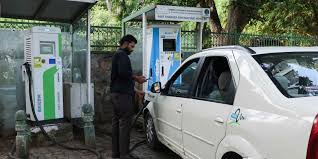
Charging infrastructure is a crucial enabler of this growth. Government and private initiatives are rapidly expanding public charging stations, battery-swapping networks, and home charging solutions. By 2025, India has installed over 15,000 public charging stations, with plans to scale to 50,000 by 2030. Companies are also exploring renewable energy integration to power charging networks sustainably.The EV boom has multiple positive impacts. Environmentally, it is reducing urban air pollution, cutting greenhouse gas emissions, and contributing to India’s climate goals. Economically, it is creating employment in manufacturing, battery production, and charging infrastructure development. Socially, it provides affordable and clean mobility, improving quality of life in urban and semi-urban areas.
Innovation is accelerating the sector. Startups and established companies are focusing on advanced lithium-ion batteries, vehicle-to-grid solutions, and smart energy management systems. Research in solid-state batteries and AI-enabled fleet management promises further efficiency and sustainability gains.
In conclusion, India’s EV revolution is more than a technological shift—it represents a sustainable transformation of transportation, economy, and urban living. With continued policy support, infrastructure expansion, and innovation, India is steering confidently towards a cleaner, greener, and more prosperous future.