


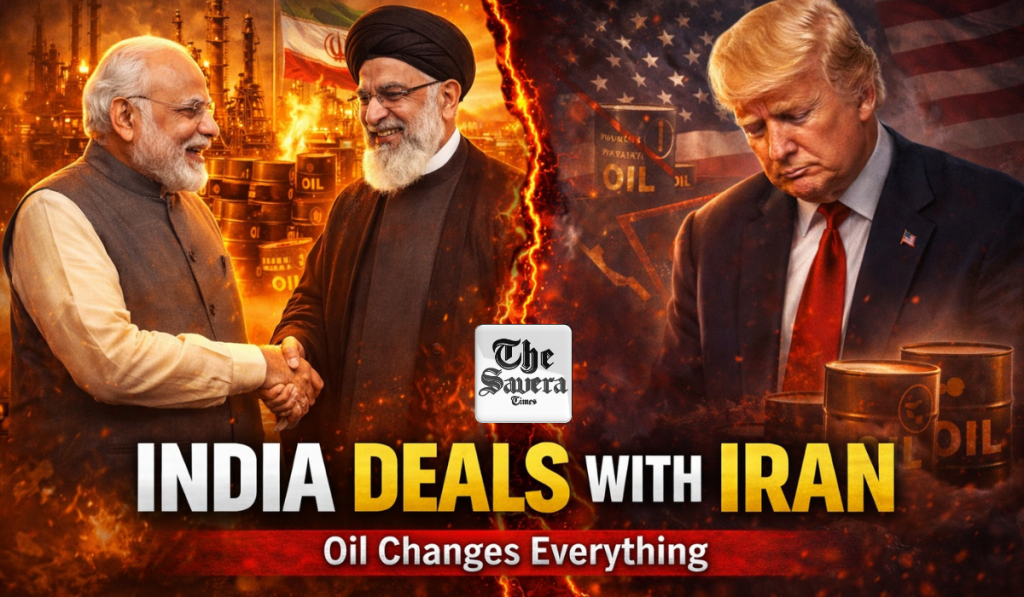
When the world’s oil lifeline is under fire, India has made a quiet but powerful move — returning to Iranian oil after seven long years.
At a time when the Strait of Hormuz is turning into a conflict zone and global energy markets are rattling, India has stepped in with a decision that is as pragmatic as it is strategic. In the middle of a raging West Asia crisis, Indian refiners have resumed buying crude from Iran — a supplier they had completely cut off since 2019.
This is not just about oil. It is about timing, diplomacy, and survival in a volatile world.
The crisis that forced a rethink
The Strait of Hormuz, a narrow stretch between Iran and Oman, is the world’s most critical oil transit route. Nearly 20 million barrels of oil pass through it daily — about one-fifth of global supply. For India, the stakes are even higher. Nearly 40–45% of its crude imports typically move through this chokepoint.
Now, with conflict involving the United States, Israel, and Iran escalating, that route has become dangerously unstable. Tankers face delays. Insurance premiums have surged. Supplies are tightening. The risk is not theoretical anymore — it is immediate.
For a country like India, which consumes around 5.5 million barrels of oil daily and imports the majority of its needs, any disruption can quickly spiral into a domestic crisis.
Breaking a seven-year pause
India’s return to Iranian oil marks the end of a long freeze.
Back in 2018, after the United States withdrew from the Iran nuclear deal and reimposed sanctions, countries around the world were forced to cut ties with Iranian oil. India stopped imports in May 2019 to avoid penalties.
Before that, Iran was one of India’s top suppliers, contributing nearly 12–14% of total crude imports. Indian refineries were optimized for Iranian crude, making it a natural fit.
For seven years, imports dropped to zero.
Now, in April 2026, that silence has been broken.
Why Iran, and why now?
The answer lies in urgency and opportunity.
With supply chains under stress, India needed a quick and reliable source. Iranian oil is geographically close, cost-effective, and compatible with Indian refineries.
A temporary U.S. sanctions waiver has also opened the door. India is using this limited window smartly to secure supplies and stabilize its domestic market.
More than oil: a deep-rooted partnership
India and Iran share a long and layered relationship.
From ancient cultural ties to modern strategic cooperation, the connection runs deep. One of the most important links today is the Chabahar Port, developed with Indian support. It provides India access to Afghanistan and Central Asia, bypassing Pakistan.
It is also part of the International North-South Transport Corridor (INSTC), a major trade route connecting India to Europe via Iran and Russia.
Even during sanctions, India stayed engaged in Chabahar — showing the long-term importance of this partnership.
The balancing act with the United States
The United States has long opposed Iranian oil exports. In the past, India had to halt imports under pressure.
This time, however, the situation is different.
The current purchases are backed by a temporary U.S. waiver aimed at stabilizing global energy markets. That gives India room to act without violating sanctions.
Still, the move reflects India’s policy of “strategic autonomy” — buying oil from wherever it makes sense, whether Russia, Saudi Arabia, or Iran.
India-U.S. ties remain strong in defence and technology. But if tensions rise or waivers end, this balance could be tested.
What this means for India
This move delivers three clear benefits.
First, it diversifies supply at a time of global disruption.
Second, it helps manage costs with potentially cheaper crude.
Third, it reinforces India’s independent decision-making.
The government has already assured that fuel supplies are secure for the coming months.
The bigger picture
India’s return to Iranian oil is not just a short-term fix — it is a strategic signal.
In a world shaped by conflict and uncertainty, India is showing that it can act quickly, balance global relationships, and protect its national interests without taking sides.
This is energy diplomacy in action.
And in times like these, it is what keeps the economy running and the nation moving.