


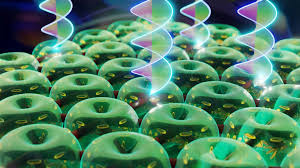
Scientists have created tiny “optical tornadoes” — swirling beams of light that twist like miniature whirlwinds — using a surprisingly simple setup based on liquid crystals. Instead of relying on complex nanotechnology, the team used self-organizing structures called torons to trap and manipulate light, causing it to spiral and rotate in intricate ways.
Even more impressively, they achieved this effect in light’s most stable, lowest-energy state, making it far easier to generate laser-like beams with these unusual properties.
Can light spin like a whirlwind? Researchers have now shown that it can. Scientists from the Faculty of Physics at the University of Warsaw, the Military University of Technology, and the Institut Pascal CNRS at Universite Clermont Auvergne have created swirling “optical tornadoes” inside an extremely small structure.
The advance points to a new way of building miniature light sources with complex shapes, which could support simpler and more scalable photonic devices for optical communication and quantum technologies.
“Our solution combines several fields of physics, from quantum mechanics, through materials engineering, to optics and solid-state physics,” explains Prof. Jacek Szczytko from the Faculty of Physics at the University of Warsaw, the leader of the research group.
“The inspiration came from systems known from atomic physics, where electrons can occupy different energy states. In photonics, a similar role is played by optical traps, which confine light instead of electrons,” added Szczytko.
What Is an Optical Vortex?
“You can think of it as an optical vortex,” says Dr. Marcin Muszynski from the Faculty of Physics at the University of Warsaw and Department of Physics City College of New York, the first author of the study.
“The light wave twists around its axis, and its phase changes in a spiral manner. Moreover, even the polarization — the direction of oscillation of the electric field — begins to rotate,” added Marcin.
These structured light states are attractive for applications such as quantum communication and controlling microscopic objects. However, producing them has typically required complicated nanostructures or large experimental systems.
Liquid Crystals Offer a Simpler Path
The team chose a different strategy. “Instead of building complex systems, we used a liquid crystal, a material with properties intermediate between a liquid and a solid. Although it can flow like a liquid, its molecules arrange themselves in an ordered way, maintaining a fixed orientation and relative positions, much like in a crystal,” explains Joanna Medrzycka, a nanotechnology student at the Faculty of Physics, University of Warsaw, who, together with Dr. Eva Oton from the Military University of Technology, prepared the liquid crystal samples.
Within this material, special defects known as torons can form. “They can be imagined as tightly twisted spirals, similar to DNA, along which the liquid crystal molecules are arranged. If such a spiral is closed by joining its ends into a ring resembling a doughnut, we obtain a toron,” Medrzycka explains. “These structures act as microscopic traps for light. A key step was creating an equivalent of a magnetic field for photons. Although light does not respond to magnetic field like electrons do, a similar behavior can be achieved for light by other means.”