


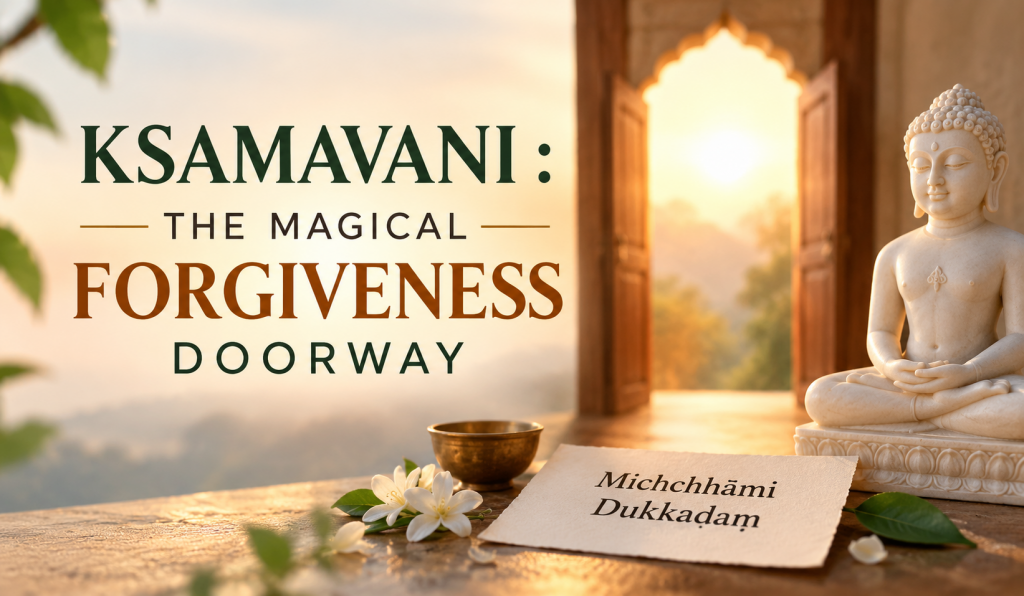
One morning in a Jain household, after the days of spiritual austerity had ended, an elderly man picked up his phone and began calling people one by one. He called his brother with whom he had argued over property. He called a former business associate whose name still carried some bitterness in the family. He called his daughter-in-law, then a servant who had left after a quarrel. He said “Michchhāmi Dukkaḍaṃ.” If I have caused you hurt, knowingly or unknowingly, in thought, word or action, may that wrong become fruitless.
In that moment, something magical happened. A man who had, for years, carried the load of accounts, arguments, duties and injuries began clearing a subtler ledger. Debts no court can settle and wounds no money can compensate. Jainism, with its astonishing moral precision has created a day when this dust must be seen, named and released.
That day is known in the Digambara tradition as Kṣamāvaṇī, the day of forgiveness. In the Śvetāmbara tradition, a similar practice is associated with Samvatsarī, the concluding day of Paryuṣaṇ, when Jains seek forgiveness from family, friends, acquaintances and all living beings. The phrase Michchhāmi Dukkaḍaṃ is traditionally used after pratikramaṇa, the ritual of confession, repentance and return from error. Jain sources explain the phrase as asking that one’s wrong actions may become fruitless, especially those committed knowingly or unknowingly. (Jain Samaj – Ahimsa Foundation, India).
The deeper Jain prayer is even more expansive:
“Khāmemi savve jīvā, savve jīvā khamantu me;
mittī me savva bhūesu, veraṃ majjha na keṇai.”
(I forgive all living beings. May all living beings forgive me. I have friendship with all beings; I have enmity with none.)
This universal forgiveness prayer appears in Jain pratikramaṇa material and is described as asking forgiveness from all living beings and granting forgiveness to all living beings. (JainQQ)
THE DEEPER CONSCIOUSNESS
This prayer is metaphysics made audible. The prayer is Universal as it appears from inside without any preconditions. Forgiving others is not contingent upon their apologies. The human consciousness moves beyond social heirarchies into the entire field of higher living. Jainism’s doctrine of ahimsa recognises that injury is not confined to visible violence. Thought, word, carelessness, indifference, pride, consumption, harshness and unconscious living can also disturb the web of life. Ksamāvaṇī therefore becomes an annual cleansing of relationship with existence itself.
The word kṣamā is often translated as forgiveness, but in Jain thought it carries the fragrance of forbearance, inner restraint and the refusal to let anger deform the soul. Uttama Kṣamā, supreme forgiveness, is the first of the ten dharmas contemplated during Daśalakṣaṇa. Jain tradition repeatedly treats forgiveness not as weakness, but as an ornament of courage. JAINA material on Daśalakṣaṇa describes Uttam Kshama as supreme forgiveness and links it with shunning anger and cultivating tolerance. (Jaina).
This is important. Forgiveness is often misunderstood as surrender before wrongdoing. Jainism does not teach moral laziness. It teaches purification of the inner instrument. A person may still act, protect, correct, litigate, discipline or withdraw. But he need not keep hatred as his private deity.
Ksamā is not the abandonment of discernment. It is the refusal to let another person’s wrong become the architecture of one’s own consciousness.
THE PSYCHOLOGY OF FORGIVENESS
Charlotte vanOyen Witvliet and colleagues conducted a laboratory study in which participants recalled real interpersonal offences while imagining either unforgiving responses or forgiving ones. When they rehearsed hurtful memories and nursed grudges, they showed more negative emotion and higher physiological arousal. When they imagined forgiving responses, the physiological burden was discernibly lower. (Association for Psychological Science)
This is how the body responds to resentment. To remember a hurt with hatred is not merely to think about the past. It is to ask the body to relive the injury. The offender may be absent, old, dead, or indifferent. Yet the heart beats faster. The blood pressure rises. The nervous system prepares again for battle. Resentment promises justice, but often delivers occupation: the occupation of the body by an old event, often culminating in disease.
Other work has also connected forgiveness with cardiovascular recovery. A study on the immediate and delayed cardiovascular benefits of forgiving found that angry rumination produced greater increases in blood pressure than forgiveness. (PubMed).
Indian spiritual traditions have always understood that anger, pride, deceit and greed attract and bind karma to the soul. The offended mind says, “I am punishing the other.” The spiritual eye sees the resentful person as fastening another knot upon himself.
Kshamāvaṇī is therefore karmic hygiene.
Every year, one is invited to ask: whom have I injured? Whom have I kept imprisoned in my mind? What have I justified because I was hurt?
SELF-FORGIVENESS
There is another dimension: self-forgiveness. Many people can say “Michchhāmi Dukkaḍaṃ” to others, but they continue to punish themselves for a failed marriage, a harsh word to a parent, a child neglected, a moral compromise, a spiritual laziness, a moment when they lacked courage. Guilt is endless self-torture.
Research on self-forgiveness has grown in recent years. A meta-analytic review found that self-forgiveness is associated with physical and mental health correlates. (PubMed).
Psychological models repeatedly emphasise responsibility, remorse, repair where possible, and then release from destructive shame. (PubMed Central (PMC))
This distinction is spiritually essential. False self-forgiveness says, “It did not matter.” True self-forgiveness says,
“It mattered. I accept responsibility. I will repair what can be repaired. But I will not keep the soul chained forever to the scene of its fall.”
Much of human hurt is not born of deliberate cruelty. A father’s harshness may arise from his own fear. A daughter’s neglect may arise from exhaustion. A spouse’s silence may arise from shame.
Forgiveness begins when the mind stops reducing a human being to his worst moment.
THE PRACTISE OF KSAMĀVAṆĪ
Neuroscience says that forgiveness interrupts rumination. Psychology says that it opens the possibility of prosocial emotion. Spirituality empasises the lightening of karmic load.
There is a reason Ksamāvaṇī is spoken. The word carries intention into relationship. Vāṇī, speech, gives shape to repentance. The tongue, which so often injures, becomes an instrument of cleansing.
For Antaryatra, the is simple.
Sit quietly. Bring to mind three persons: one whom you hurt, one who hurt you, and yourself. For the first, say: “If I caused pain knowingly or unknowingly, I seek forgiveness.” For the second, say: “What happened was painful. Justice may still have its place. But I release the hatred that keeps me bound.” For yourself, say: “I accept responsibility. I will repair where I can. I will not turn guilt into lifelong imprisonment.”
Then repeat slowly:
I forgive all beings.
May all beings forgive me.
Friendship with all.
Enmity with none.
This may not be completed in one sitting. Like dust, resentment returns. Like prayer, forgiveness must return too.
A woman who was practising, once said after such a practice, “The person I forgave did not change. But my breathing changed.”
Ksamāvaṇī reminds us that the soul becomes light by releasing what no longer deserves to travel with it. We carry so many invisible burdens: the insult, the betrayal, the jealousy, the shame, the old sentence, the unfinished apology. Ancient wisdom asks us to release these. For the soul must travel light to be exalted.
Michchhami Dukkaḍaṃ. May the harm I have caused become fruitless. May the harm I have received no longer bear bitter fruit. May friendship replace enmity.
Parneet Sachdev, IRS is the Chairman of Real Estate Regulatory Authority and a leading author.