


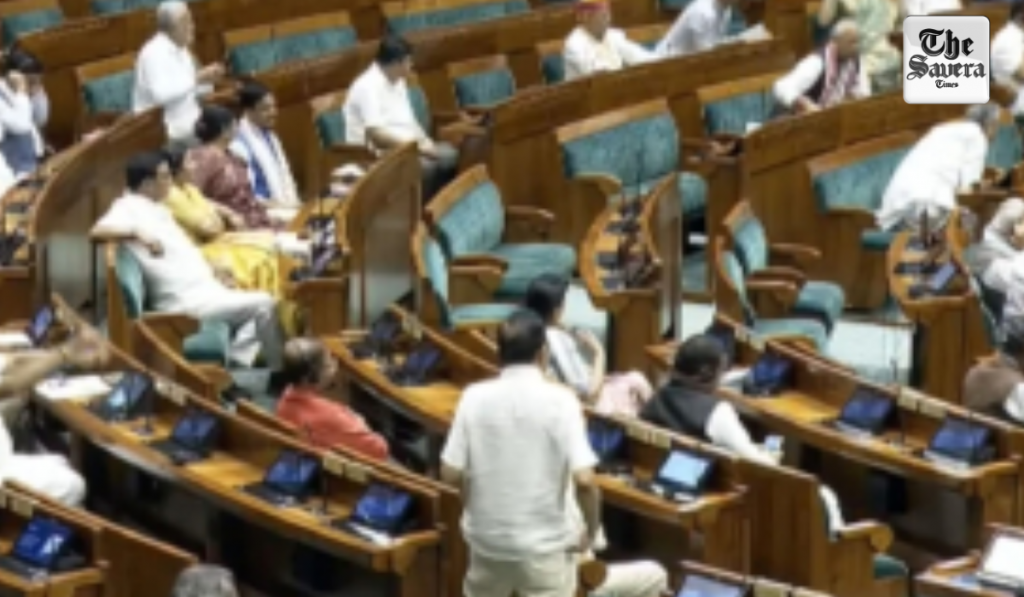
New Delhi: The Lok Sabha on Friday passed the Registration of Births and Deaths (Amendment) Bill, 2026, amid continuous protests and sloganeering by Opposition members, who demanded a discussion on the alleged police action against students during the July 20 Parliament march.
The bill was taken up for consideration after the House reconvened at noon, with BJP MP Dilip Saikia presiding over the proceedings. Despite repeated disruptions and Opposition members entering the Well of the House demanding the presence of Union Home Minister Amit Shah, the legislation was passed by a voice vote without any debate.
Soon after the bill was cleared, the House was adjourned for the day.
Government Criticises Opposition for Skipping Debate
Parliamentary Affairs Minister Kiren Rijiju criticised the Opposition for not participating in the discussion on the bill, saying the government had intended to hold a debate on what he described as an important piece of legislation.
Calling the situation “unfortunate”, Rijiju urged Opposition members to engage in legislative discussions instead of disrupting House proceedings.
“People who sent you to Parliament will seek answers from you. Please do not repeat this in the future,” he said, while appealing to members to participate constructively in future debates.
Presiding officer Dilip Saikia also expressed disappointment that the bill had to be passed without meaningful participation from the Opposition.
What the Amendment Bill Proposes?
The Registration of Births and Deaths (Amendment) Bill, 2026 seeks to strengthen the process of delayed registration of births and deaths and encourage timely reporting of such events.
Under the proposed amendments, registrations made more than two years after the occurrence of a birth or death will require an order from a Judicial Magistrate First Class.
At present, delayed registrations beyond one year require approval from a District Magistrate, Sub-Divisional Magistrate, or an Executive Magistrate authorised by the District Magistrate. Under the amended law, this provision will continue to apply for delays of more than one year but up to two years.
The bill also updates legal terminology by replacing references to the Code of Criminal Procedure, 1973 with the Bharatiya Nagarik Suraksha Sanhita, 2023, thereby aligning the legislation with the country’s revised criminal laws.
Part of Government’s Legislative Push During Monsoon Session
The amendment bill was approved for introduction by the Union Cabinet on July 20 and builds upon changes made to the Registration of Births and Deaths Act through the 2023 amendments.
With its passage in the Lok Sabha, the government has cleared another key piece of legislation despite repeated disruptions during the ongoing Monsoon Session.
Earlier, Parliament also passed the Public Examinations (Prevention of Unfair Means) Amendment Bill, 2026 and the Prevention of Insults to National Honour (Amendment) Bill, 2026.
The Registration of Births and Deaths (Amendment) Bill, 2026 will now be taken up for consideration in the Rajya Sabha.
JPC on Constitution Amendment Gets Extension
During Friday’s proceedings, the Lok Sabha also approved an extension for the Joint Parliamentary Committee (JPC) examining the Constitution (130th Amendment) Bill, 2025.
BJP MP Aparajita Sarangi, who chairs the committee, was granted additional time to submit the panel’s report by the first day of the last week of the upcoming Winter Session.