


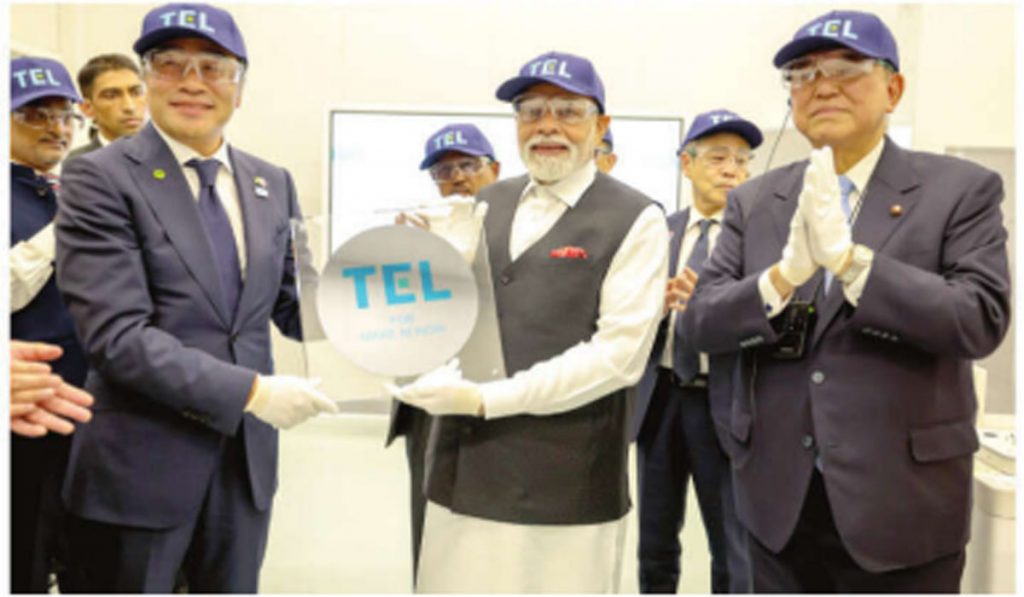
Written by Sheena Sandhu: When Prime Minister Narendra Modi touched down in Tokyo this week, it was not merely another bilateral ritual. It came at a moment when global trade politics has been shaken by Washington’s sudden tariff hikes, leaving India’s exporters staring at uncertainty. For New Delhi, the optics in Japan were not just about camaraderie. They were about signalling resilience, diversifying bets, and showcasing that India has reliable partners in an unpredictable world.
Beyond the smiles, a hard edged agenda
Modi’s meetings with Prime Minister Shigeru Ishiba carried three clear priorities: secure supply chains, deepen capital flows, and tighten security coordination. If Washington’s tariffs underline the fragility of India’s export reliance, Tokyo offers an antidote: a trusted partner with deep pools of technology, finance, and political predictability.The subtext was unmistakable. As India faces tariff shocks on labourintensive exports—from textiles to leather—Japan cannot replace America as a market. But it can co-create the very shift India needs: away from low-margin commodities to higher-value manufacturing and green technologies. That is why Modi’s stop at Tokyo Electron in Sendai was not symbolic; it was a signal that India wants to fast-track semiconductor and electronics integration with Japanese know-how.
Capital, connectivity, and clean energy
Japan has been India’s most patient investor, from the Delhi–Mumbai Industrial Corridor to the bullet train. This visit extended that playbook— fresh investment intent, clean energy collaboration, and long-horizon infrastructure bets. At a time when global capital is jittery, Japanese balance sheets are quietly underwriting India’s growth story. Clean energy and batteries, in particular, emerged as the next frontier. If India must secure its energy transition while creating manufacturing jobs, Japanese technology and concessional finance are the bridge. Unlike Western capital, Tokyo does not demand quarterly political proof; it bets on decades.
Security: beyond the Quad’s rhetoric
Amid Chinese assertiveness in the Indo-Pacific and along the LAC, security cooperation with Japan is no longer a polite add-on. The summit pushed for tighter interoperability, maritime domain awareness, and infrastructure standards. Unlike America’s fluctuating political mood, Japan offers consistency: a likeminded power committed to a rules-based order, but without demanding alliance entanglement from India.
A hedge in the age of tariffs
The real importance of Modi’s Japan trip lies in timing. With Washington turning protectionist and Europe tilting inward, India cannot afford to appear cornered. By putting Tokyo front and centre, New Delhi is telling investors and trading partners: India is not hostage to tariff tantrums; it is building redundancy. In global trade, predictability is the new currency. Japan, unlike most, still offers it.
The takeaway
This was not just about optics, though the warmth of Tokyo was designed to counterbalance the frost elsewhere. It was about risk management. The visit builds another lane for India’s growth and security—insulating it from tariff shocks, accelerating the technology catch-up, and strengthening supply-chain resilience. For a country betting its future on exports and manufacturing, the message was simple: India will not wait for tariff politics in Washington to settle. It will write its own script—Tokyo is now part of that script.
(The writer is a retired civil servant, views are personal)